Experiment in Linen

I wanted to try working with linen again.  The last time I wove with linen threads was at least ten years ago, and while I ended up with some pretty nice tea towels. I remember many people saying linen was a cantankerous fibre to work with.  But oh, such a beautiful fabric, with great lustre and feel.

I decided to work on a series of handwoven linen scarves.  I envision linen as a beautiful cool fabric for summer scarves.

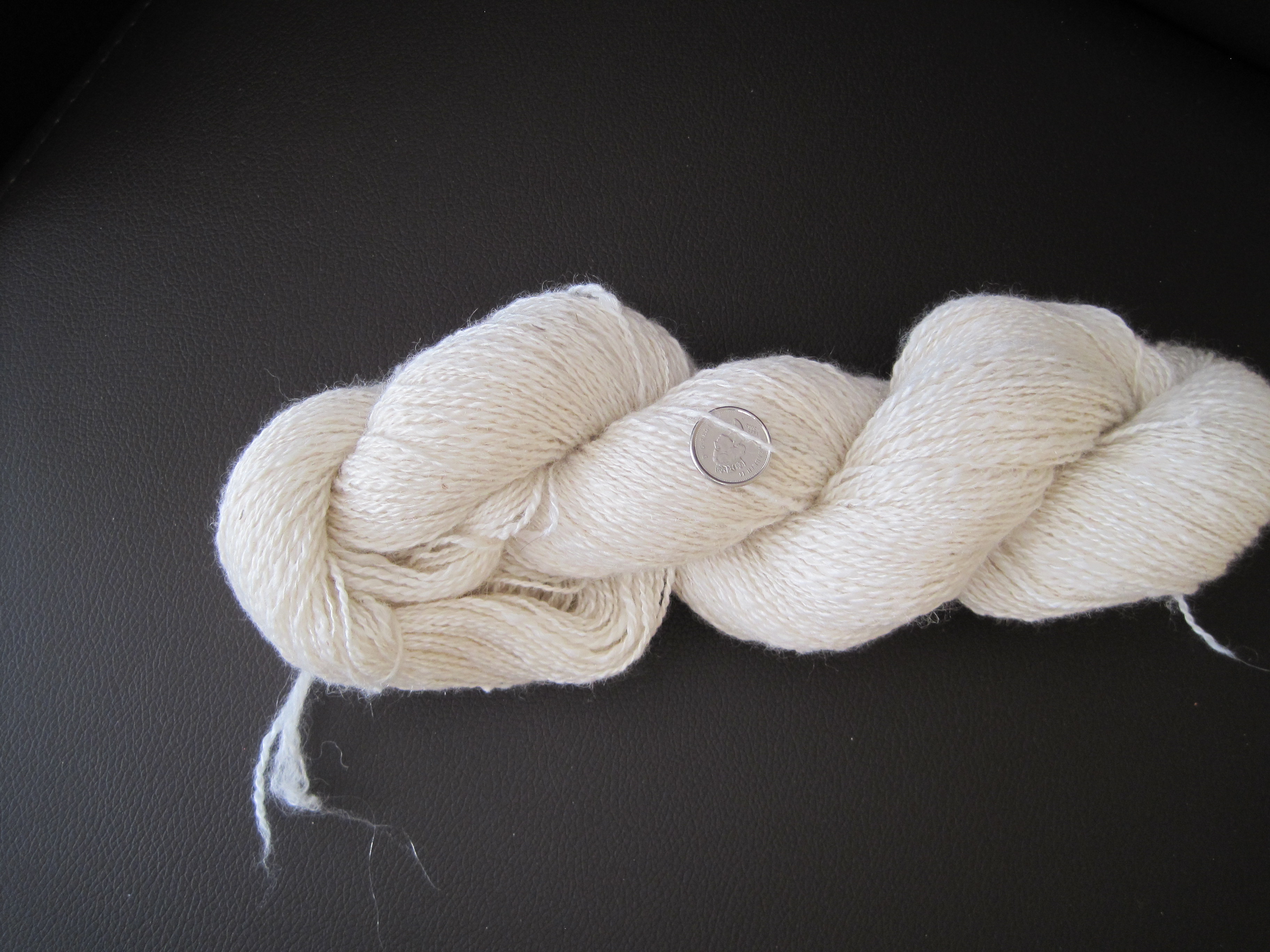
For the first two scarves, I used Euroflax linen, in 14/2 lace weight from Louet. The cost is $25.00 per 100 gm cone, and I used one cone of natural, and one cone of caribou for two scarves.

For drama, I wound 4 inches of natural, and 4 inches of caribou, warp length 5 yards and sett at 12 ends per inch for a more open weave.

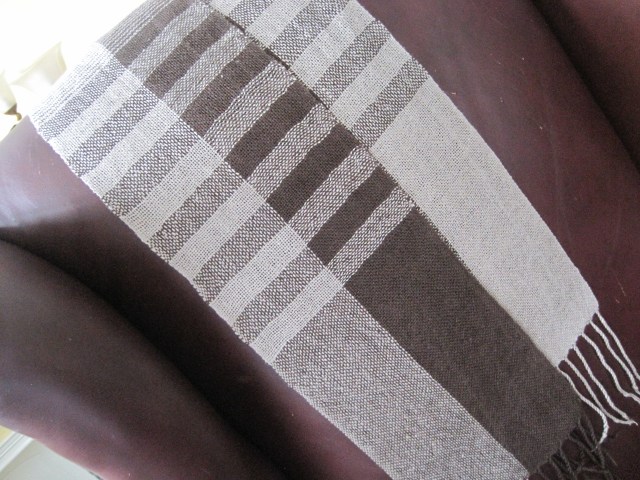
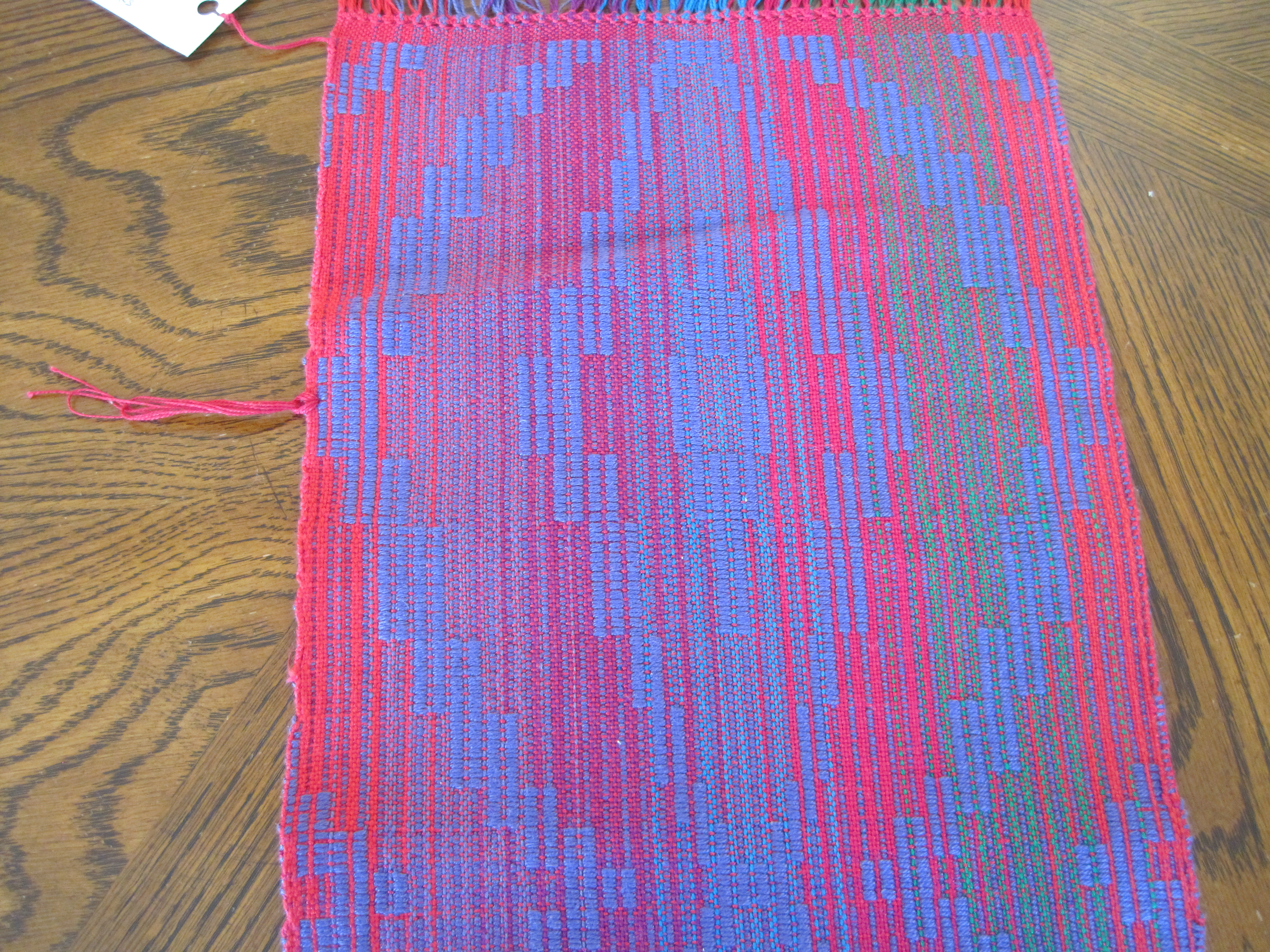
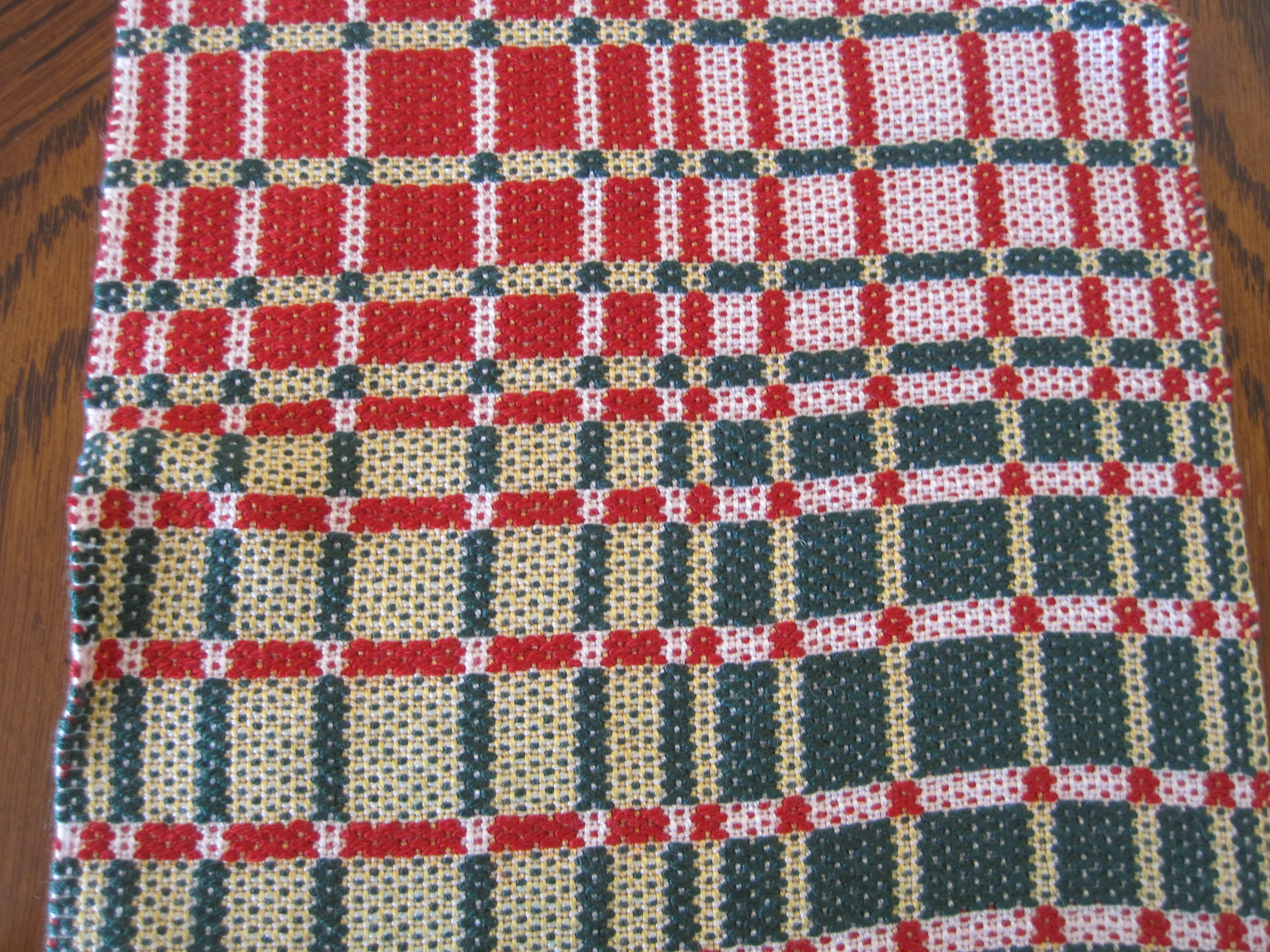
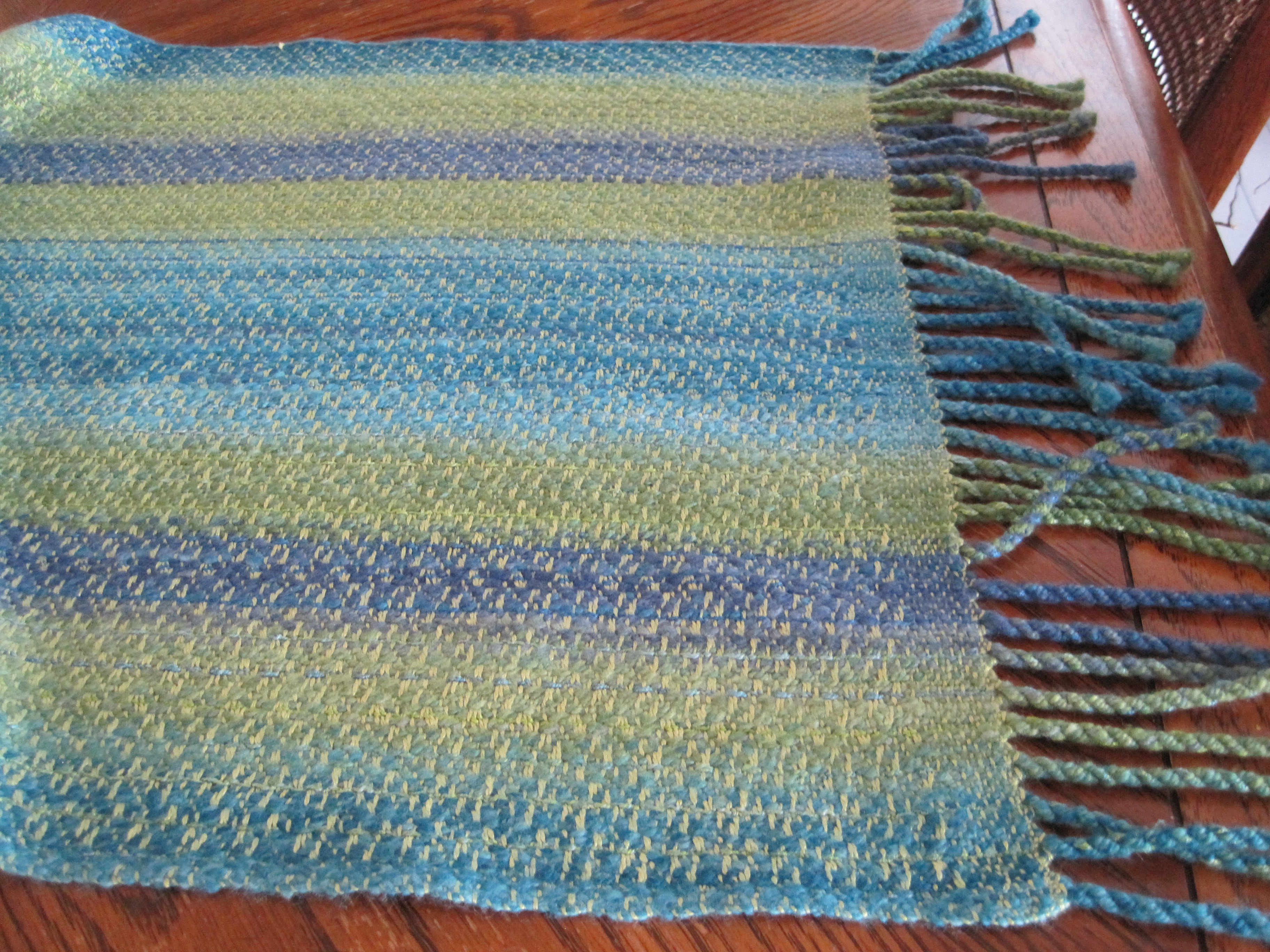
For the first scarf, I wove 12” in natural, 12” in one-inch wide stripes alternating colours, 24” in two rows natural, two rows caribou, 12” in alternating one inch wide stripes, then 12” in caribou.  Simple plain weave, beautiful results.

IMG_3670

IMG_3671

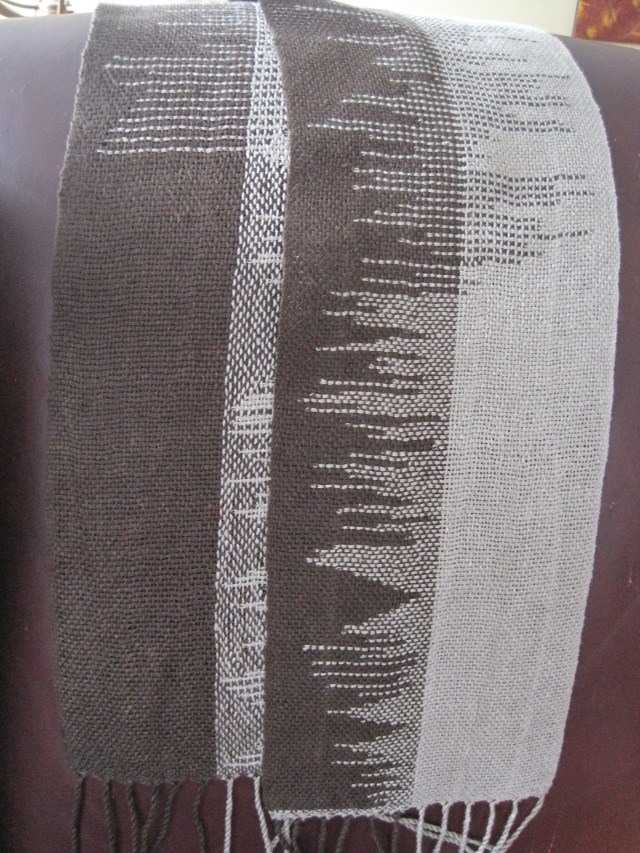
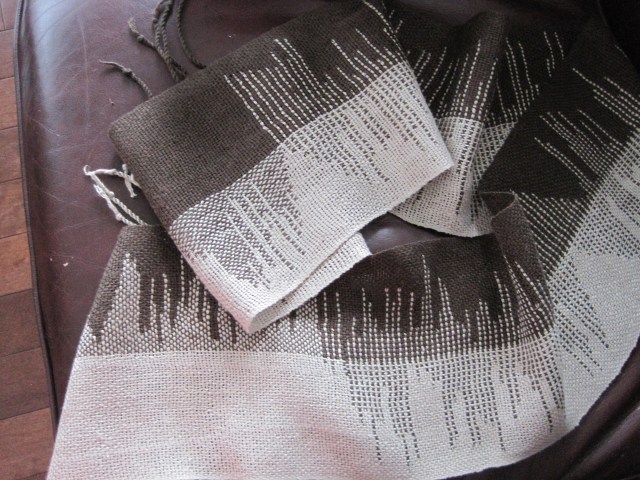
For the second scarf I used a clasped weft technique, 12 inches where the natural thread was pulled past the centre line to give a clear natural block, with mixed colours on the caribou side, then the middle 60 inches where the threads were alternately pulled to the natural side, then the caribou side, and the final 12 inches where a clear caribou block was achieved.

IMG_3669

IMG_3673

I had no problems at all working with the linen thread.

To finish, I washed in hot water in the machine, which made the scarves extremely wrinkled.  I hard pressed when damp to remove the wrinkles.  The fabric was very crisp.  I then threw the scarves in the dryer for 10 minutes with a fabric softener sheet, and the scarves came out with a soft hand.  For linen, repeated washing/pressing/drying will increase the softness over time.

Posted in Weaving | Tagged , , , , , , , , , , | 9 Comments

The Lovely Month of May

So many things seem to happen in May.  Our Guild elections have taken place, and I will be President of the Peace Arch Weavers and Spinners Guild for a second year.  Hopefully I can use the second time around to improve those things that were new to me last year.

2016 is the Peace Arch Weavers Guild’s 50th anniversary, and lots of “Golden” events are happening.  Saturday, May 14th was the annual “Sheep to Shawl” competition at the Surrey Museum in which I was a participant spinner.  Our team of six on the floor consisted of four spinners (myself, Yuuko, Shona, Grete) two of whom also manned the hackles for fibre prep, one plyer (Janice), and one magnificent weaver(Ginette).  Mary stepped in to help with the fringe twisting.  In front of the public we had Janeesha as our steward who rose to the challenge of her first sheep to shawl competition, and Joan who entertained the youngsters in the audience with a smile on her face.  We also had a small army of people behind the scenes who worked diligently before the competition to help us prepare.

Our shawl was so lovely in a Huck lace pattern.  The warp is a combination of Cotswold wool and Muga silk, bringing in the gold for our 50th.  The weft was a soft Merino-Romney wool cross.  The shawl just glows with golden goodness.  We won the competition!

sheep to shawl 1

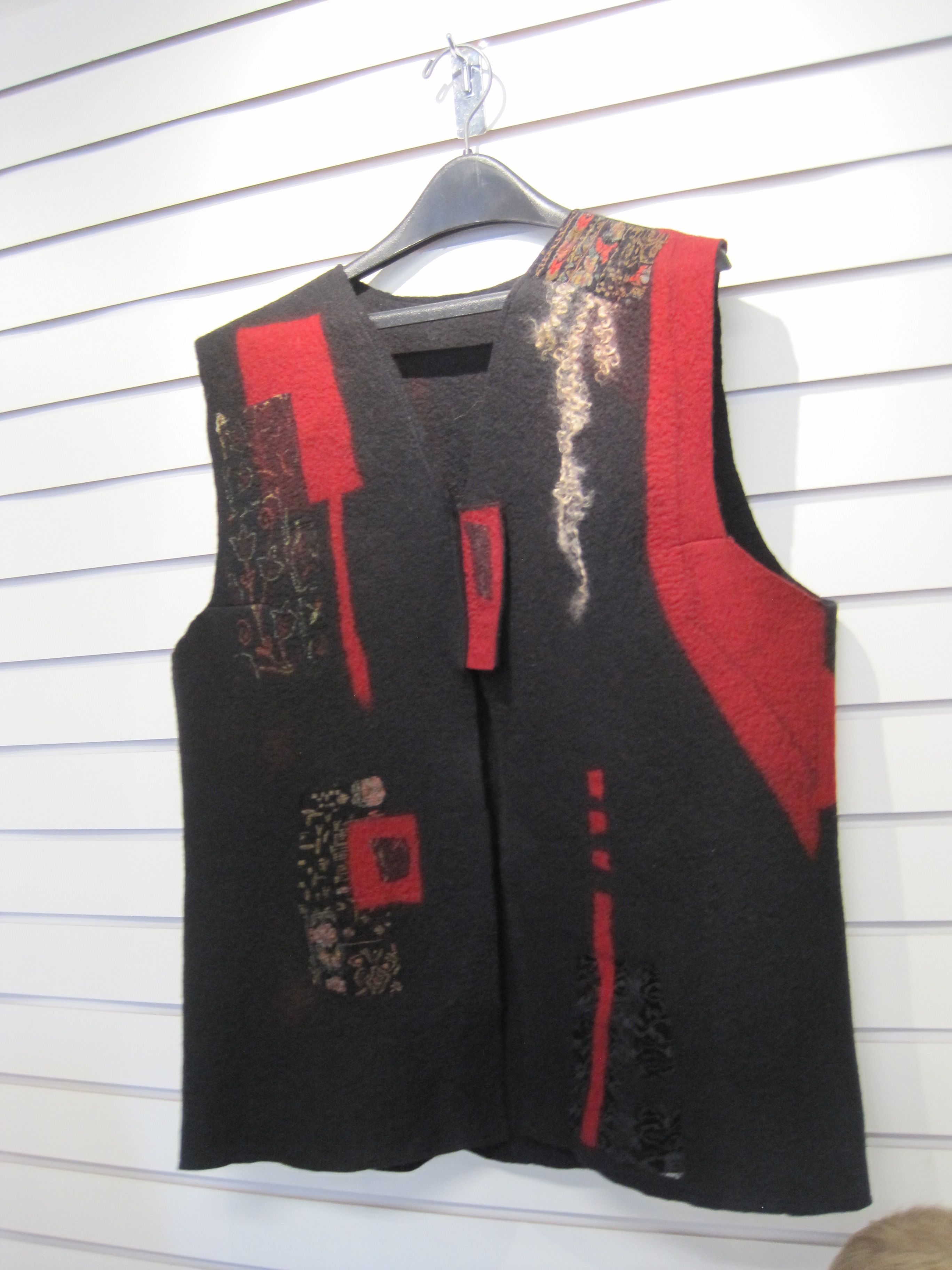
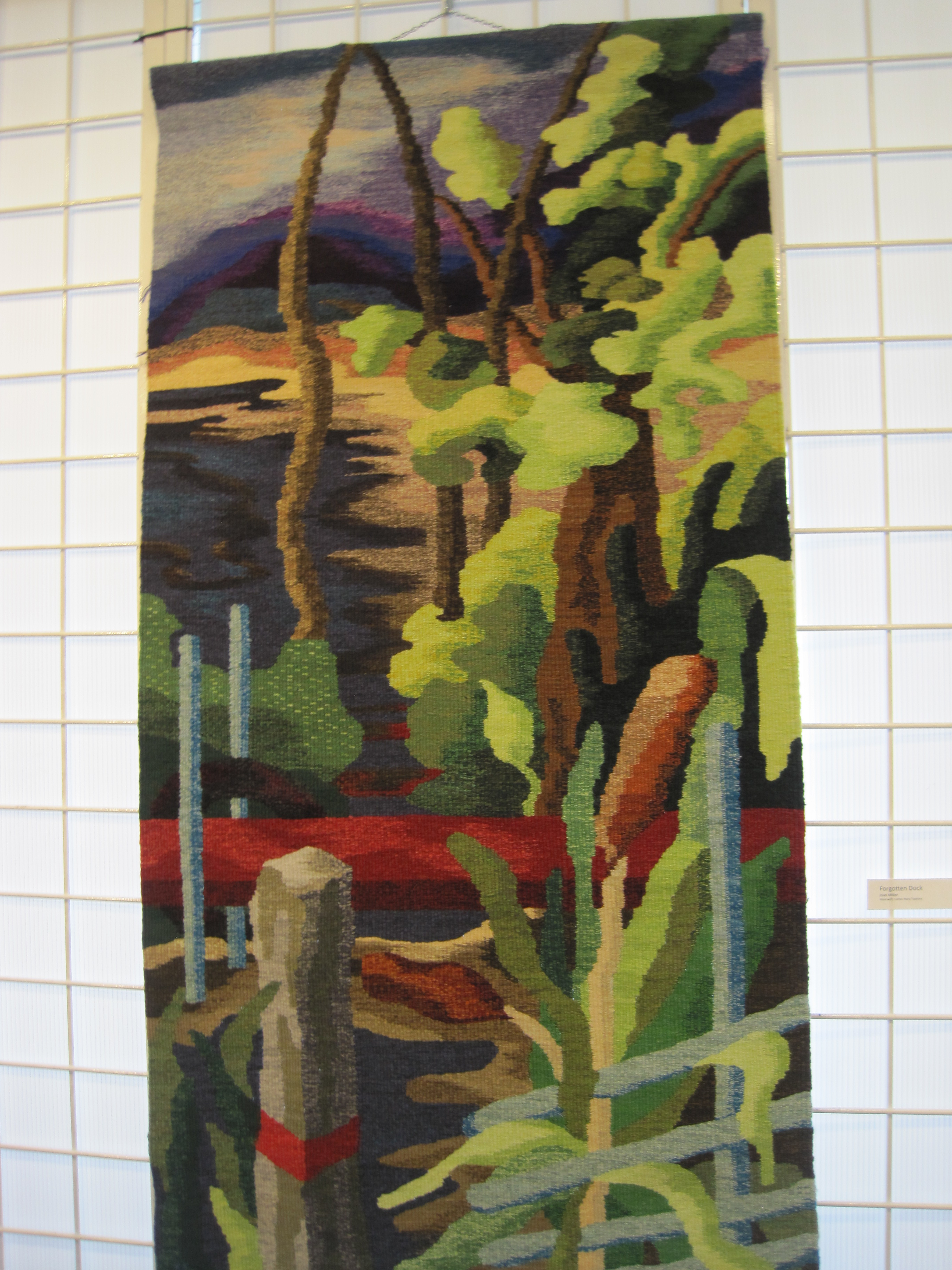
Sunday was the opening of the PAWS Guild “Celebrating Fifty Years of Fibre Arts” showcasing 13 PAWS Guild Artists, at the Newton Cultural Centre Gallery.  I am honoured to be one of the exhibiting artists.  The show will run to May 31, 2016.  Beautiful work from our members is on display.  The pictures below are: my handwoven scarf, Donna’s felted vest, and Joan’s wonderful tapestry.  I love the diversity of our members.

IMG_3648   IMG_3642  IMG_3646

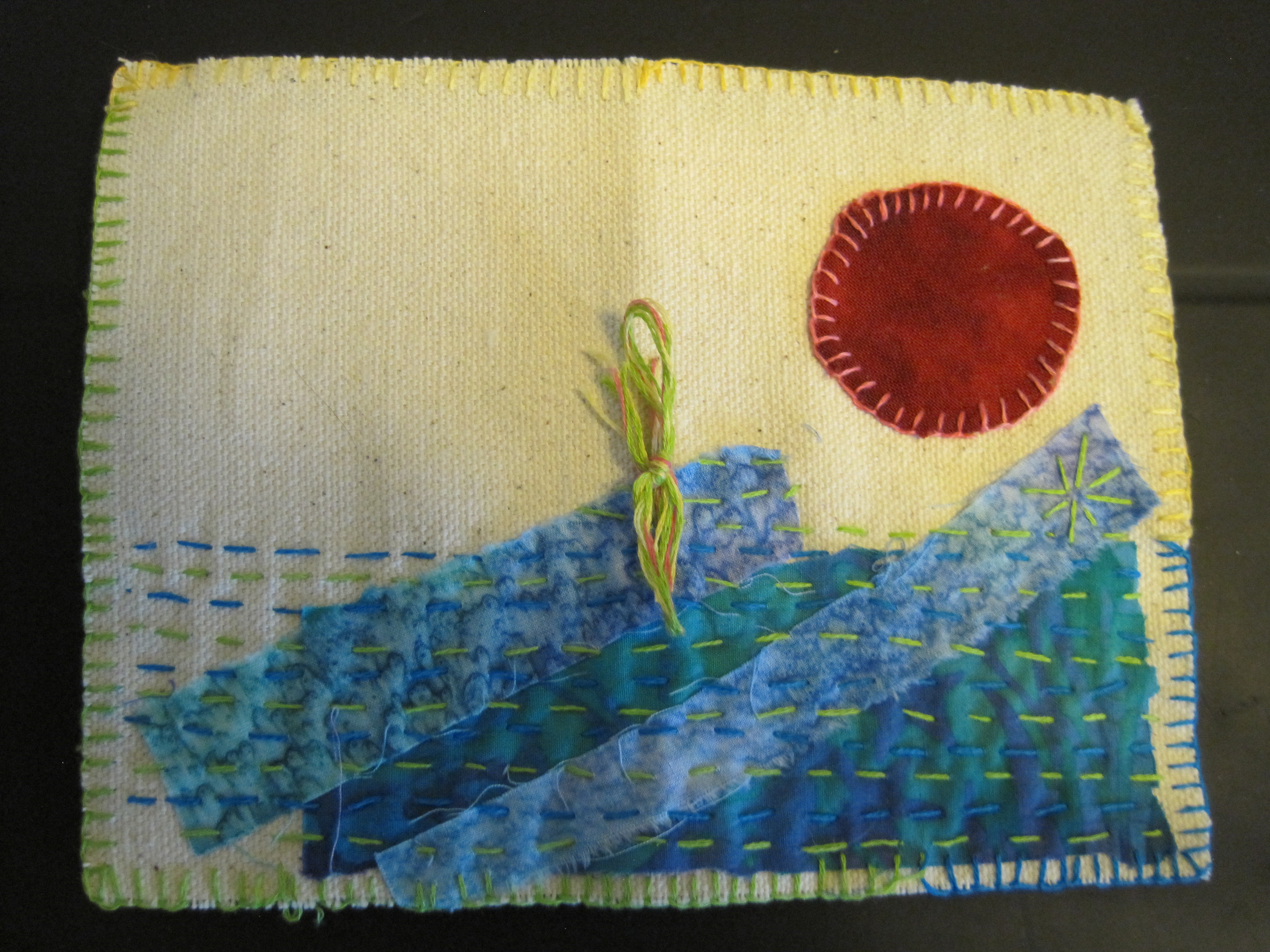
And at the Coquitlam Weavers Guild meeting last week, we were honoured to have well-known fibre artist, Catherine Nichols, conduct a mini workshop on stitching.  On a small canvas cloth we added fabric and stitch to create a small booklet cover.

IMG_3656  IMG_3660

Catherine is one of the artists featured in the show “Mended” which is currently on display at Place des Arts, Coquitlam for the month of May.  Catherine also showed us some of the antique Kantha cloth blankets she collects.  Kantha is a form of stitched cloth from India, made by those whose need led them to collect discarded clothing and other fabrics, and stitch them together in layers to create new layered cloths for blankets and clothing.  They are beautiful in their simplicity and creative stitching, with a deep connected history.  Fascinating.  I would love to take a longer workshop with her.


Posted in Uncategorized, Weaving, Weaving Guilds | Tagged , , , , , , , , , , , , , , , , | Leave a comment

Denim Dreams

Every textile, fibre, or yarn that moves through my hands sparks a thought, a memory, an emotion or a flight of imagination.  I get lost and my mind wanders, following the thread . . . . . .

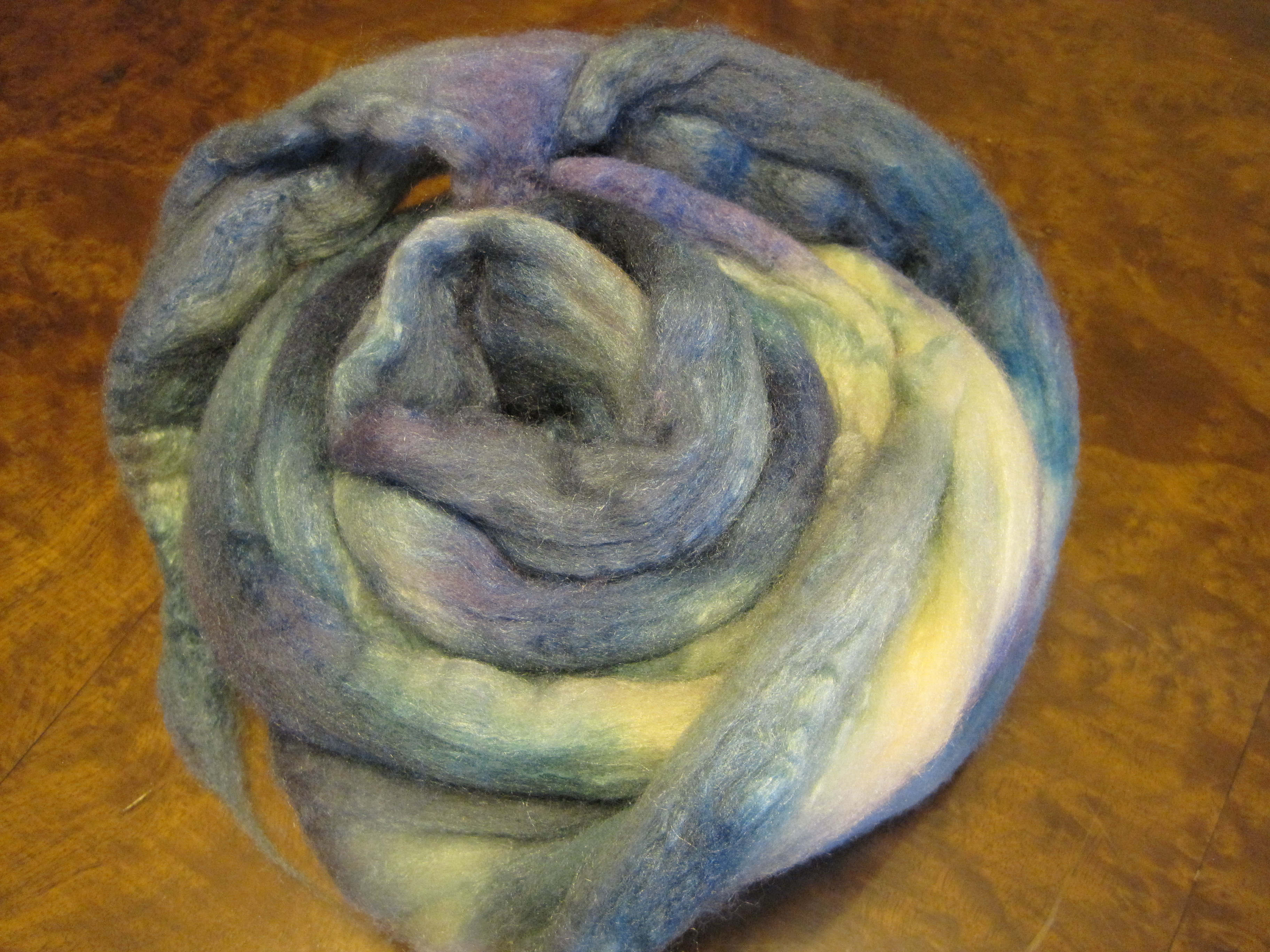
I have been spinning again.  This beautiful pile of fluff was blended and dyed by Lynne at West Coast Colour.  Lynne loves to work in fibre and names her fibre blends.  This one, called “Satisfaction”, is a blend of 60% Polwarth wool, and 40% silk.

IMG_3569

While Lynne names her fibre blends, I like to name the colour story.  Not when the fibre first comes to me, not while it is on the stash shelf, but as I start to spin and draw out the fibre, the name and the story start to evolve.  This fibre is dyed with blues and a hint of purple, and as I worked it started to remind me of a pile of blue jeans on the floor, some darkly new, and others old and soft and faded to nearly white.  And so, my mind wanders to denim dreaming.

I started to think about myself and what blue jeans have meant to me throughout my life.  When I first noticed and wanted blue jeans as a child, my mother insisted that jeans were the uniform of farmers and cowboys.  OK to wear while working in the house and garden, but never to be worn into town!   When going to town, dresses and leather shoes were the only respectable clothing.

IMG_3581

I spun a fine thread of blues and thought some more.  High school meant wearing a school uniform every day (kilt, white blouse and knee socks).  Weekends meant blue jeans and freedom.  I remember slitting the sides of my jeans and inserting large wedges of patterned fabric into the opening and now they were bell-bottoms.  Accessories were fringed vests, felt hats, and love beads.  The soundtrack of the “Mammas and Pappas”, “James Taylor”, “Carol King” and “Sonny and Cher” was heard in the background.

IMG_3582

Still I spun the pile of blues, and moved on to university, first time away from home, and denims became a uniform of a different nature.  These jeans clothed me through learning about the larger world: civil rights, philosophy, world religions, cultural differences, war and peaceful protests.  My mind was opened up to new thoughts and philosophies and optimism that my generation could change the world.

In my twenties my jeans morphed into Mom Jeans and family responsibilities.  Oh, how I loved these days: playing in the park with the kids, exploring tadpole pools, piling up and jumping in the autumn leaves, snowball fights and building snowmen in the winter, bike rides and swings in the spring, baseball, beaches and bar-b-ques in the summer.  These days passed oh so quickly, fast as life.  My second bobbin of yarn was filling up.

IMG_3584

On to the plying, the colours now coming together in a patchwork of blue.  Now what do I wear?  Old lady jeans?  Maybe.  But like a favourite pair of well-worn jeans I am softer, paler, a little torn and patched, but oh, so comfortable in myself, in my own skin.  I fit.

IMG_3632  IMG_3634

This 119 gm skein of “Denim Dreams” is 557 yards long, and took 14 hours to spin – lots of time for dreaming.  I plan to weave a comfortable scarf or shawl to wear with my jeans.


Posted in Essays, Spinning | Tagged , , , , , , , , , , , | 4 Comments

A Spinning Odyssey

My spinning wheel has been busy this month spinning these beautiful colour combinations from fibre hand dyed by my friend Brenda at Penelope Fibre Arts.  The fibre is Blue Faced Leister.  The colour combinations are:

Fall Bouquet

IMG_3587

Northern Lights

IMG_3586

Medieval Tapestry

IMG_3591

Each soft, squishy 2 ply skein weighs 4 oz (113 gms) and measure 292 yards, 377 yards, and 277 yards respectively.

I would like to knit something simple to show off the intense colours to best advantage. Maybe some hats or cowls.  What do you think?


Posted in Spinning | Tagged , , , , , , | 4 Comments

February – A Month of Love

Ah, sweet February, a short month that brings us days that grow increasingly longer.  As winter slowly releases its grip, and with Valentine’s Day smack in the middle, I found time to reflect on the loves in my life.

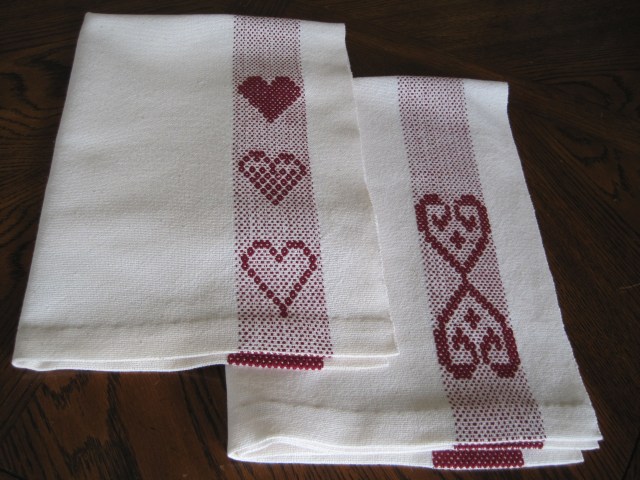
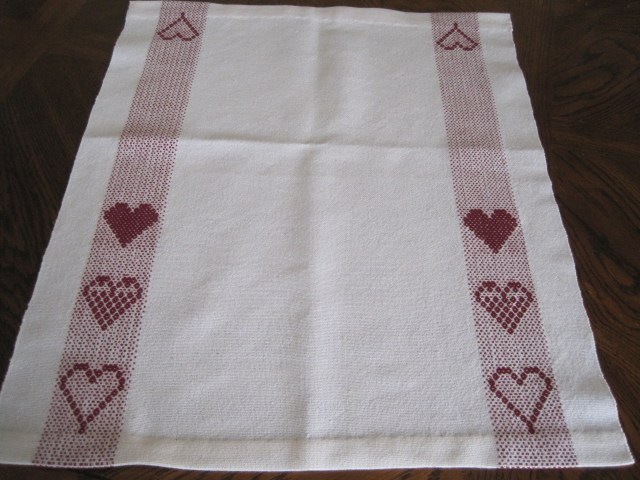
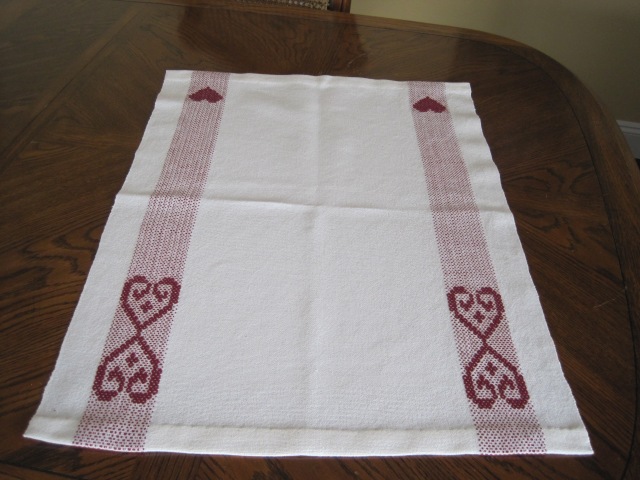
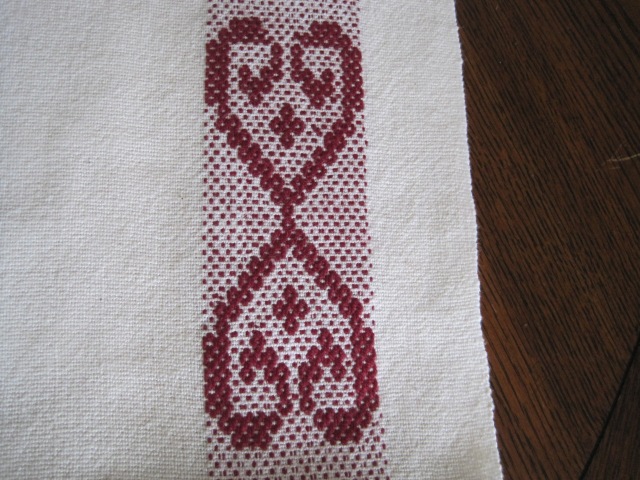
These simple towels, basically plain weave, with two bands of turned summer and winter represent my reflections on love.

IMG_3561

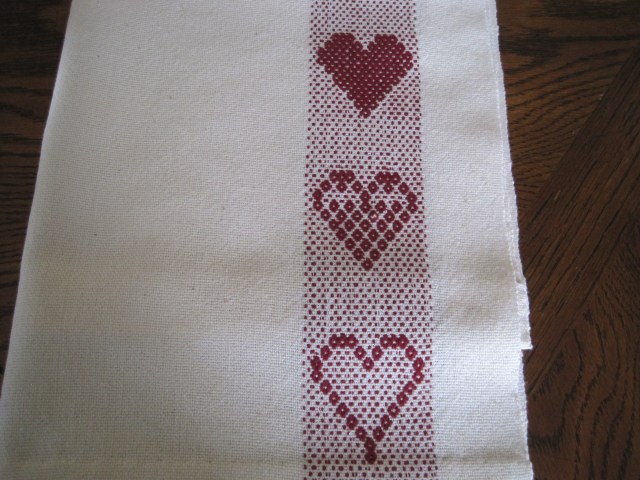
The first towel, with three hearts, reminds me of the love of a good relationship.  A couple meets with hearts open to each other.  As the relationship grows, and the couple learns more about each other, their hearts begins to fill up with memories created: first date, first kiss, first dance, a grand romance.  Love continues to grow and now we see the full hearts of mature and lasting love.

IMG_3564

IMG_3563

The second towel, with connected hearts, reminds me of the love between a mother and child.  The first sound a child hears is the beating of the mother’s heart.  As the child grows each step and bump and fear and laugh and smile is shared and softened by the mother’s arms and heart.  Even as the child grows and grows and finally becomes an independent adult, the hearts of mother and child remain connected forever, no matter how far apart they are.

IMG_3565

IMG_3562

These towels, though simple, took a while to weave as each row of the design had to be picked up thread by thread which gave me a lot of time for reflection.

Technical Information

February’s towels are woven in Turned Summer and Winter, which means the pattern and background threads are built into the warp, and only one shuttle is used for the weft.

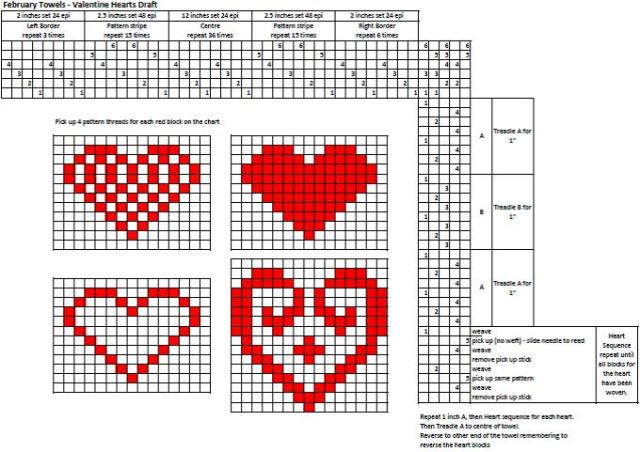
These are the February towels found in “Weaving Towels as a Means of Learning the Basic Four-Shaft Weaves”, by Clotilde Barrett, Weavers Journal, Fall 1983, Volume VIII, Number 2, Issue 30, pages 11- 19.  I adapted the draft to use 2/16 cotton sett at 24 ends per inch.  This makes the pick-up bands 2.5 inches wide.

I also realized that since I had to do pick-up, I could change the motifs as I went along, and had fun playing with different heart designs.

The original draft was written on four shafts, with the plain weave threads alternating between shafts 1 and 2, and the pattern on shafts 3 and 4.  This will require  222 heddles on shaft 1 and 222 heddles on shaft 2.  Make sure you have enough heddles on shafts 1 and 2 before you start dressing the loom.

Because I had an eight shaft loom available, I spread the plain weave sections over shafts 1,2,3,and 4 and put the pattern threads on shafts 5 and 6.

Use a 12 dent reed and sley 2 ends per dent in the plain weave sections, and 4 ends per dent (2 background and 2 pattern threads) in the pattern bands.  The pick-up is based on 4 pattern ends for each block in the diagram, and the 12 dent reed is enormously helpful in counting your pick ups.

Warp:  2/16 cotton, natural for the background thread, and 2/8 cotton, raspberry, for the pattern thread.

Weft: 2/8 cotton, natural.

Sett:  24 epi (ends per inch), in plain weave sections, 48 epi in pattern bands (24 natural cotton, 24 raspberry cotton)

Total number of warp ends: 624

Width in reed: 21 inches

Warp length: 3 yards (for two towels)

Colour order
white 48 1 288 1 48
red   1   1  
15x 15x

Feb towel draft

Posted in Weaving | Tagged , , , , , , , , , , , , | 4 Comments

Intermission

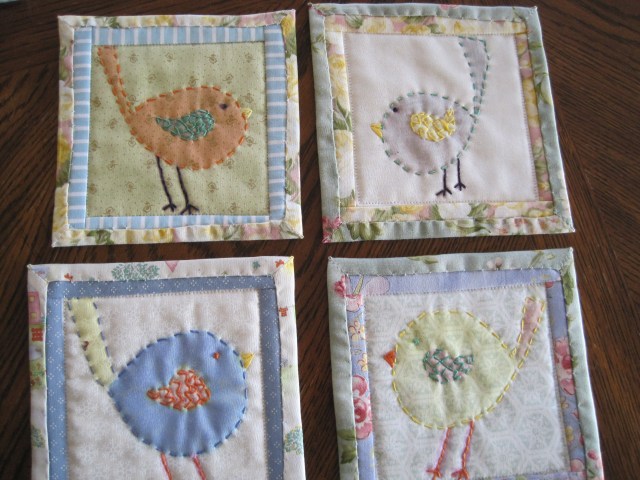
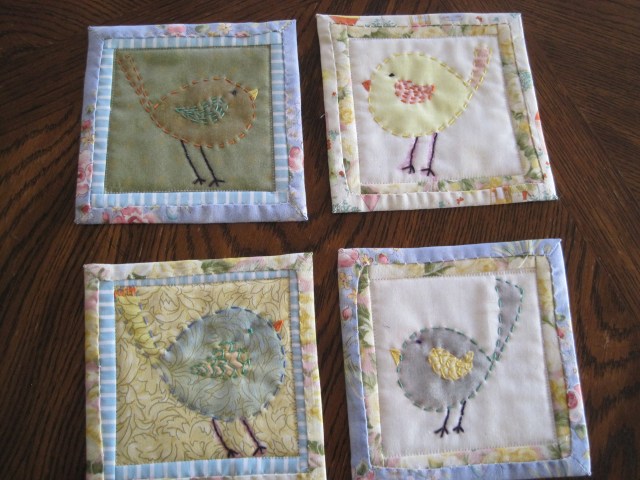
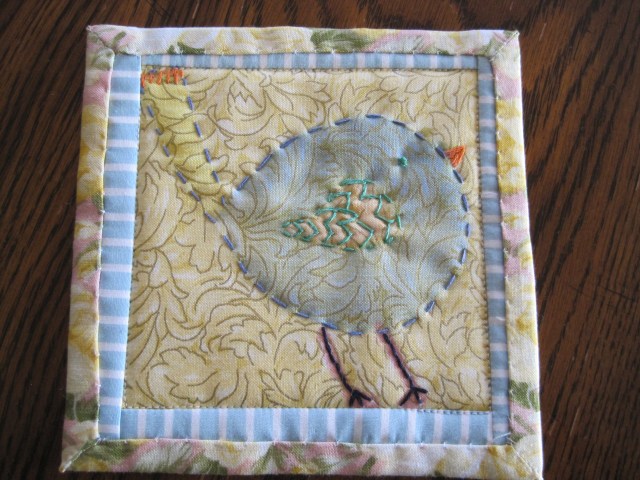
I took a short intermission from weaving and spinning to try my hand at surface design.  These cute little bird mats were made through the use of transfer dying.  Transfer dyeing only works on polyester fabric.  The image is coloured, using fabric crayons, or painted, using transfer paints, on paper, and then transferred to the fabric through heat and pressure, using an iron.  Each image can be transferred four or five times. I then embellished the pictures with hand embroidery and added batting, backing and trim.

IMG_3552

IMG_3547

IMG_3548

I like the translucent quality of the print, with the background fabric showing through the image.

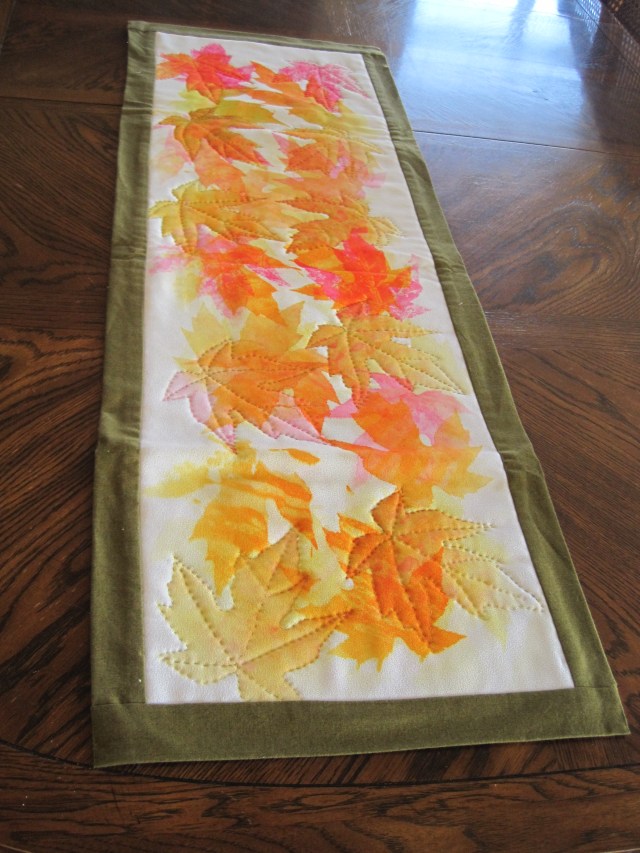
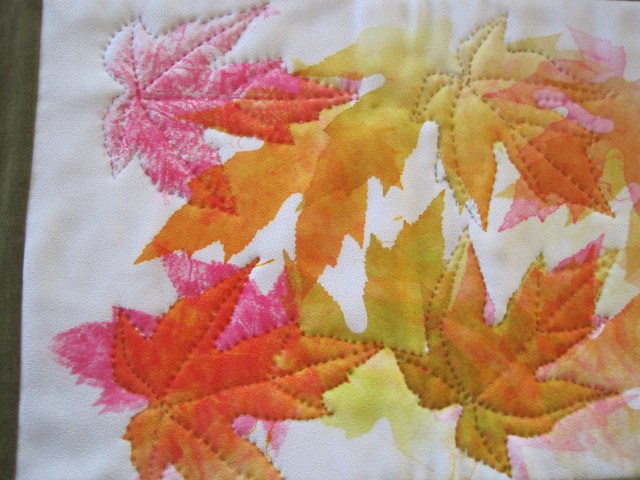
The table runner was made by painting silk leaves with transfer paints, and then the leaf prints were transferred through ironing onto the fabric.  This was finished with machine quilting outline work.

IMG_3545

IMG_3546

So, a lovely  little intermission, trying something new.  It was loads of fun.


Posted in Surface Design | Tagged , , , , , , , | 1 Comment

Swedish Lace Towels Draft and Instructions

For those of you who asked, I am including here the full draft and instructions for weaving the Swedish Lace Towels.

I wanted to use traditional Swedish Lace to the fullest on four shafts, so I worked out a profile draft that would include both a table, and the flower motif.  I also knew that I wanted a tea towel that would be close to 20 inches in the reed.  The thread I chose was 2.10 mercerized cotton from UKI in bleached white.  The profile draft I came up with is:

profile only

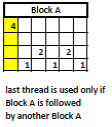
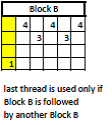
To determine the threading, Use the Block A thread by thread to replace every A on the threading portion of the profile draft and the Block B thread by thread to replace every B on the threading portion of the profile draft.

The last thread, shown in yellow in each block substitution is called the incidental thread.  The incidental is used only when Block A is followed by another Block A, or Block B is followed by another Block B.  Obviously, if Block A is followed by Block B, the incidental does not need to be used, because Block B starts on shaft 4, and when Block B  is followed by Block A, the incidental does not need to be used, because Block A starts on shaft 1.

The first and last block in the profile is marked PW for Plain Weave, and is threaded on shafts 1 and 4.

A Block  B Block

The first portion of the thread by thread draft is shown below.

Swedish lace threading

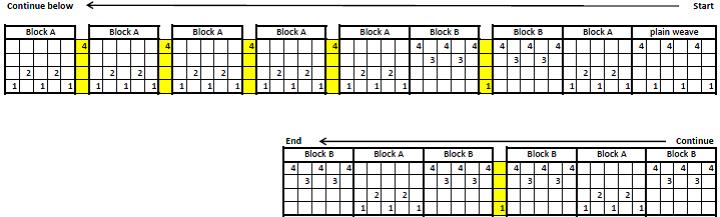
Treadle as drawn in according to the profile draft, substituting plain weave, Block A  and Block B as shown below for the first part of the treadling.  As with the threading, use incidentals when Block A is followed by another Block A, or Block B is followed by another Block B:


Swedish lace treadling

Details:

Warp and Weft:  2/10 Mercerized cotton, bleached white

Sett: 24 ends per inch

Total warp ends 493

Width in reed:  20.5 inches

Warp length:  3 yards for two towels or 5 yards for four towels.

Weaving:  for each towel: Weave 2 inches for hem, weave as drawn in for 28 inches, weave 2 inches for hem.

Finishing: Machine wash quick setting.  Iron while damp.

Posted in Uncategorized, Weaving | Tagged , , , , , , , | 10 Comments

January – A Time for Swedish Lace

Yes, I know it’s late, but here we go anyway.  For January, I decided to make some towels in Swedish Lace.  I worked up a simple two block profile draft and then used traditional Swedish Lace threading to make the lace units.  I remembered to separate any repeat blocks by adding an incidental thread on shaft 4 for Block A and Shaft 1 for Block B.

The towels are woven with 2/10 mercerized cotton in snow white for both warp and weft, Sett at 24 ends per inch and treadled as drawn in, also at 24 picks per inch.

I love the way the towel has the feel of an heirloom textile, even though it just came off the loom.  I love the little windows.  Handwoven lace is so romantic.  This is a formal towel for special occasions.

IMG_3527  IMG_3529

My previous posts show Atwater/Bronson Lace towels in June 2015 and Huck Lace in July 2015.

Last week I taught a class on “Summer and Winter Weave” for my local guild.  Everyone worked hard to complete the samples, and still had enough warp left on their looms to go home and play some more.  Here are just a few of the samples created.  Summer and Winter is so flexible, I could get caught up in exploring the possibilities for years.

IMG_3532     IMG_3534  IMG_3539  IMG_3537

Posted in Weaving, Weaving Guilds | Tagged , , , , , , , , | 4 Comments

Back on Track

Well, here I am again after a little break.  I haven’t been posting, but I have been active, with spinning, weaving, family and guild stuff.  I had quite a lot of fun.

On the spinning front, I spun a nice light fingering weight yarn from an 85% alpaca, 15% bombyx silk fibre from Kensington Farm Alpaca.  It was clean, but there was some vegetative bits in the roving, so it was some stop and start spinning to remove the debris.  It turned into some very nice yarn after all was said and done.  I spun 358 yards from 50 gms of fibre.  I will work it into a lace shawl.

IMG_3522  IMG_3521

The yarn is very soft, and warm to the touch.

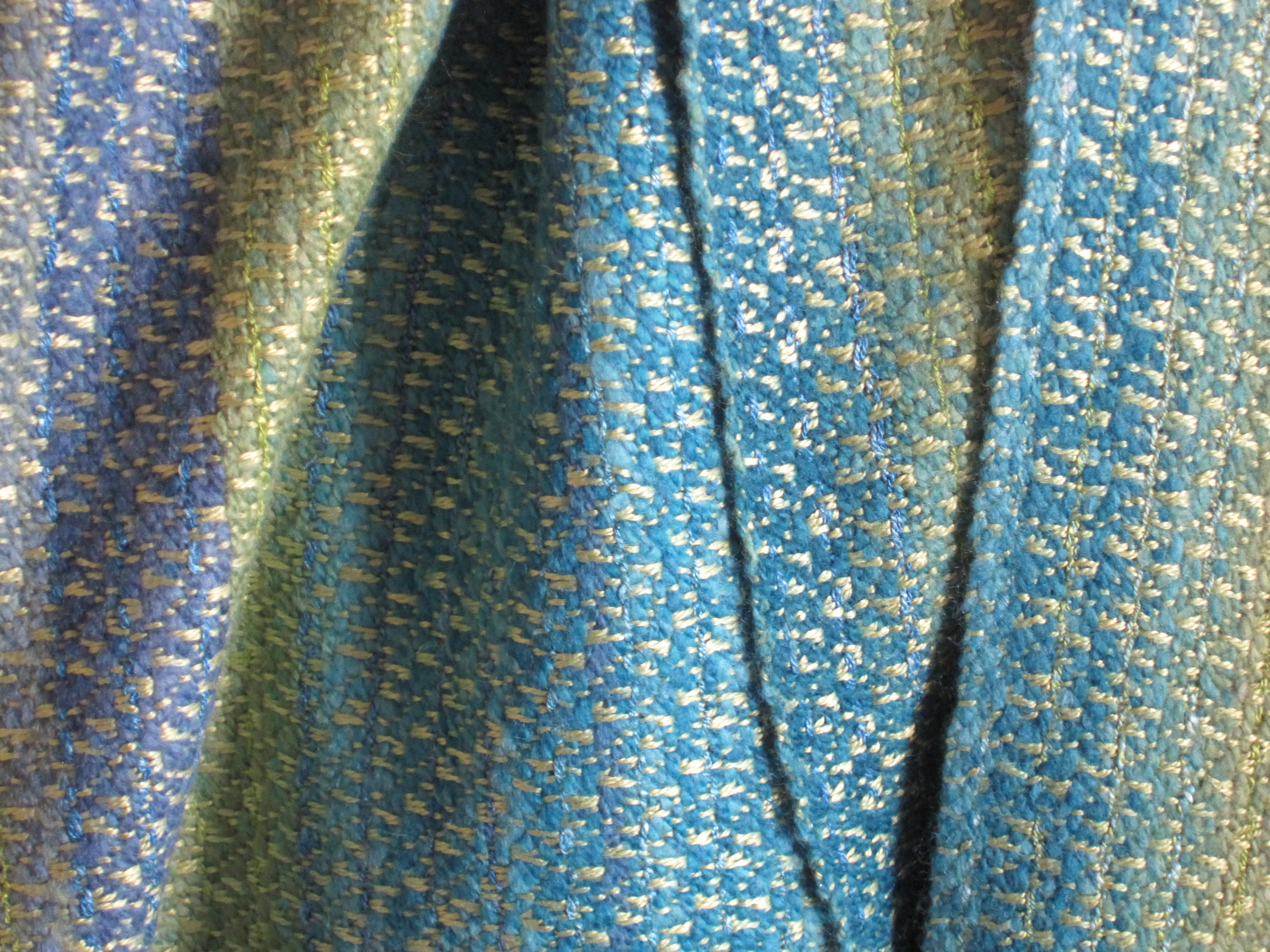
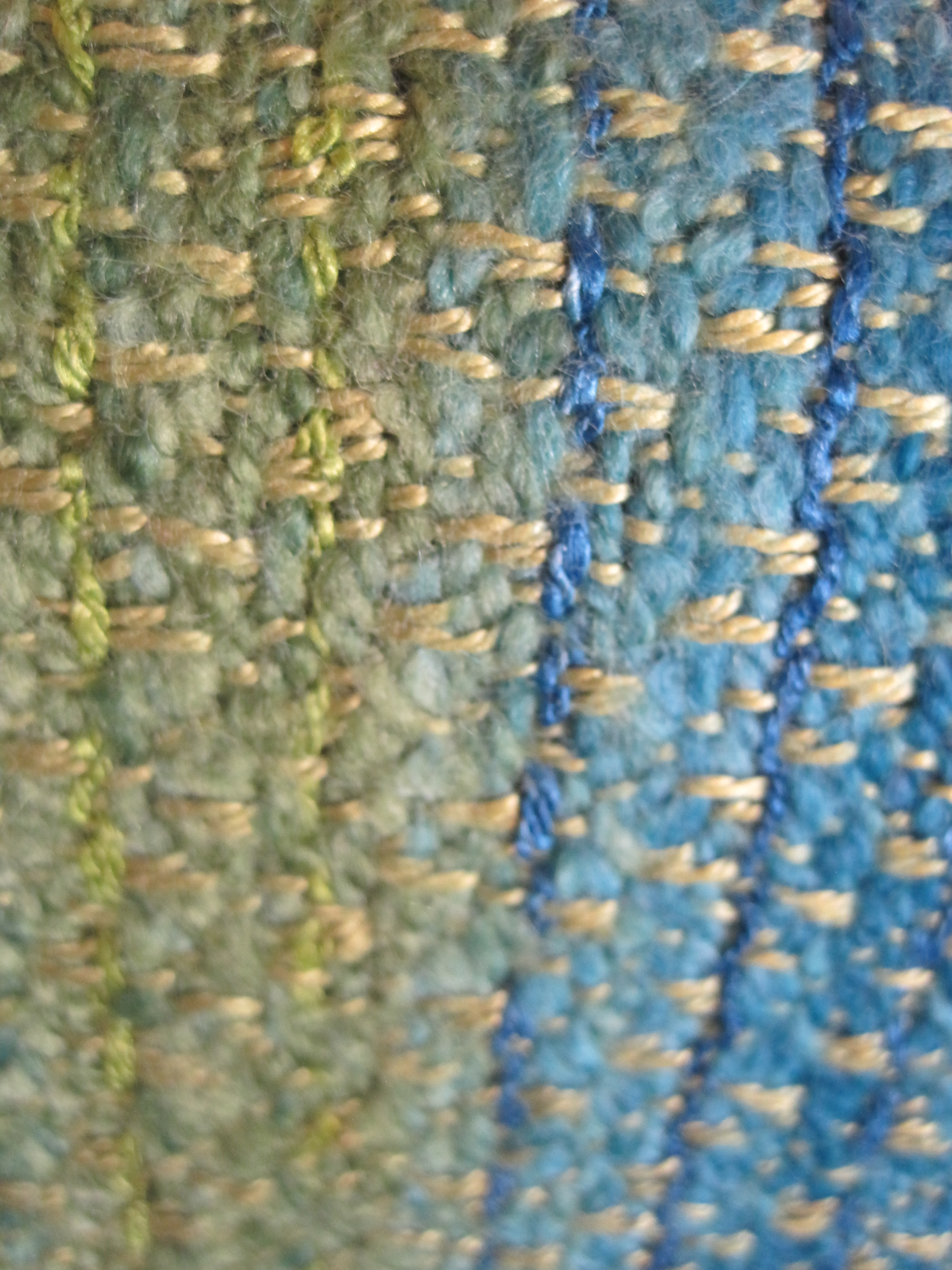
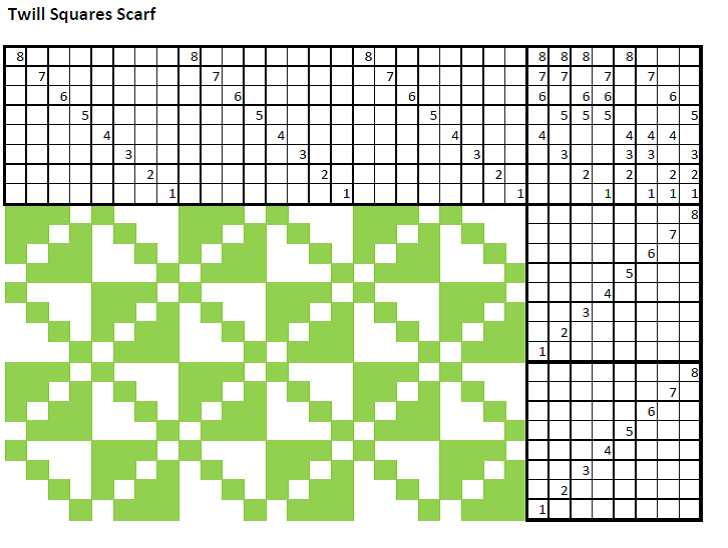
I have been weaving again after having naked looms through most of November and December.  I wove a shawl from some of my handspun yarn.  This was 100% merino from braids dyed by indie dyer Kinfolk Fibres.  I spun two dyed fibre braids into a gradient yarn, moving from turquoise through green to purple and then back to green and turquoise.  It finished at 712 yards.  I used this as warp for a wide scarf/shawl, set at 16 epi, 18 inches wide in the reed.  I used a small twill on 8 shafts, a balanced 3/1 twill against a 1/3 twill, using 2/20 silk from Jane Stafford Textiles in “lime lights” colour.  The scarf has excellent drape and is light weight and soft.

IMG_3516  IMG_3511  IMG_3520  twill squares scarf

The colours in real life are much more vibrant.  The silk catches and reflects the light, and the shawl is wonderful around my shoulders on a cool night.

For those who have asked, I have designed a January towel, in a Swedish Lace pattern, and will weave it in snow white mercerized cotton.  I am working towards completing the towels by the end of January.

Posted in Uncategorized | 4 Comments

October Wrap-up

Sorry, I wasn’t able to weave any towels in October simply because the end of September and all of October were extremely busy for me, but all in a good way.  I give you here, all of the exciting learning events and happenings for me over the month.

1) September 24,25,26 – An intensive three day Silk Spinning Workshop with Kim McKenna.  Kim is an extremely knowledgeable and generous teacher, and her workshops are very full of information about spinning/dyeing in general in addition to the subject being focused on.  In this workshop we learned about every kind of silk available, where it comes from, how to spin it, how it is processed and what to do with it.  Kim provided us with over 40 generous samples of silk, from the expected bombyx and tussah to Eri and Muga, in all forms including reeled silk, slivers, roving, hankies, noils, laps, carrier rods, throwster’s waste, peduncles.  The silk blends included silk with linen, bamboo, wool, seaweed, camel, alpaca and llama.  Kim also taught us how to make our own blends, how to document our results, and different ways of plying our singles.  So, I came home with a very big bag of samples and fibres to play with.  This picture shows only about a third of all the samples.  Some I finished spinning, some I still want to blend, and some I still have to spin.
IMG_3462

Silk being reeled from cocoons

IMG_3402

2) October 2 – Dyepot club – we participated in bucket dyeing.  See the socks below, which are a result of this play. Thanks, Terry.

2)  October 3 and 4 was the Knit City fibre event with vendors, demonstrations, workshops and lots of fibre interaction.

3) October 8 – Block Study Group meeting where we continue to explore blocks, drafts and other weaving adventures, loosely following the Ontario Handweavers and Spinners home study modules.

4) October 12 – Canadian Thanksgiving and family gathering.  Good food and good times.

5)  October 16, 17, 18 – Peace Arch Weavers annual Fibre Flare Show and Sales, with set-up Friday night, Saturday and Sunday sales, customer support, demonstrations, silent auction.  The event was successful and tiring, but so worth it.  Such fun to see what everyone has been working so hard on all year.

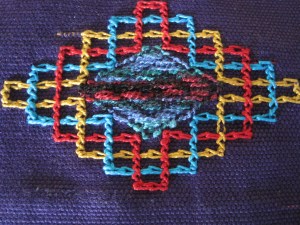
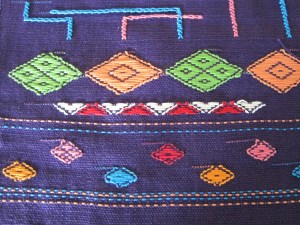
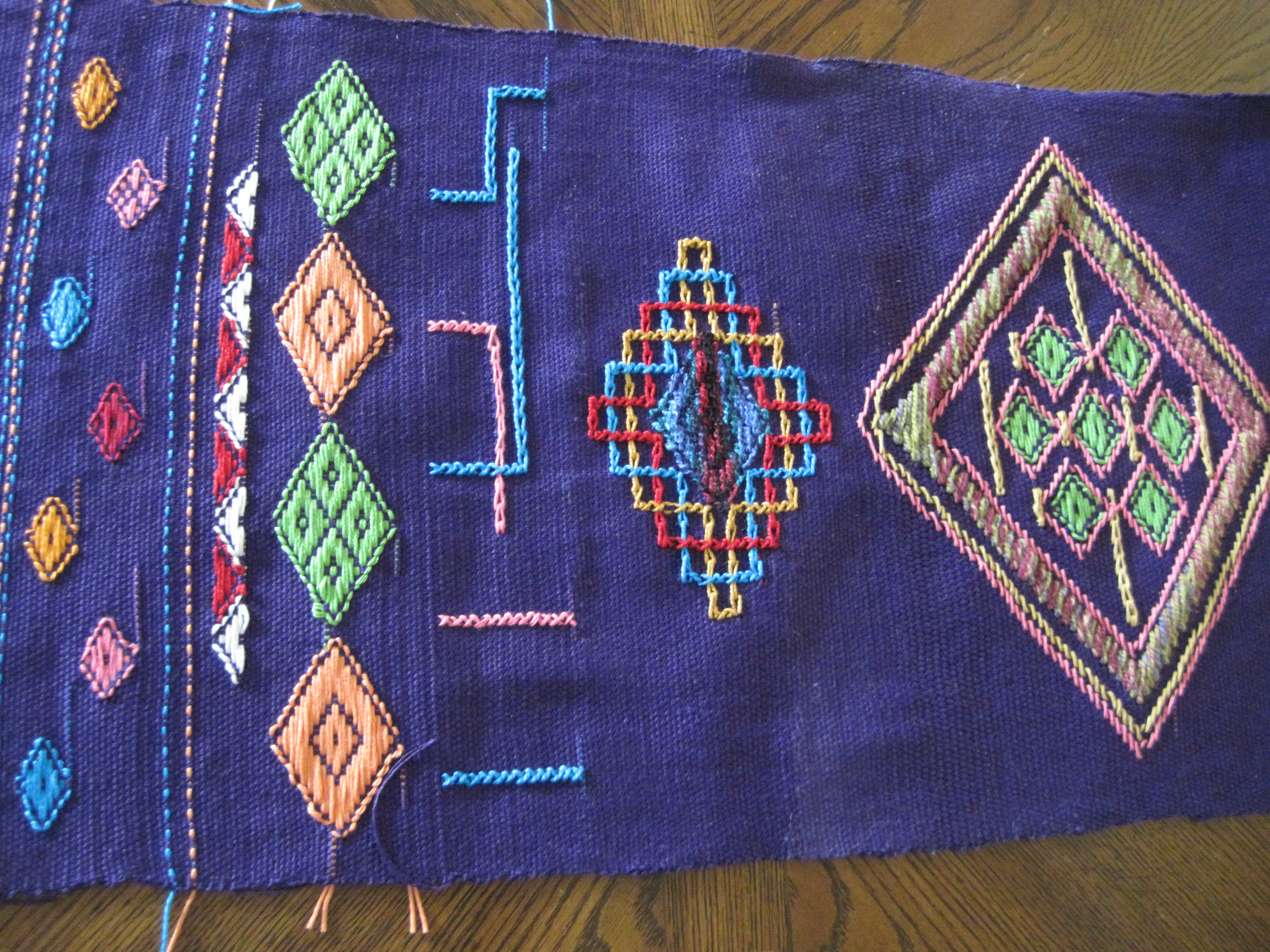
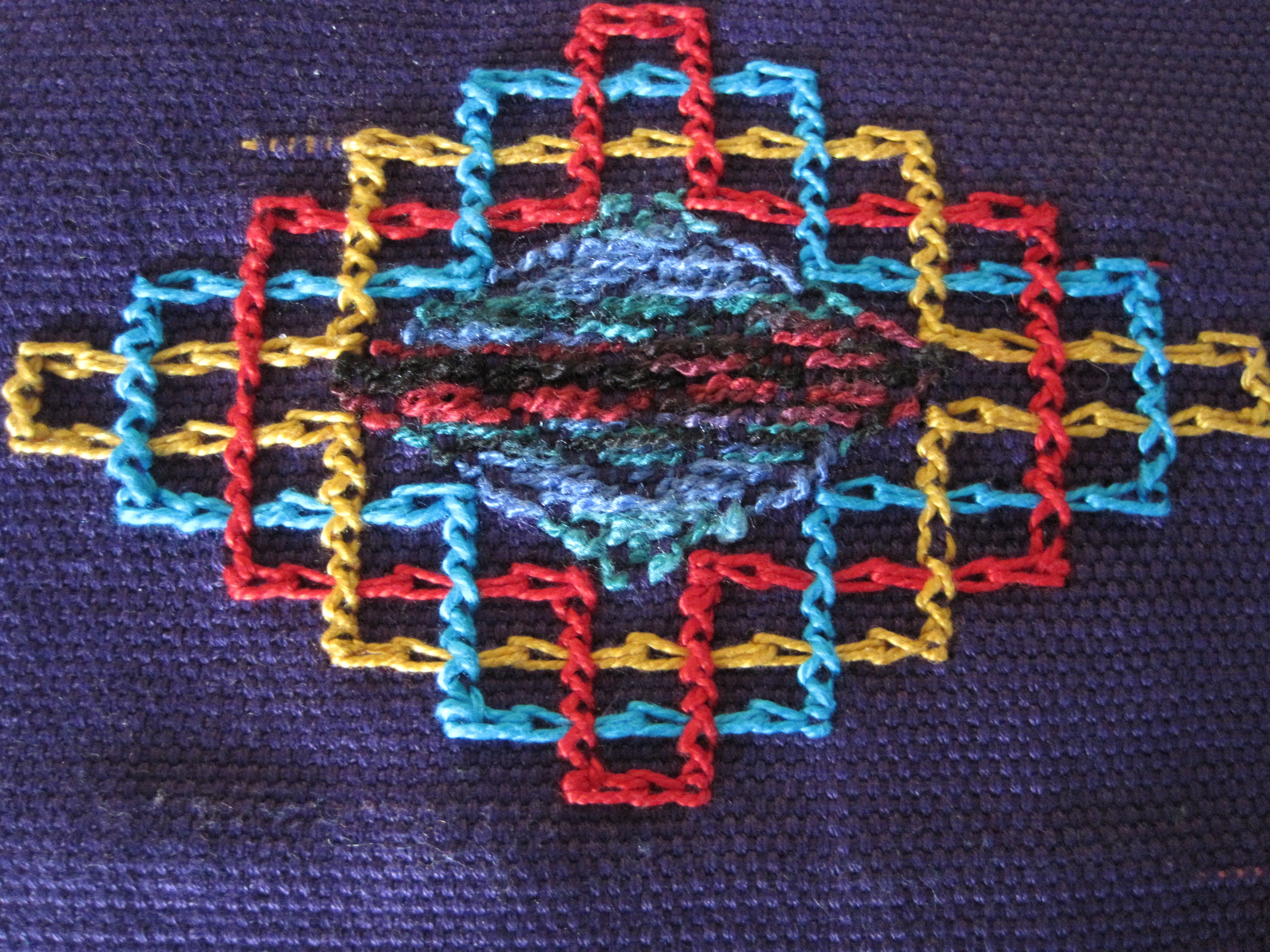
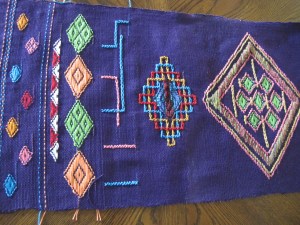
6) October 29, 30, 31 – I attended a three day workshop on Bhutanese Weaving taught by Wendy Garrity at the Maiwa Symposium on Granville Island.  Another great learning adventure and meeting friends old and new.  We have such a great weaving community!

These are the samples I managed over the three days of the workshop.  The inlay technique is not fast at all, but very satisfying.
IMG_3457  IMG_3459  IMG_3458

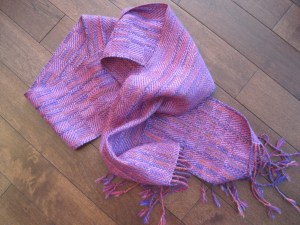
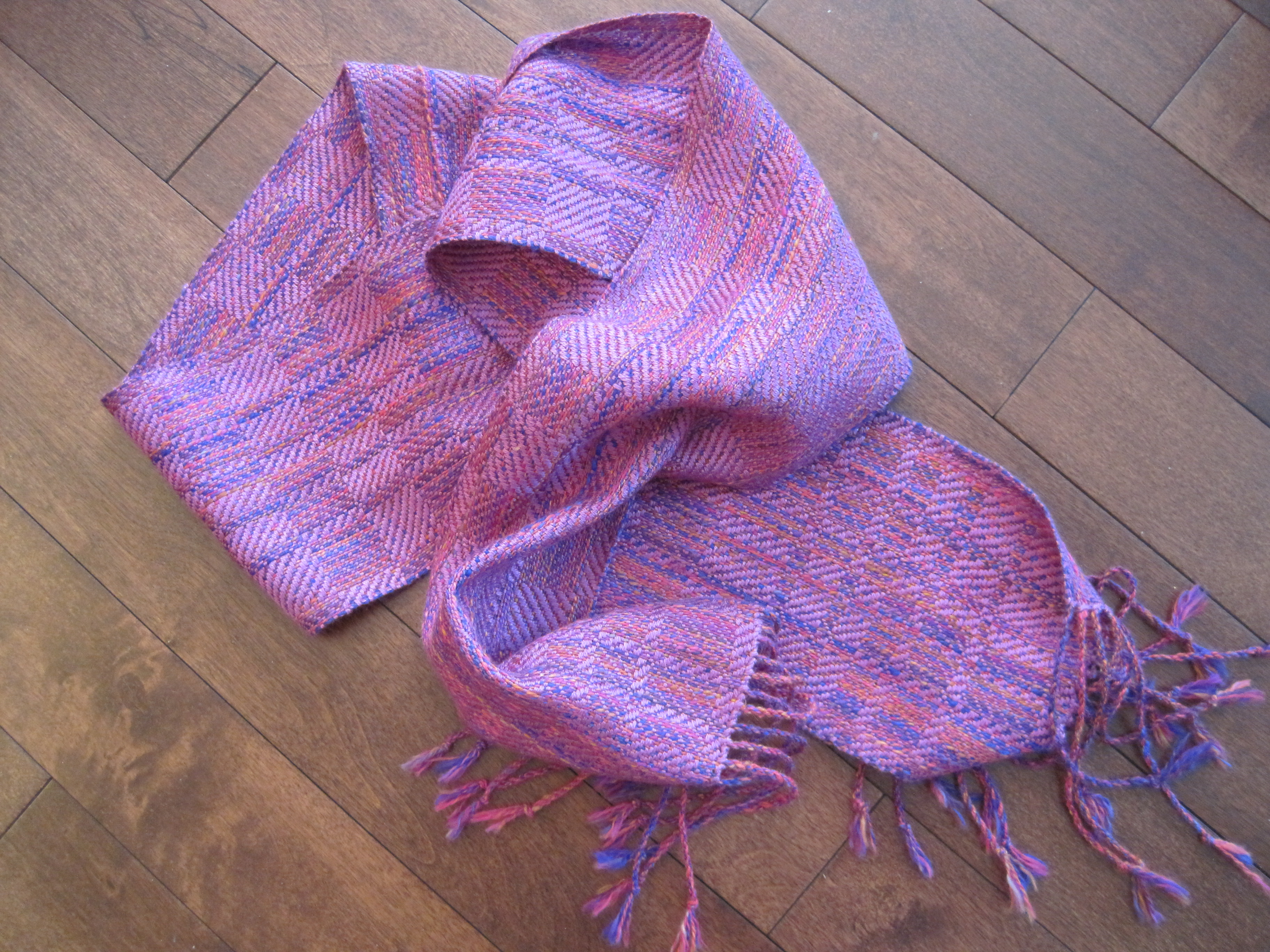
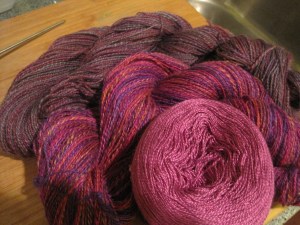
In between the spaces of time I accomplished some weaving.  This scarf turned out just the way I wanted in turned twill blocks.   The warp is my handspun from fibre purchased from Ellen Hamilton (70% mohair/30% merino), sett at 20 ends per inch, and the weft is 20/2 silk from Jane Stafford Textiles.  I love the juxtaposition of the shiny, smooth silk against the hairy, mat mohair.  The drape is excellent.
IMG_3410  IMG_3473

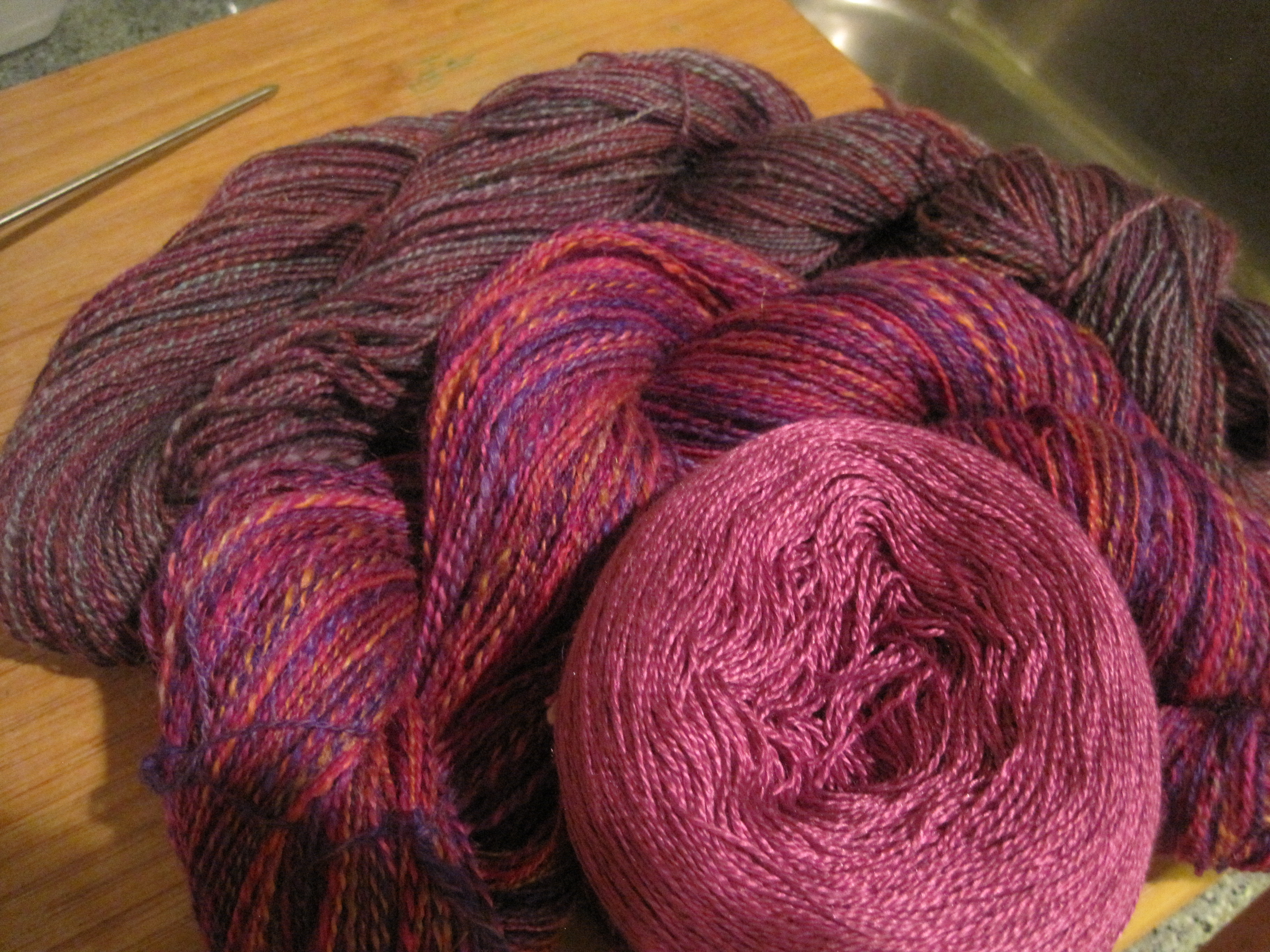
I used the bright pink/purple/mohair  handspun as warp and the “Budha Berry” silk as weft.  The colours are brighter than the picture of the scarf would suggest, more like the colours in the skein picture – a bright, almost fuchsia tone.

I also did a good amount of spinning, dyeing  and knitting.

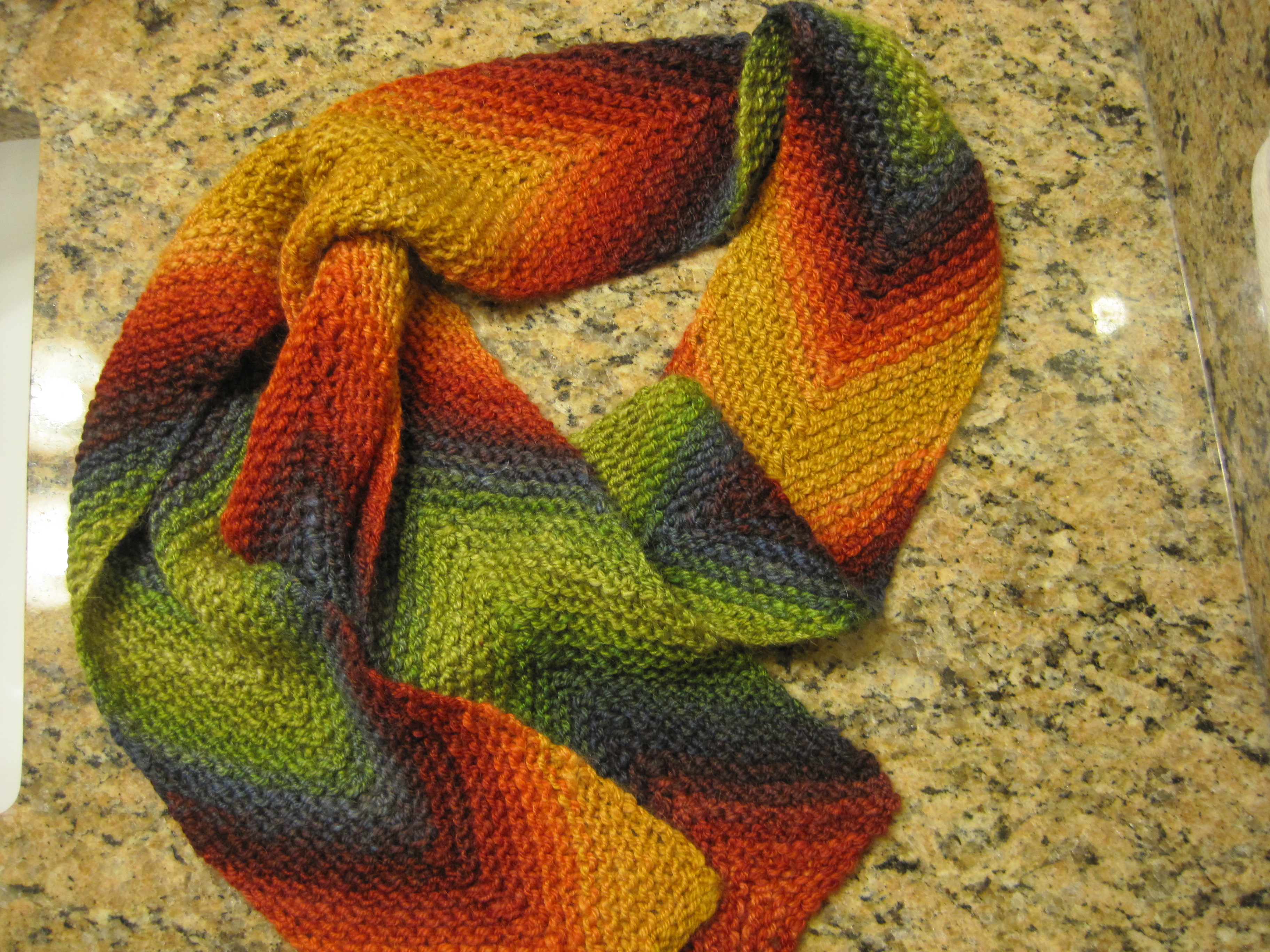
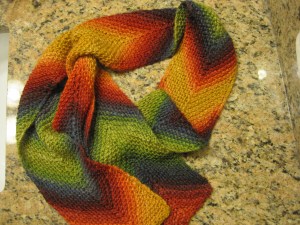
I finished knitting the chevron scarf from yarn I spun from a lovely autumn blend of colours from indie dyer Woolgatherings. The singles were chain-plyed (sometimes called Navaho plying) to keep the colour blocks intact.
IMG_3471

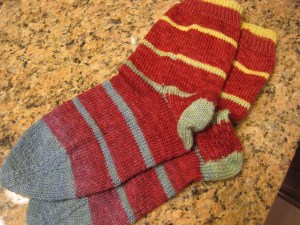
I knit some yummy socks from two balls of wool that were simultaneously dyed through colour gradients in a bucket.  Starting with yellow, additional colours were added as the ends of the two balls of yarn were progressively pulled out of the bucket.  The colours moved from yellow, through green and blue then into purples and finishing with red.  I knit the socks, starting with the yellow from one end, and then the red from the other end of the ball, alternating ends of the ball, and ending somewhere in the middle.  If you haven’t tried bucket dyeing, you should put it on your dyeing bucket list!
IMG_3466

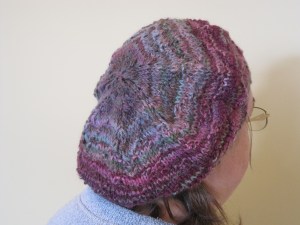
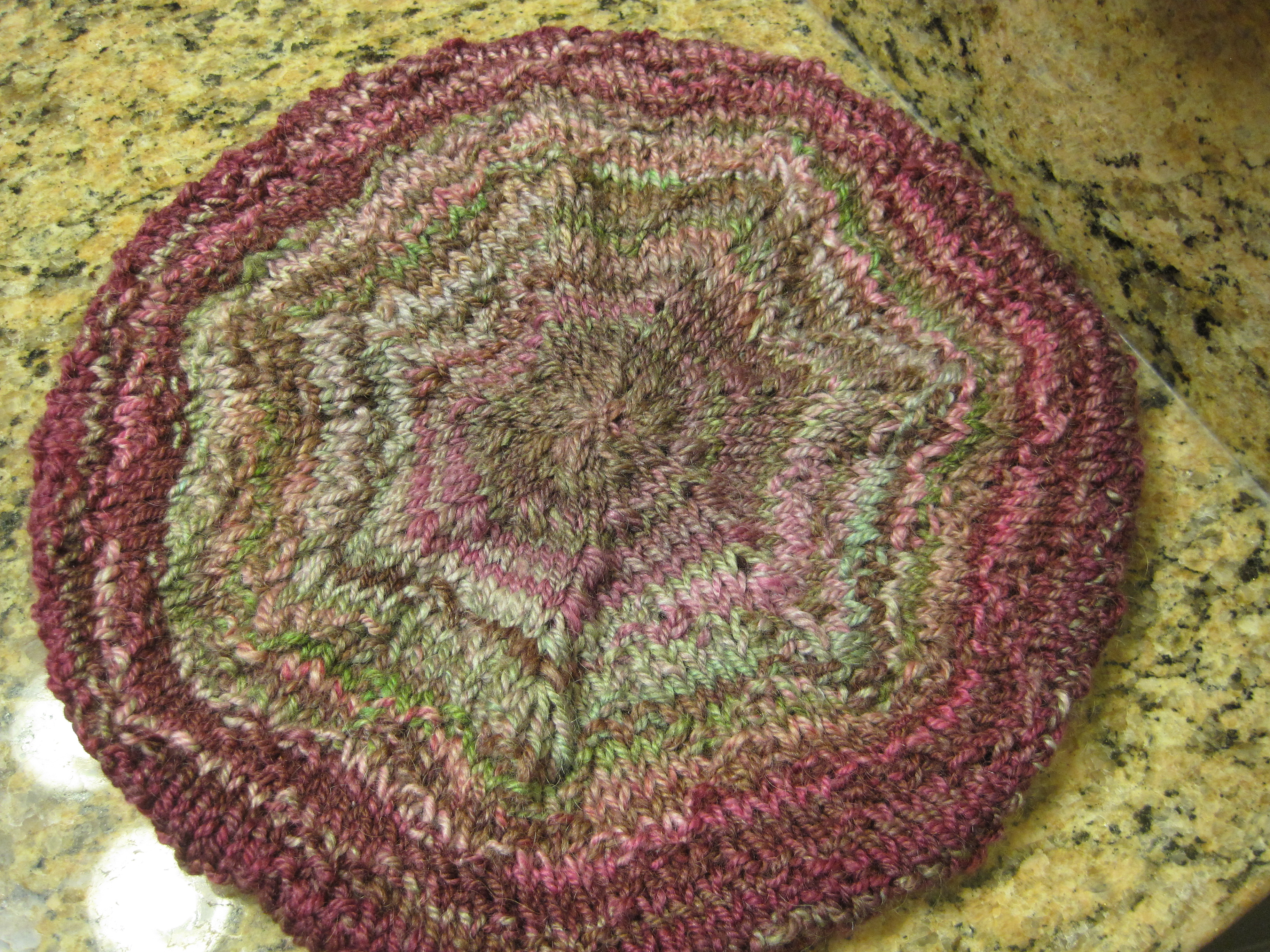
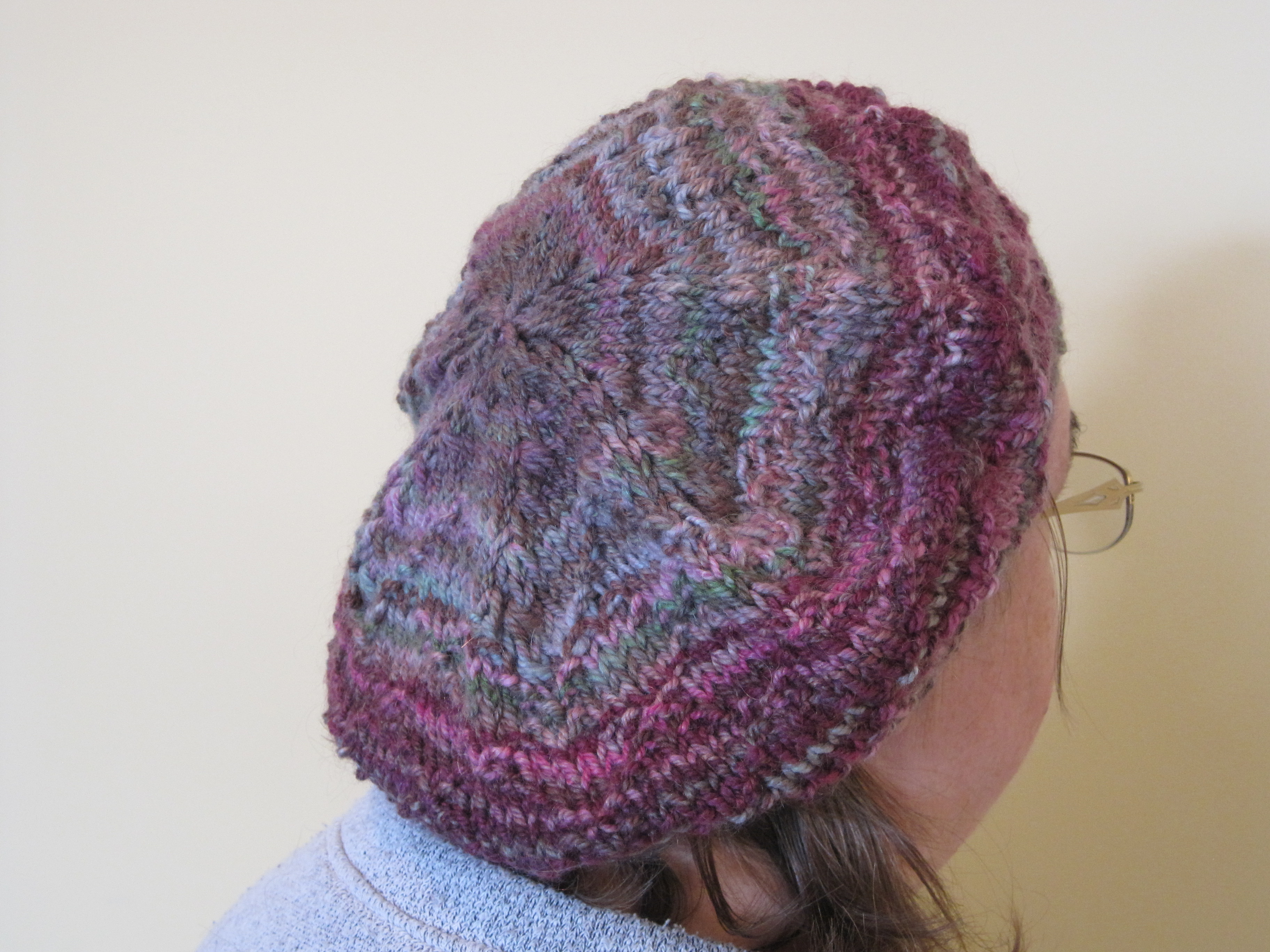
And finally, a funky slouch tam knit from  a three-ply yarn I spun – fibre from West Coast Colour and Carding P.M.S. – Polworth wool, Mohair, and Silk.  The pattern is Classic Elite Yarns Diamond Cap from Ravelry.  The diamond pattern is a little obscured by the colour changes, but the texture is there.
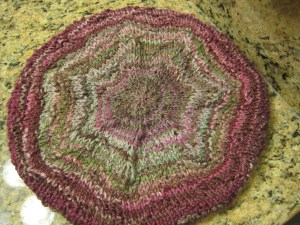
IMG_3467 IMG_3468;

So, if I missed you this month, this is where I’ve been!
Posted in Uncategorized | Tagged , , , , , , , , , , , , , | 3 Comments