It all started with Karaoke

As Karl Lagerfeld has said, “Some things never go out of fashion in the world of fashion: jeans, the white shirt, and the Chanel jacket.”

Ahh, the Chanel Jacket.  It’s classic, reported to be comfortable and easy to wear, and I have been dreaming of owning one for years.  This is the year I am going to make it a reality, and sew a Chanel-style jacket out of my own handwoven fabric.

This is really going to be a long-term project that I started over a year ago.  I examined the tweed fabrics in the Linton Tweeds catalogue.  I searched the internet and looked at examples of Chanel jackets.  I knew I wanted to create a unique tweed fabric.

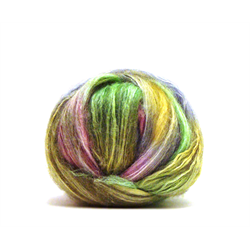
This is where it all began.  My fabric started with a ½ pound of fibre from Louet, called Karaoke in the Parrotfish colourway, in mainly greens and pinks,  50% Soysilk / 50% wool.
Karaoke Parrotfish


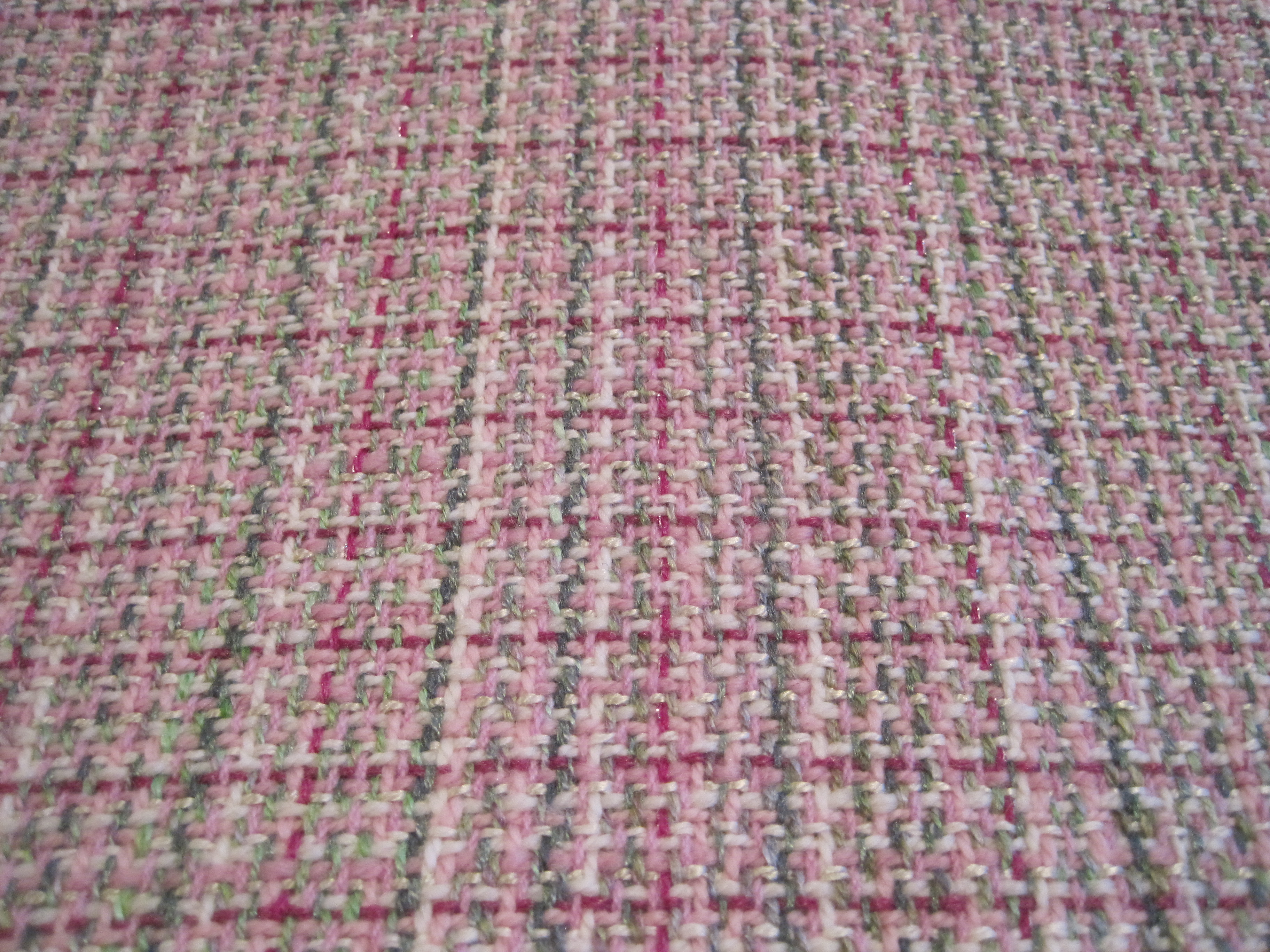
I spun it into a beautiful silky 2 ply yarn.  I carried a sample of the yarn around with me to conferences, spin-ins and events.  I added and spun 100 grams of pink Corridale.  I unravelled, unplyed and re-plyed the yarn from a fine cashmere sweater I found at a thrift store.  I found some green silk, and some lighter green bamboo, some fine white and pink wool, and dark green wool, a natural silk yarn, a tiny bit of silver sparkle.  I added in some Zephr wool/silk in a colour called Chanel, a beautiful dark purple-pink.  Of course, I had to include this, how could I not?.    I bought the pattern – Vogue 8804, and measured out the pattern pieces in my size to determine the yardage requirements.  My fabric would need to finish to 9 yards long, 22 inches wide.

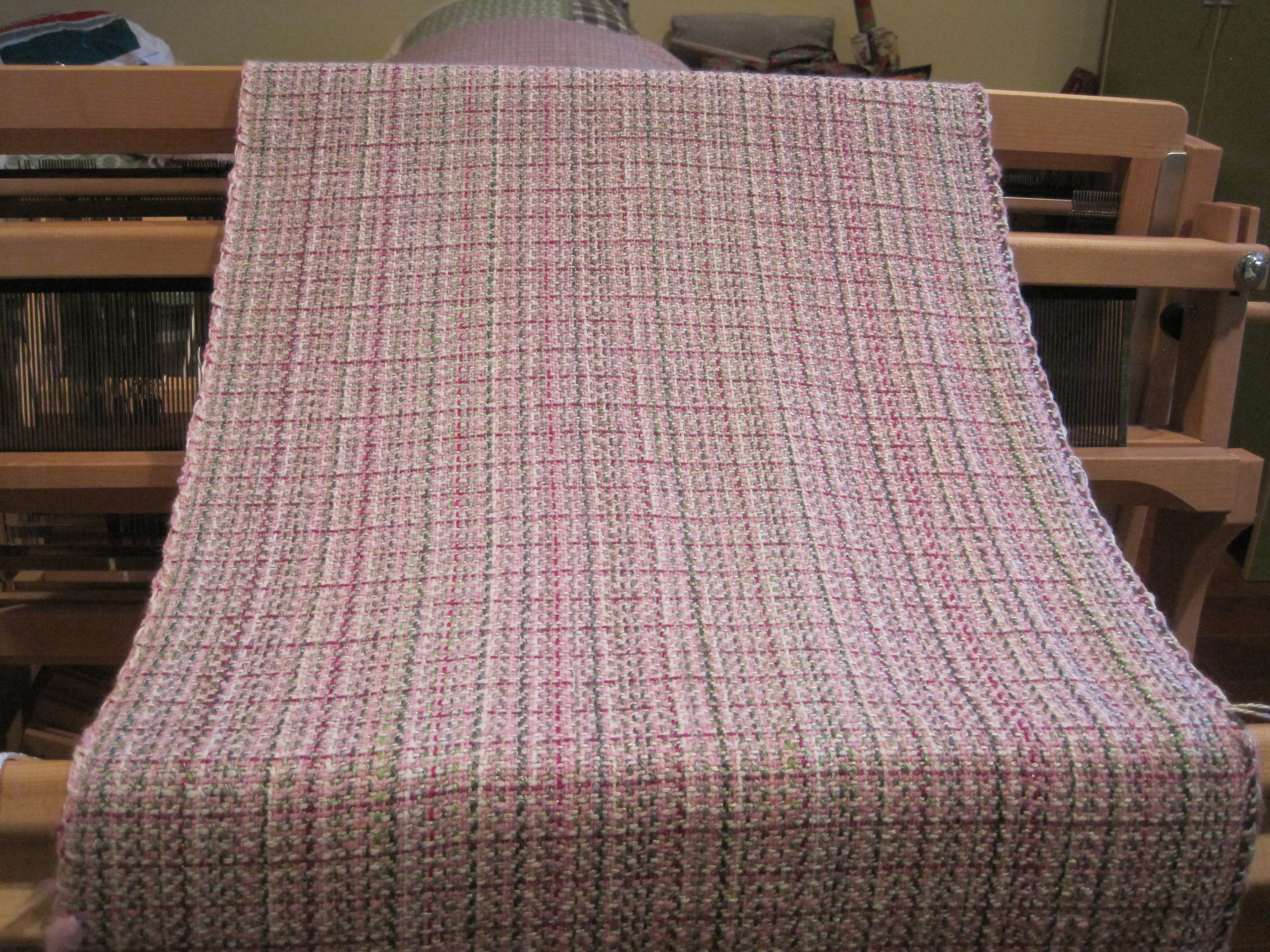
I had about 50-100 grams each of about 10 yarns, including the handspun yarns to use in the fabric.  In order to maximize my yarns, I made separate warp chains, 10 yards long, from each yarn to determine how many ends I had of each one.  I then took each warp chain to the loom, and randomly sleyed them through the reed to 20 ends per inch.  From the reed I threaded in a broken twill pattern, tied on to the back beam and wound on.  So, yes, this was threaded front to back.  Because of the warp chains layered on top of each other, it did take longer to wind on, but I had very little breakage, thank goodness, because I had very little extra yarn.

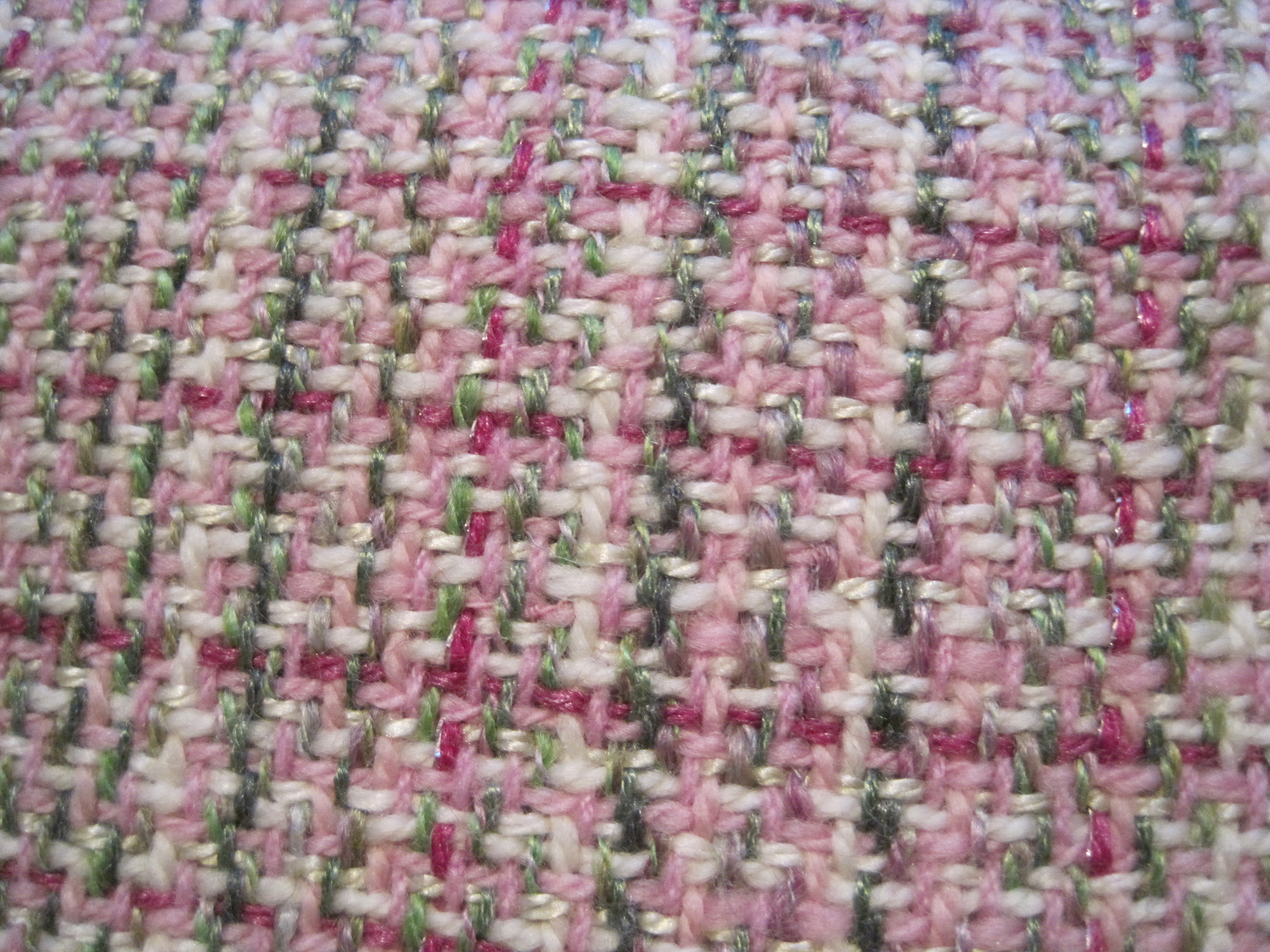
I wove the yardage with a regular repeat of six threads: white wool, white silk, pink wool, pink handspun wool, green bamboo, interrupted by the Zephr wool/silk every tenth shot.  It was very slow weaving, with so many weft threads going – It seemed to take forever!  I started weaving January 2013, just before I left for Australia, and finally finished this January, 2014.

Here, then, is the finished fabric.
IMG_1653  IMG_1656 IMG_1657

Next steps:  Learn couture sewing methods, create a coordinating braid, sew and fit a toile, hope it all works out.  Like I said, this is going to be a long-term project.
Posted in Spinning, Weaving | Tagged , , , , , , , , , | 5 Comments

Ontario in January

We just returned from a week in Ontario.  It was bitterly cold and blowing snow.  This is not normally where I would choose to vacation in January, but my husband, daughter and I went to attend the memorial service for my mother-in-law, Nora McIlvenna, who passed  away on November 2, 2013, in Brantford, Ontario.  It was beautiful to spend time with family and friends who knew and loved Nora.  The service was friendly and down-to-Earth, just as Nora was.  Although it was sad to say our finale good-byes,  we leave with the knowledge that she lived a full life, happy in the devotion to her family.

We returned to BC with a fuller appreciation of enjoying each day we are given to our fullest capacity.  The weather here has cooperated, with sunny blue skies and warmer afternoons around 10 degrees, following the morning fogs.  The grass is green and growing, and the hyacinth bulbs have sprouted.  They may get a rude awakening next week when temperatures will fall again, closer to zero.  Finally, I am ready to move into this new year of 2014 with appreciative anticipation.  Later this week I will post more about my weaving and spinning adventures.

Posted in Essays | Tagged , , , | Leave a comment

First Weaving of 2014 Completed!

I just finished my first weaving of 2014!

A year ago I was preparing to go and live in Australia for ten months.  A lot happened in 2013; some of it good and some of it sad, but Western Australia captured my heart, and helped me see the world through a different lens.  Certainly the colours of Australia captivate – so bright and sparkling, with reds and oranges and colours of the earth predominating.  I wanted to weave something that I could hang on my wall, and that would make me smile and transport me back to a place I was happy to call my second home.

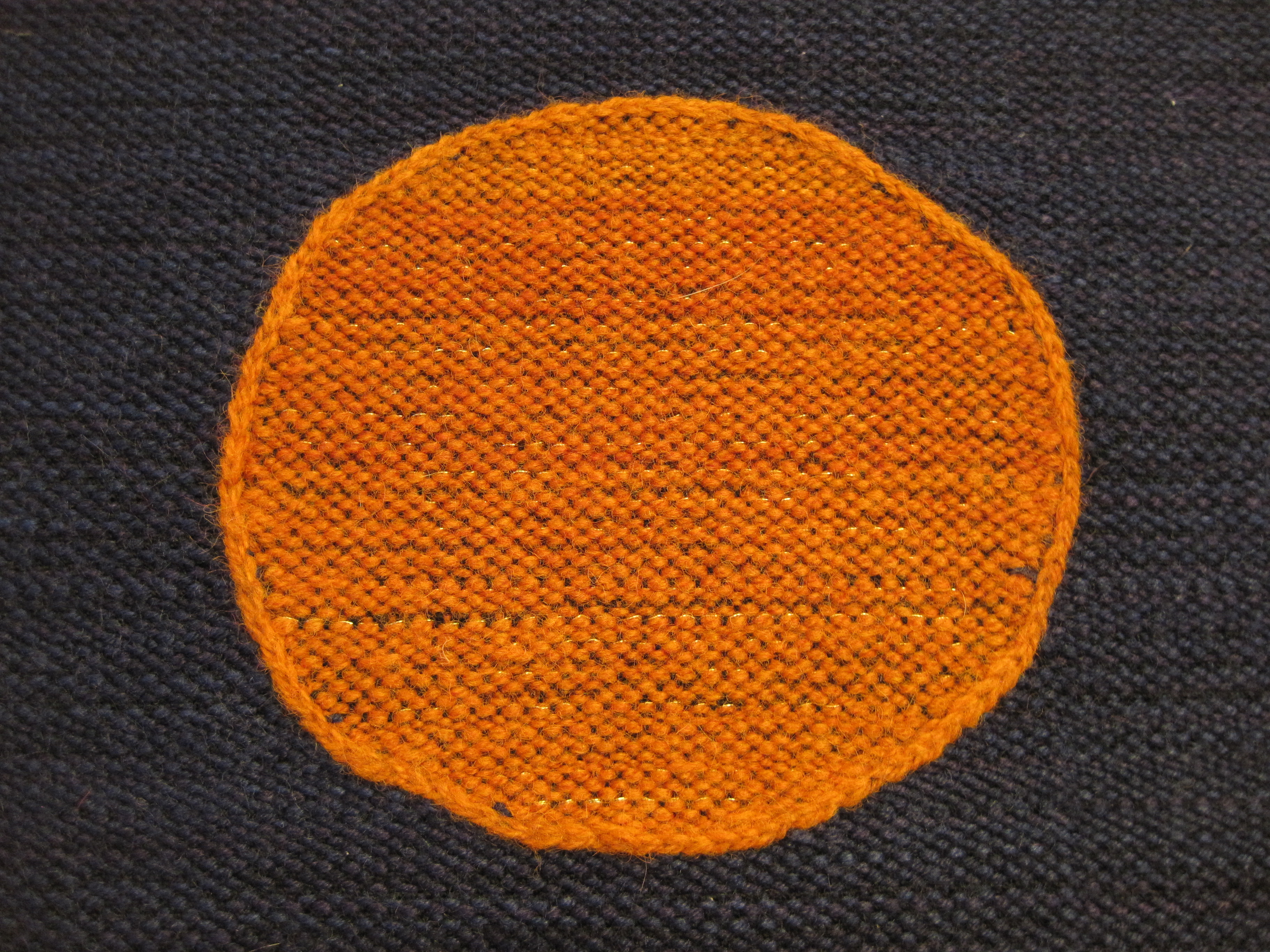
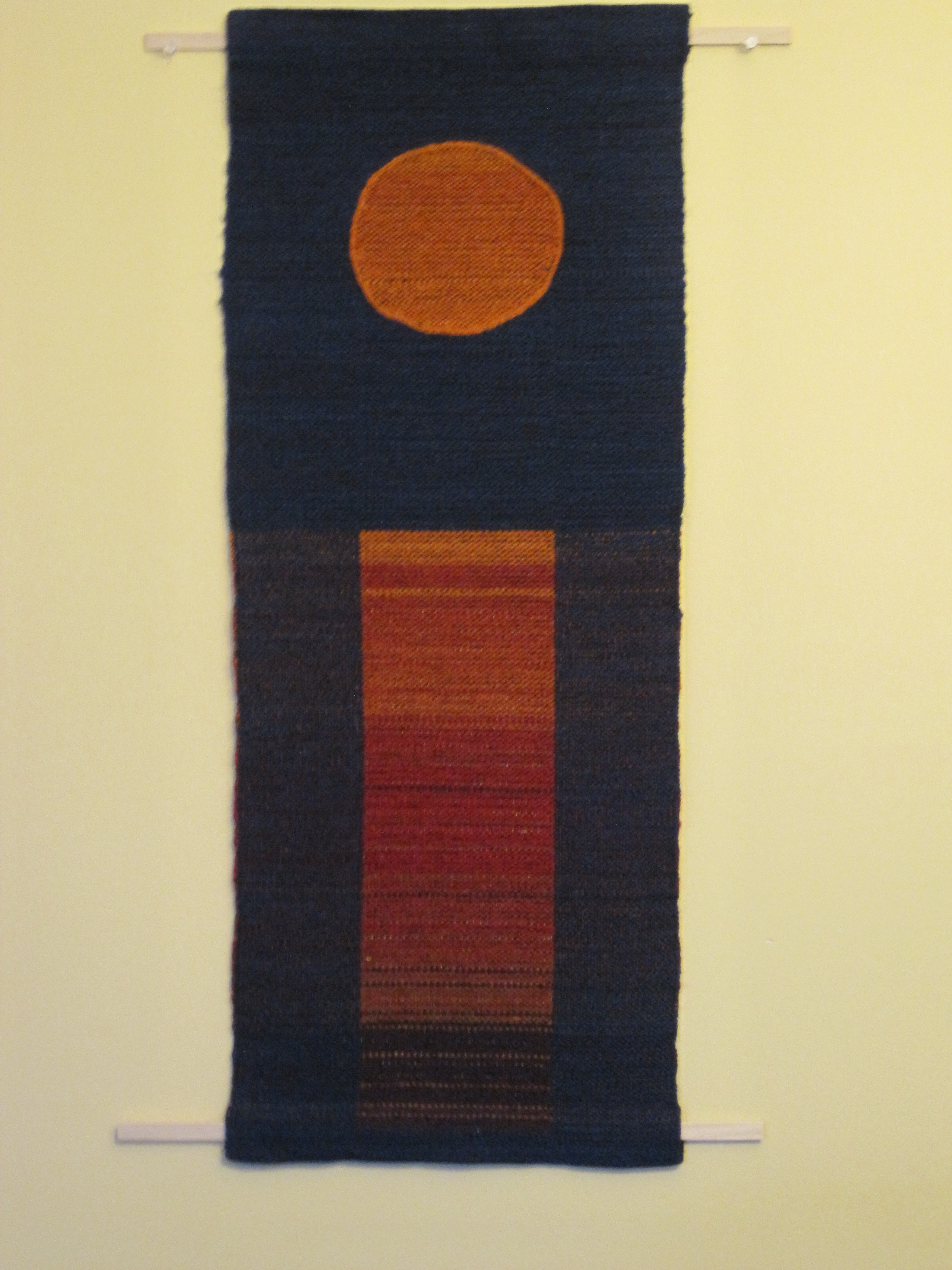
This is a woven interpretation of the iconic “Stairway to the Moon”, much photographed, near Broome, Western Australia.  I am an Aries, a “Fire Sign”, but water always calms me.  To see the sun or the moon reflected in the water fills me with both joy and wonder – such magnificent forces in the universe that came together to create this wonderful earth on which we live.  This, then, is my interpretation of the full moon rising over the horizon, big and bold,  and reflecting in the tidal flats.  It truly is a wonderful world.

IMG_1635

Technical information for other weavers:

The image is derived from photographic images of the Stairway to the Moon;  Google “Stairway to the moon” to see some brilliant examples.  I wanted to experiment with using knitting yarns in my weaving, particularly sock yarns and yarns with long colour changes.  The yarns I chose to experiment with are Trekking XXL sock yarn in a very subtle colour change variegation of navy, midnight blue and indigo purple, which I used for the sky and the water in shadows.  For the moon and the reflection, I used Kauni wool from Denmark, which is sold locally.  It has very long and blended colour changes, which I manipulated to get to the colours exactly where I wanted.  I started with purples at the bottom, moving up through the reds and finishing with the oranges.  The moon is inlaid in the weaving, and finished with a chain stitch circumference.

IMG_1637  IMG_1638

The weave structure is a very simple two-block Summer and Winter, used without tabby (on opposites),  Block A on the edges, and Block B for the moon and its reflection.  Two shuttles were used for each row, blue for the water and sky, and variegated for the moon and the reflection.  I added a very fine gold metallic randomly, on top of the variegated yarns to represent the sparkle of the moon on the water.  The moon is finished with chain stitch around the circumference.

The warp was set 14 inches in the reed, and woven to 36 inches long.  The finished hanging is 12 inches wide by 32 inches long.

Posted in Uncategorized, Weaving | Tagged , , , | 2 Comments

Why Weave on a Winter Solstice?

Tomorrow is Winter Solstice, the shortest day of the year.  Today it is snowing.   As I look at the snowy trees outside my window, sipping a warm cup of tea, I am thankful for the warmth of central heating inside the house, and the beauty of the snowy landscape in front of my eyes.  My thoughts drift back to our ancestors for whom the first days of winter meant a hope that enough food was put away, that there was enough firewood chopped and stacked to last until spring, and that there was an abundance of warm clothing and blankets available to keep their families warm.

IMG_1452


Sometimes the question is asked “What is the value and the purpose of Hand weaving?”  Spinning and hand weaving to create cloth are skills that have been passed down through humankind for thousands of years, and through almost all cultures.  The historical evidence shows that it was, and still is, not just about finding ways to keep our hairless bodies warm and covered, but also in finding ways to decorate our environment and to imbue cloth with religious, spiritual and protective symbols, as well as symbols that appeal to our aesthetic sense of beauty.  Textiles bring purpose and meaning to the rituals and rites of passage in our lives:  we have swaddling cloths and baby blankets, we talk of a boy graduating from short pants to long pants, we wear our “Sunday Best” and our work clothes, we don wedding dresses and business suits, and in the end, we have burial clothes and shrouds.

We weavers also create functional and decorative blankets, pillows, tablecloths, napkins, rugs and other cloths for our household needs.

But why, now, when so much of the process has been industrialized, do we still need handspun, hand woven, handmade textiles?  I think precisely because handwovens appeal to our sensory perceptions, our aesthetics.  The knowledge that this piece of cloth exists through the efforts of our individual hands.  For the maker, weaving is a task with sensory appeal.  We enjoy the visual pleasures of mixing, blending, combining colours in the dyeing, spinning, weaving, forming and embellishment of our textiles; the unique smell of natural fibres – wool, cotton, linen, silk; the tactile sensation of running our hands over the fibres, yarns and cloth – smooth silk, warm wool, fuzzy mohair, crisp linens.  Weavers have a need, an urge, to see and touch the fabric up close – hence the reality of “the weaver’s handshake”.

Weaving also connects us to the earth, and to our collective ancestors who learned the skills from their own ancestors, and passed the skills and knowledge down through each successive generation.   Weaving by hand produces slow cloth.  The act of creating it teaches patience, allows our minds and hearts and breathing to slow down; weaving provides a space for contemplation.

While I thank my ancestors for passing on these skills, I am also very grateful to be a weaver now, where I can weave for pleasure, and do not have to create every single piece of clothing and household linens for my family to use.

To family and friends near and far, I send my wishes for you to have a joyful winter, a Merry Christmas and a Very Happy Holiday season.

Posted in Essays, Weaving | Tagged , , , , , , , , | 1 Comment

December is for Finishing

In December I like to pull out all the unfinished projects in a push to get them to completion before the end of the year, so that I can start the New Year fresh and free.  So far, I have completed the following:

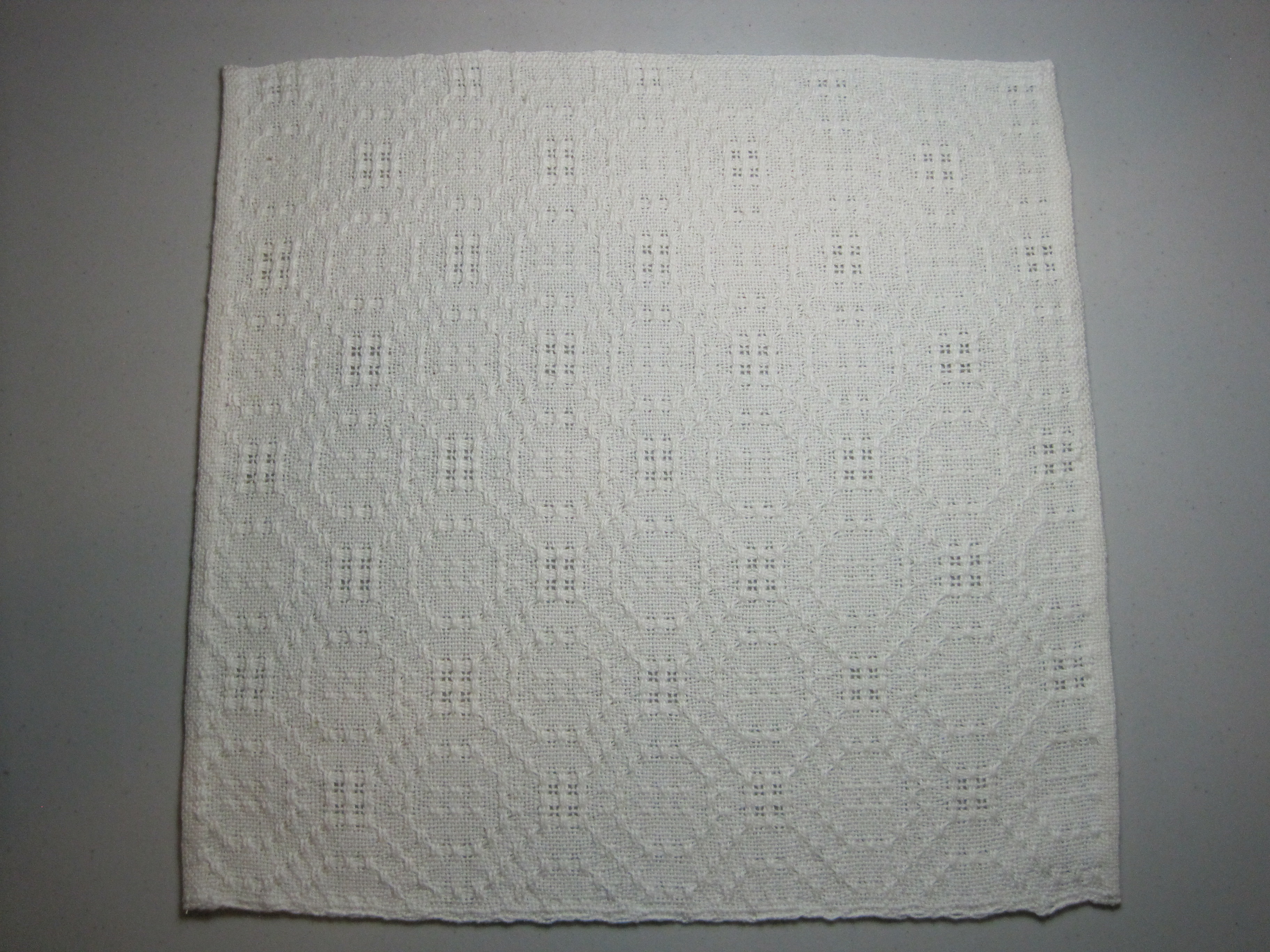
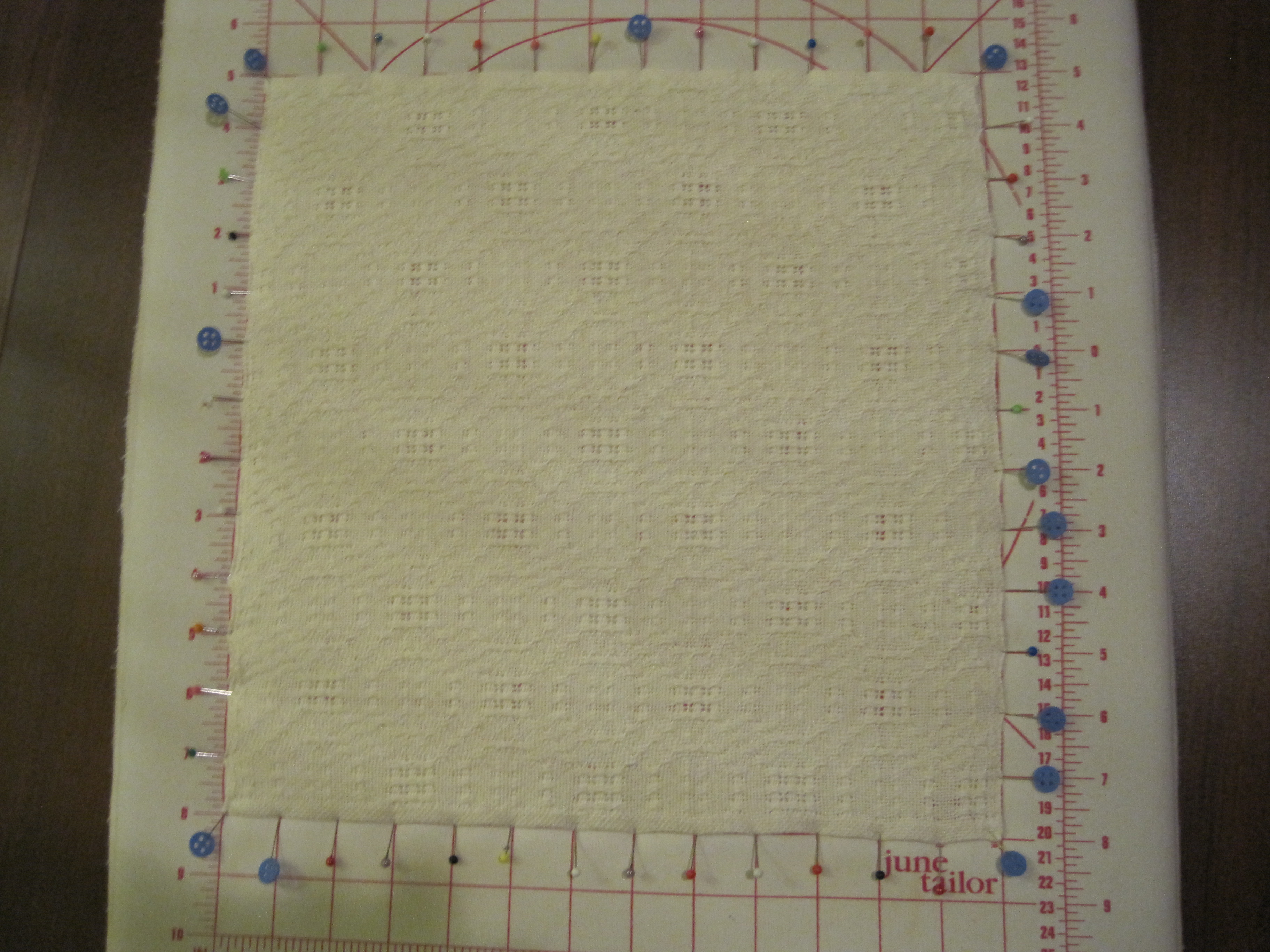
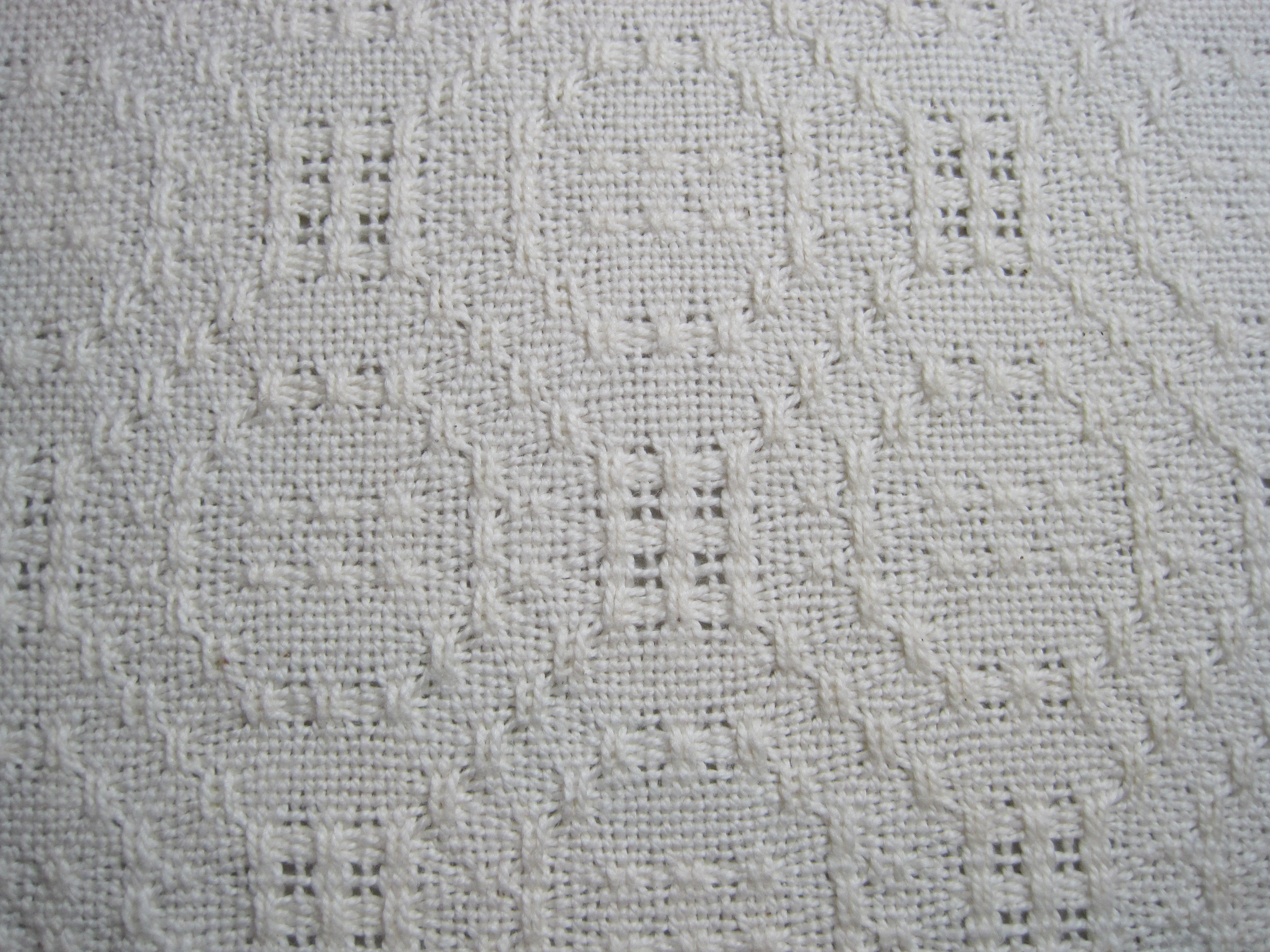
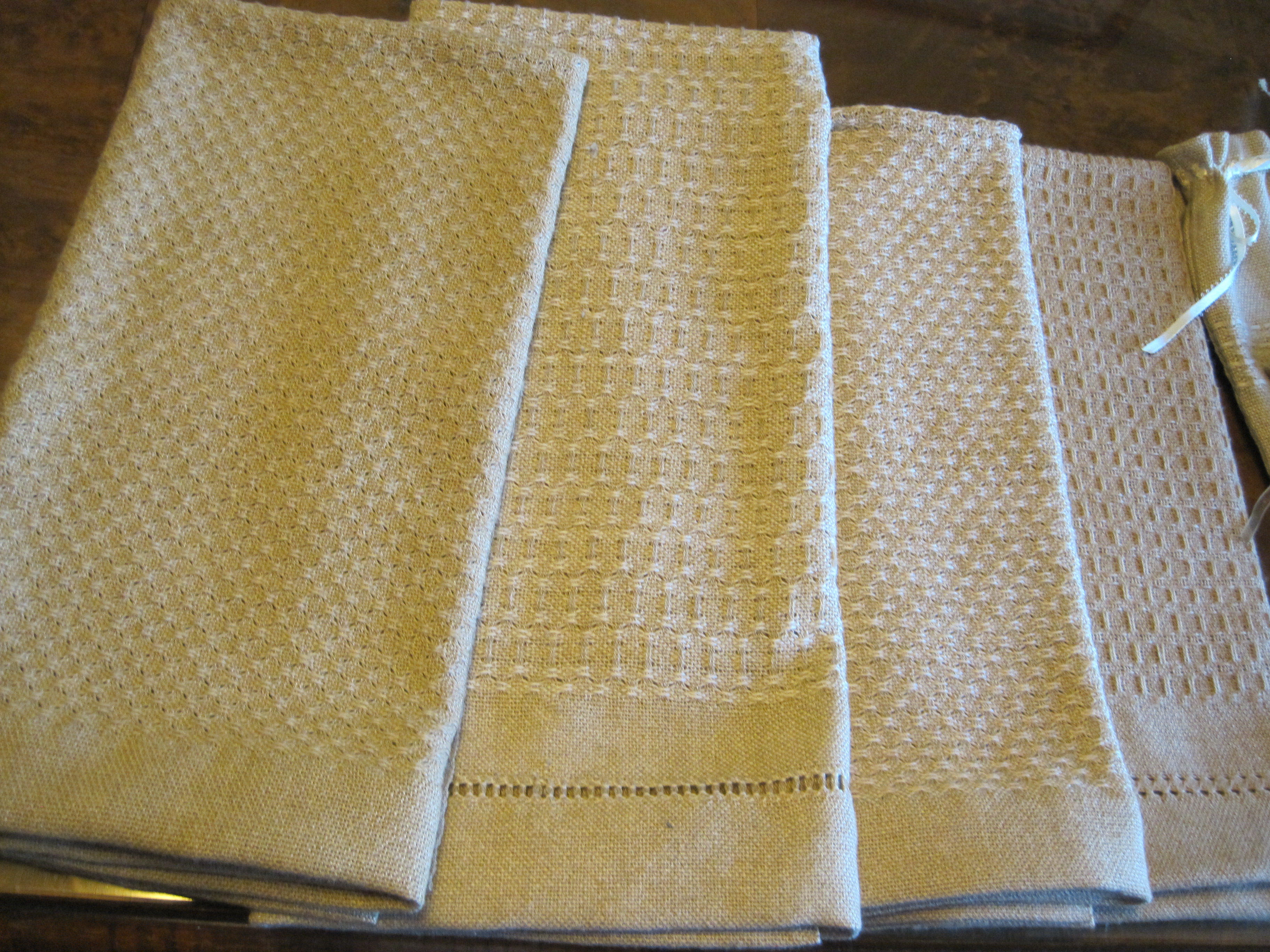
Woven napkinsThese napkins, I wove a while ago, and I just needed to add hems to the set of eight.  The napkins are woven of 2/8 natural cotton, sett at 20 ends per inch, and based on the pattern “Johann D’s No. 32” in Marguerite Porter Davison’s  A Handweaver’sPattern Book, page 97.  Ms. Davison calls this Swedish Lace, but I think it is actually a combination of Bronson Lace and Spot Bronson, because every other thread is on shaft 1.

IMG_1396

Although usually I just hem, wash and iron dry cotton and linen napkins, this time I decided to block them individually to prevent the plain weave hems from flaring out wider than the lace pattern.  I blocked to 13” square, which allows the lace pattern to show to best effect.

IMG_1393  IMG_1395

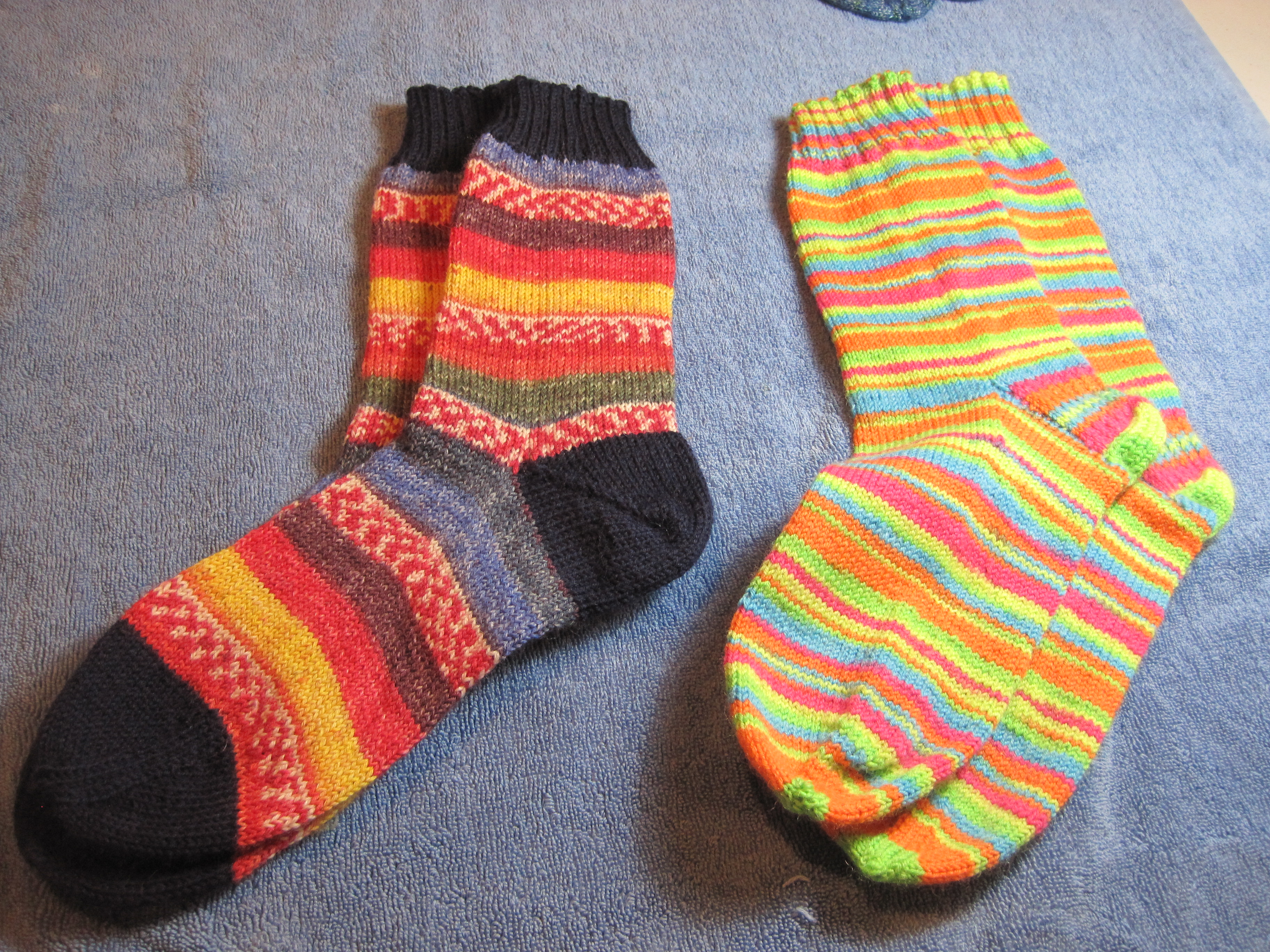
Socks, part 1:  These knit socks just needed to have the toes completed and the ends woven in:

IMG_1398 IMG_1404

Done, done, and done.

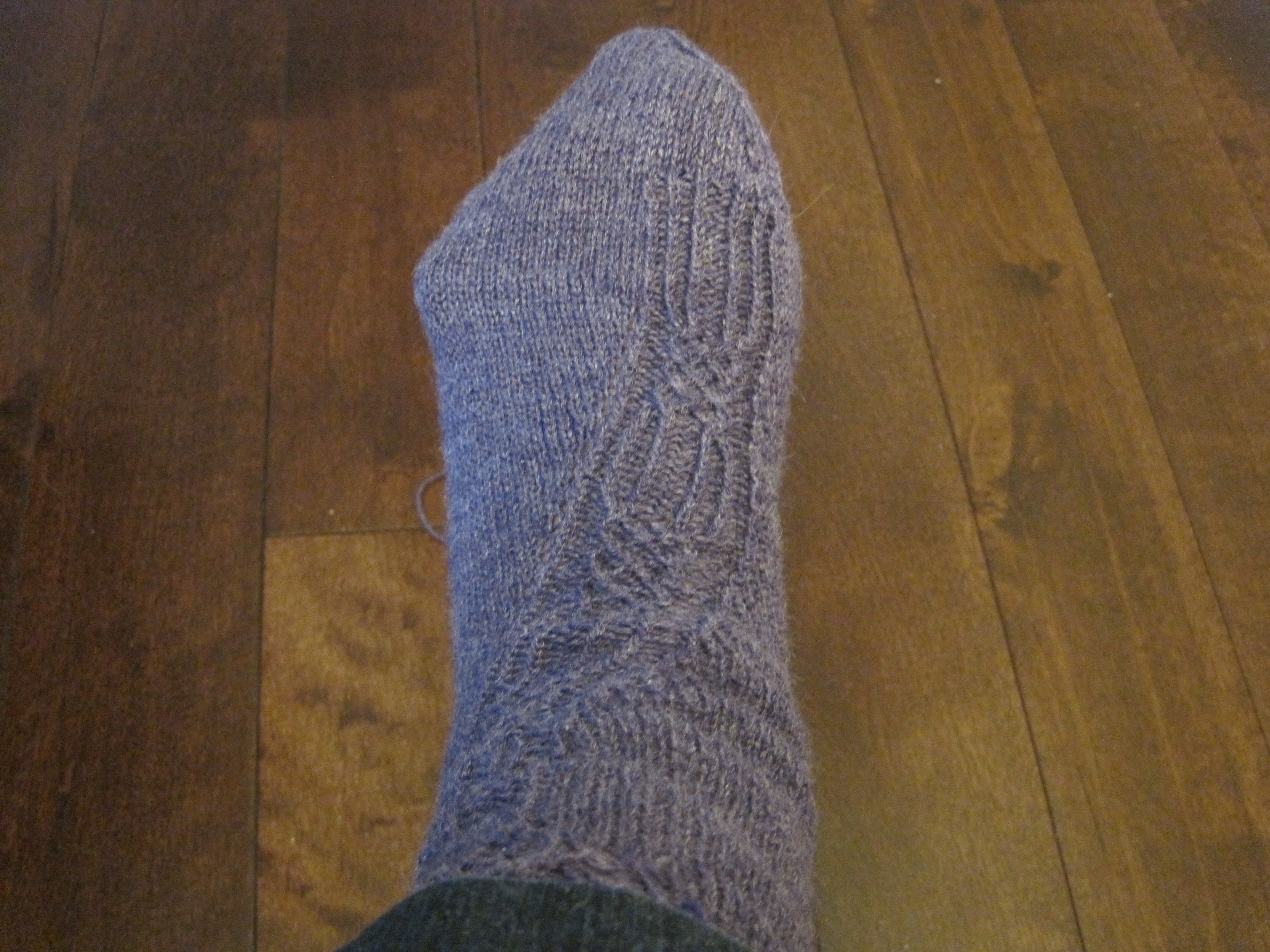
Socks, part 2:  These knit socks, however, proved to be very tight to put on over my heels.  Although they are very pretty, I would probably never wear them because they are so hard to get on and off.

IMG_1406

Funny how I knit the first sock, tried it on and knew it was too tight, but then went ahead and knit the second sock, even still.  Now they have languished in the “to be finished” box for almost a year.  I pulled them out, tried them on again.  Nope, my feet did not shrink over the year.  Reluctantly, I decided to totally rip them out and re-knit on a size larger needle.  This will go back to the new project pile, and therefore doesn’t have to be finished before the end of the year.

I can make up my own rules if I want to.

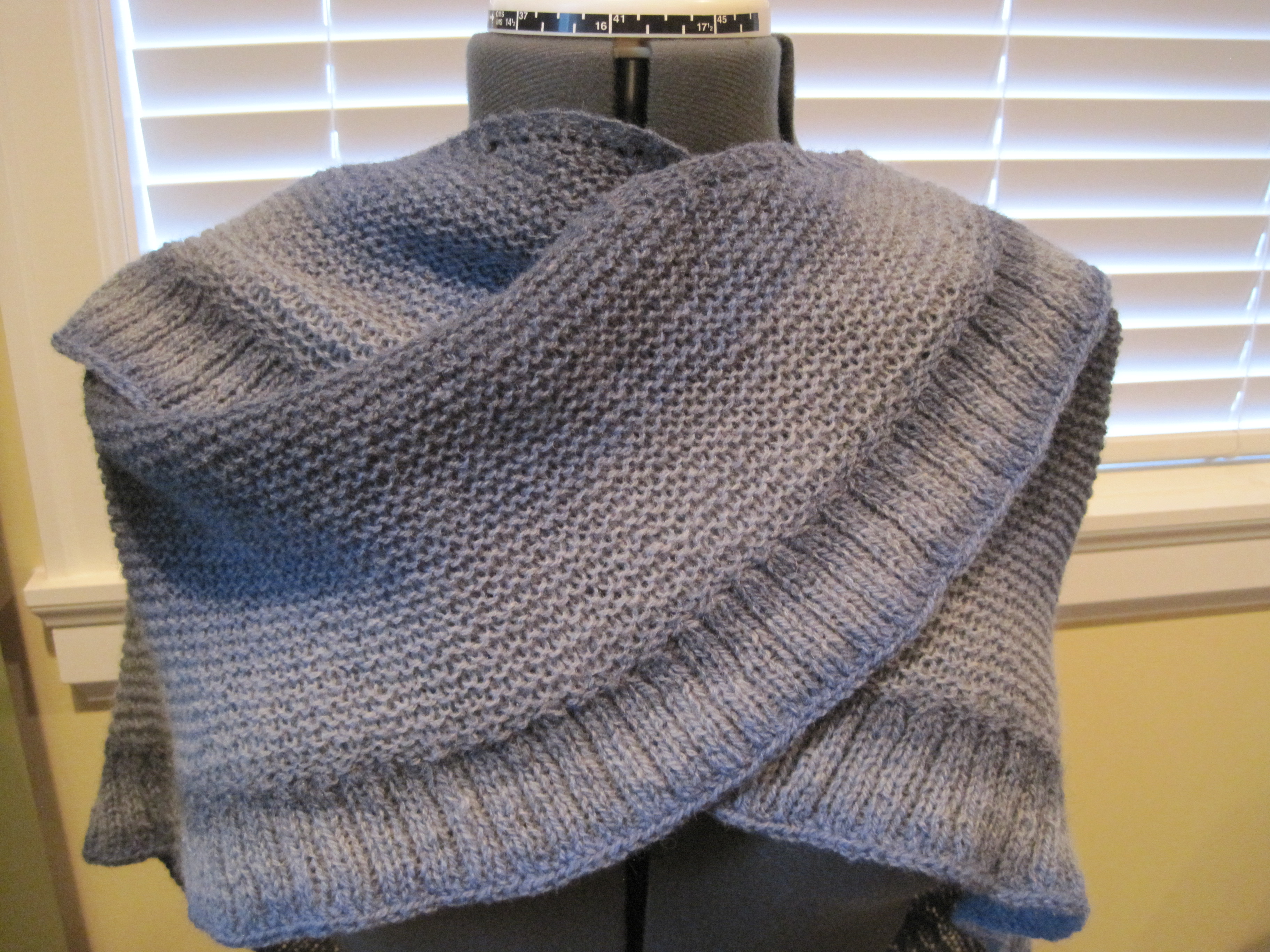
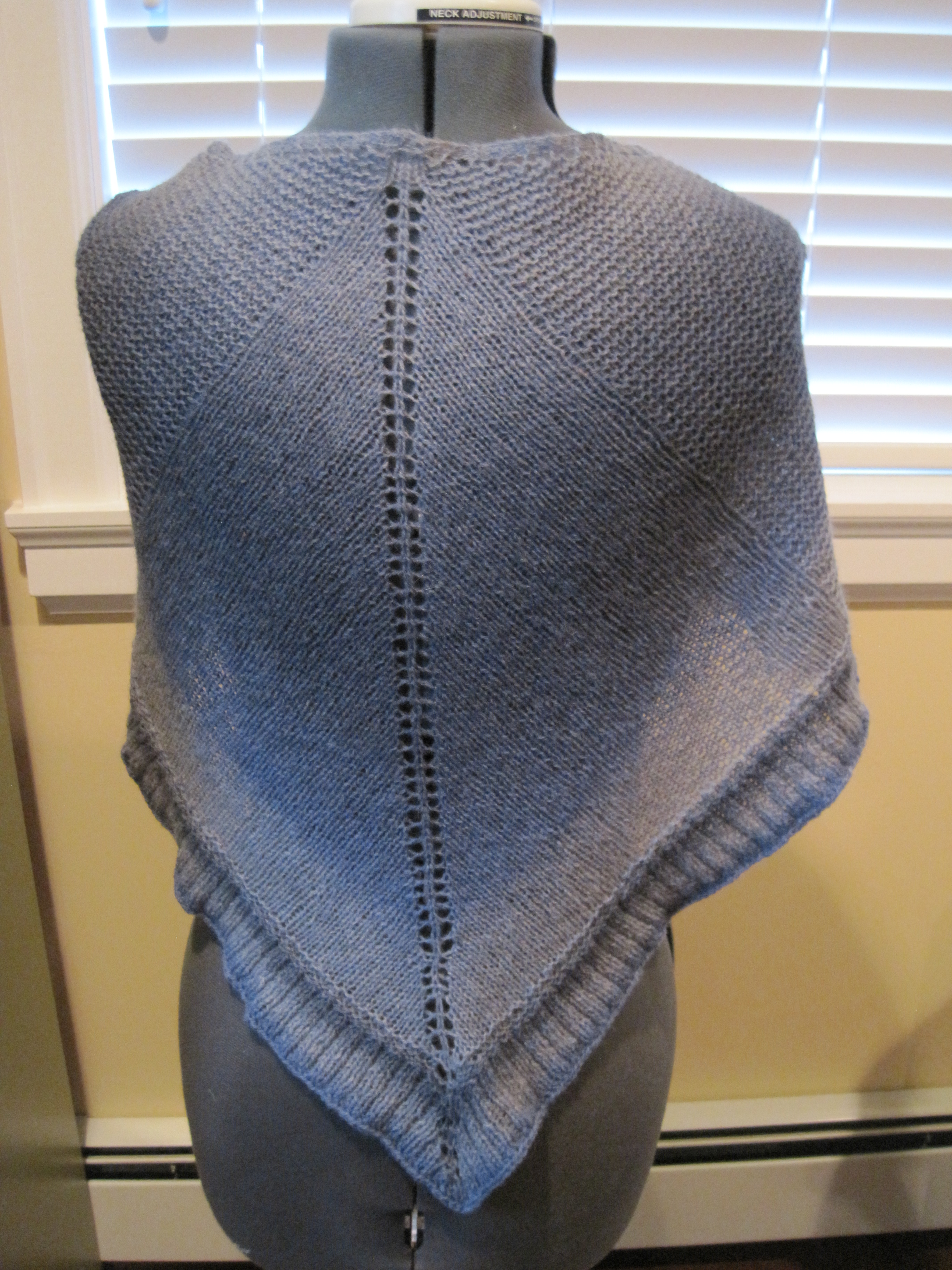
Blue Shawl: Next up, a blue shawl in an ombré wool yarn from Kauni (Denmark) that reminds me of fading blue jeans.  I knit the ribbed edging, then washed and blocked the finished shawl, and I am really pleased with the result.  The shawl is simply knit in garter and stocking stitch, based on the pattern “Flamboyan” from Stephen West.

IMG_1400 IMG_1401 IMG_1403

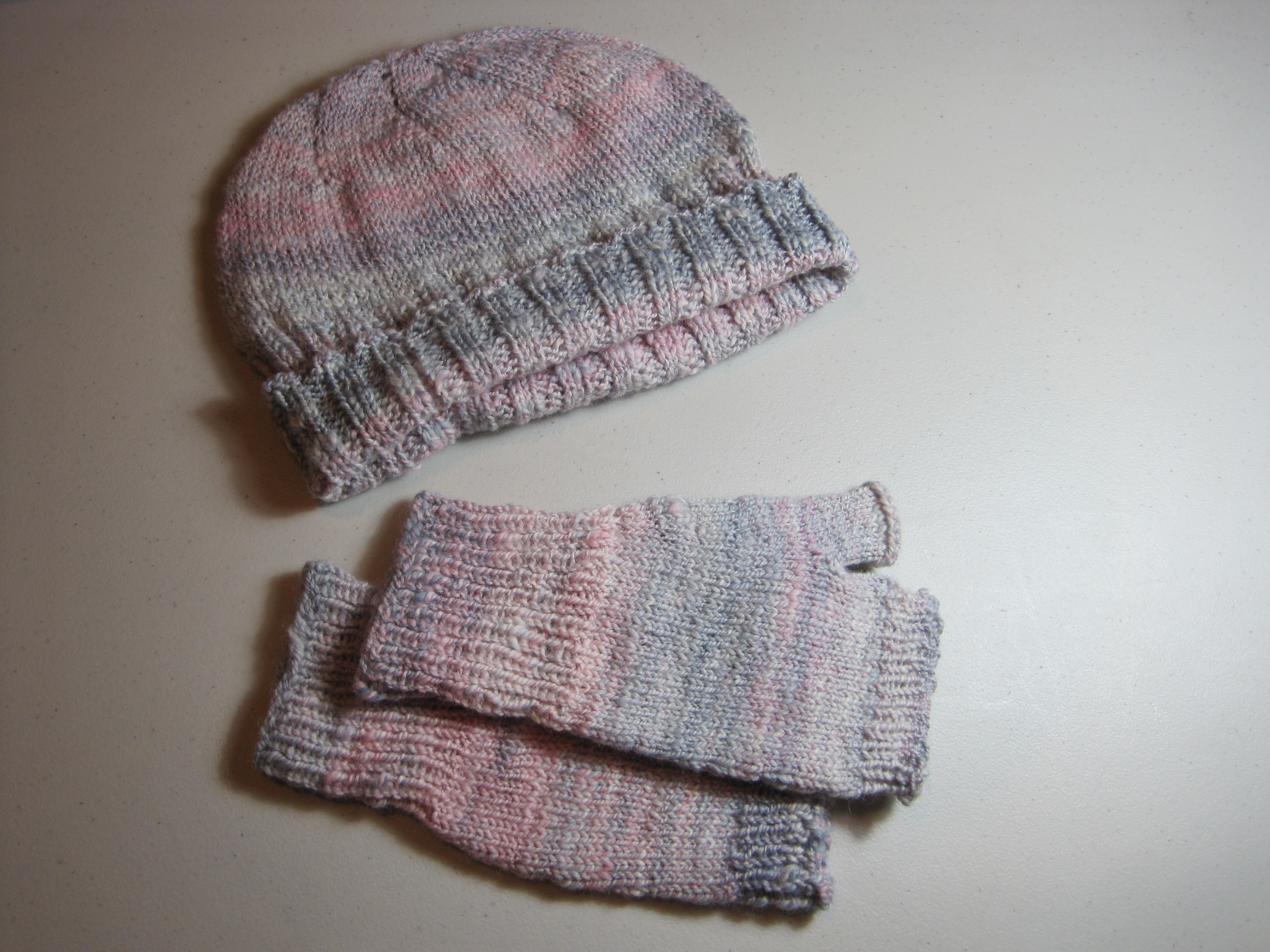
Cap and Mitts

Finally, I completed the Watch Cap and Fingerless mitts from my own handspun yarn.  These are international – spun in Australia, knit in Canada.

IMG_1405


Posted in Weaving | Tagged , | 3 Comments

Weaving is Fun

So much fun to be weaving again and having the projects turn out the way they are supposed to.

I recently completed these Huck Lace tea towels on my four shaft floor loom.

IMG_1387


These are woven of naturally coloured cotton from FoxFibre in four different colours.  The warp is dark green, and the wefts are dark brown, light brown, light green and dark green.  I love how the colours deepen with washing, and the drape on these towels is amazing.  These are sett at 20 ends per inch and woven at 20 picks per inch.  The cotton is a 2/12 weight.

At the end of the warp I wove six little gift bags, a good size for special jewelry, or to add sachet for the drawers.

IMG_1388


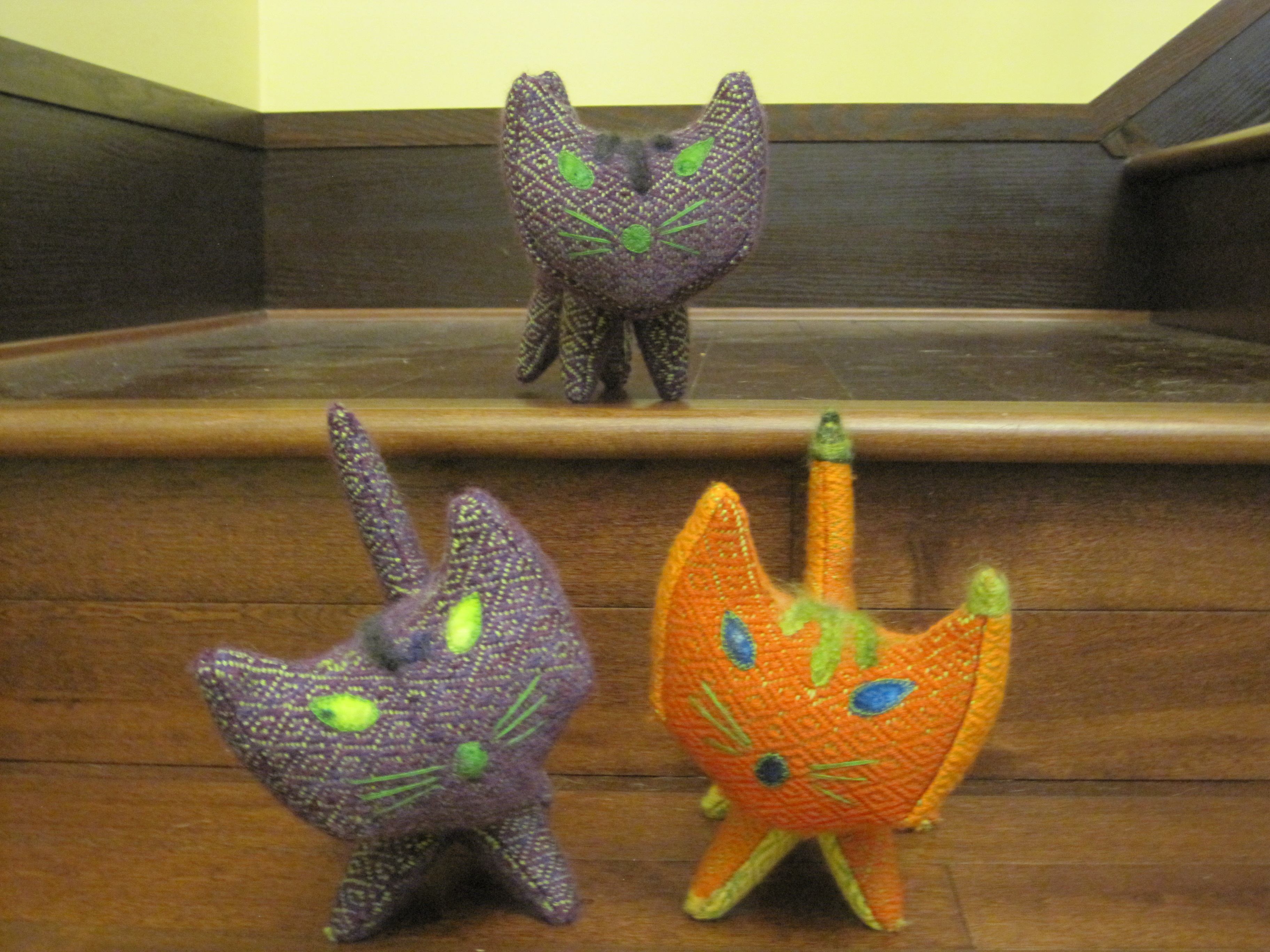
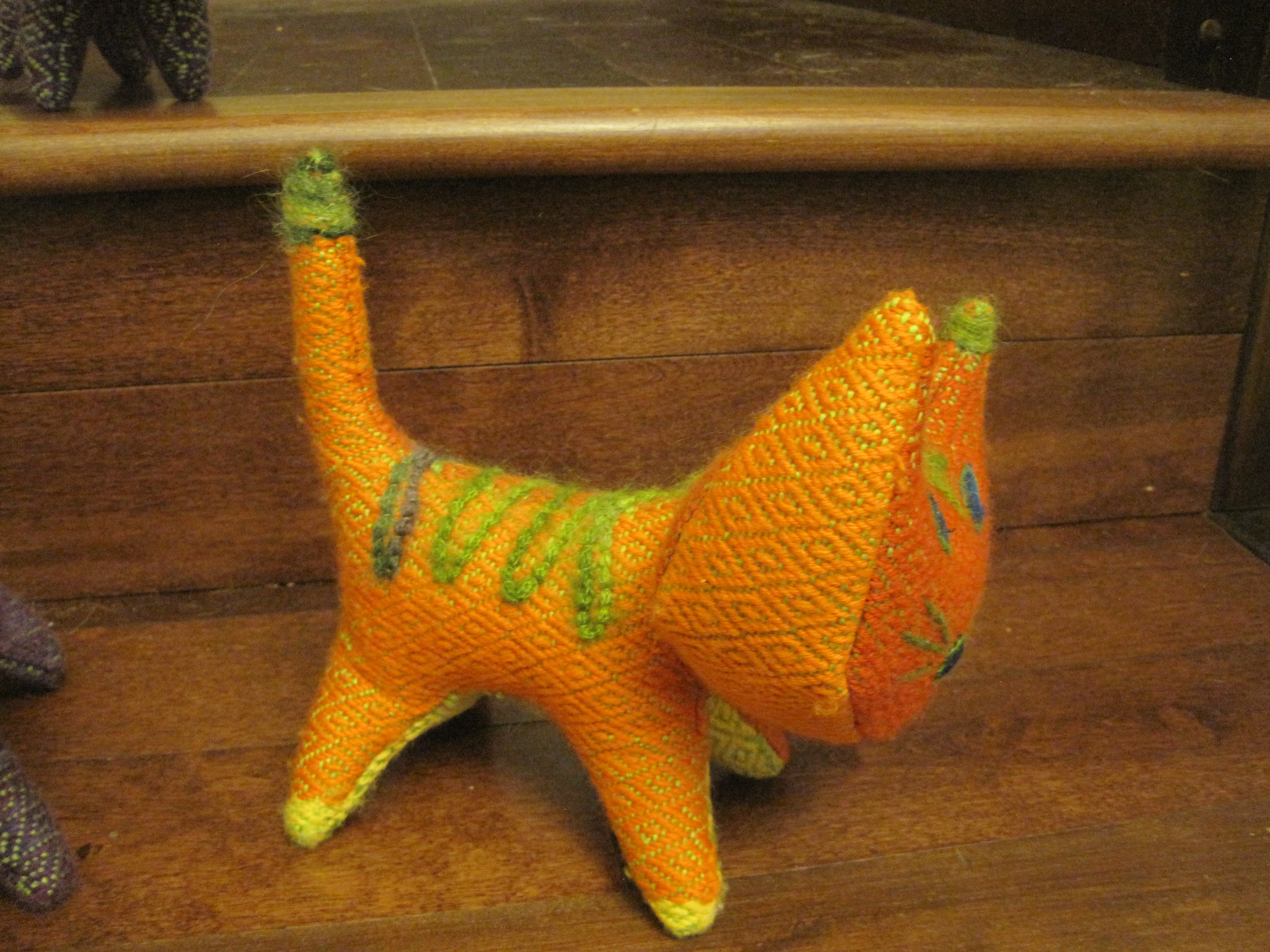
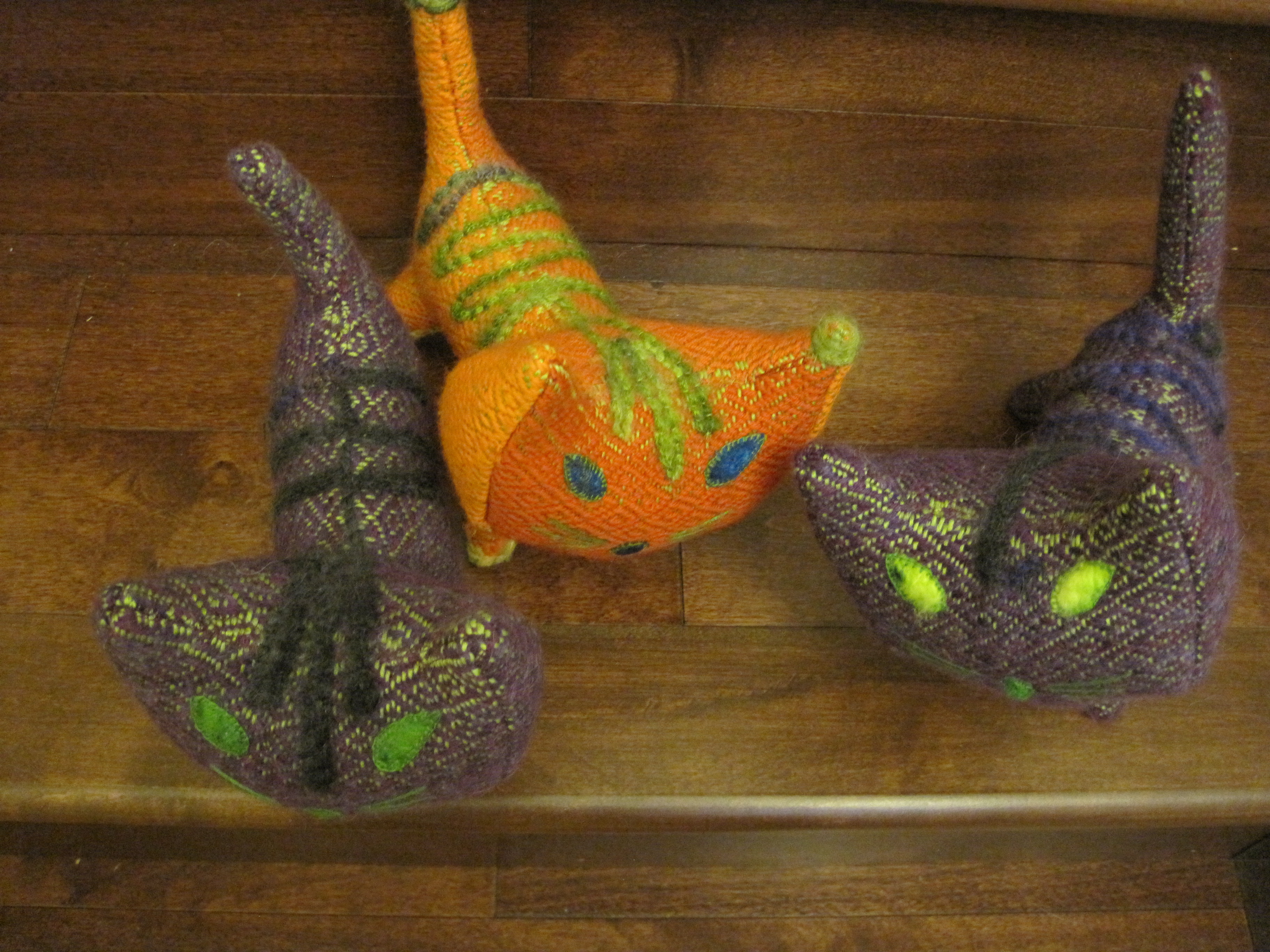
Also fun, my house is being visited by a plethora of colourful handwoven cats, in response to the Coquitlam Guild challenge.  In the challenge we were given a small amount of luxury yarn, (kid silk haze in purple, brown and green multi-coloured yarn) and a silk cocoon, and needed to incorporate these into a weaving (or spinning) project inspired by the painting “A Plethora of Cats” by Dr. Seuss (Theodor Geisel). And so these cats were born.  The bodies are made of a handwoven cats eyes pattern, the luxury yarn forms pattern stripes on the cats backs. The silk cocoon was dyed and cut up for the cat’s eyes and noses.  Just too much fun!

IMG_1370  IMG_1372  IMG_1376

Posted in Weaving | Tagged , , , , , | 1 Comment

Whonnock Weavers and 2 new scarves

Yesterday I attended the Whonnock Weavers and Spinners Guild Annual Show and Sale.  This event stands out for several reasons.  First, the venue is spectacular!  The Whonnock Lake Centre is located in Whonnock Lake Park, and the room has lovely big windows that look out over the lake and let in the sunshine to brighten up the room with natural light.  Although not a super huge room, the items for display and sale are laid out on tables of varying height, with enough room to walk around in between, and get a good look at everything.  In addition to the weavers and spinners, the guild invites other craft artists in woodworking, pottery, jewellery and glass making, so there really is something for everybody.  As the goods are snapped up the guild volunteers rearrange the items on the tables so the second walk around I see things I missed the first time.  The guild also offers tea and cookies and a place to sit and chat with friends.  I came away with a beautiful pottery serving bowl and a skein of luxurious handspun silk.  How could I want for a better way to spend a sunny Sunday, than a drive in the country, a chat with friends, and a purchase of handmade gifts?  Beats mall shopping any day.

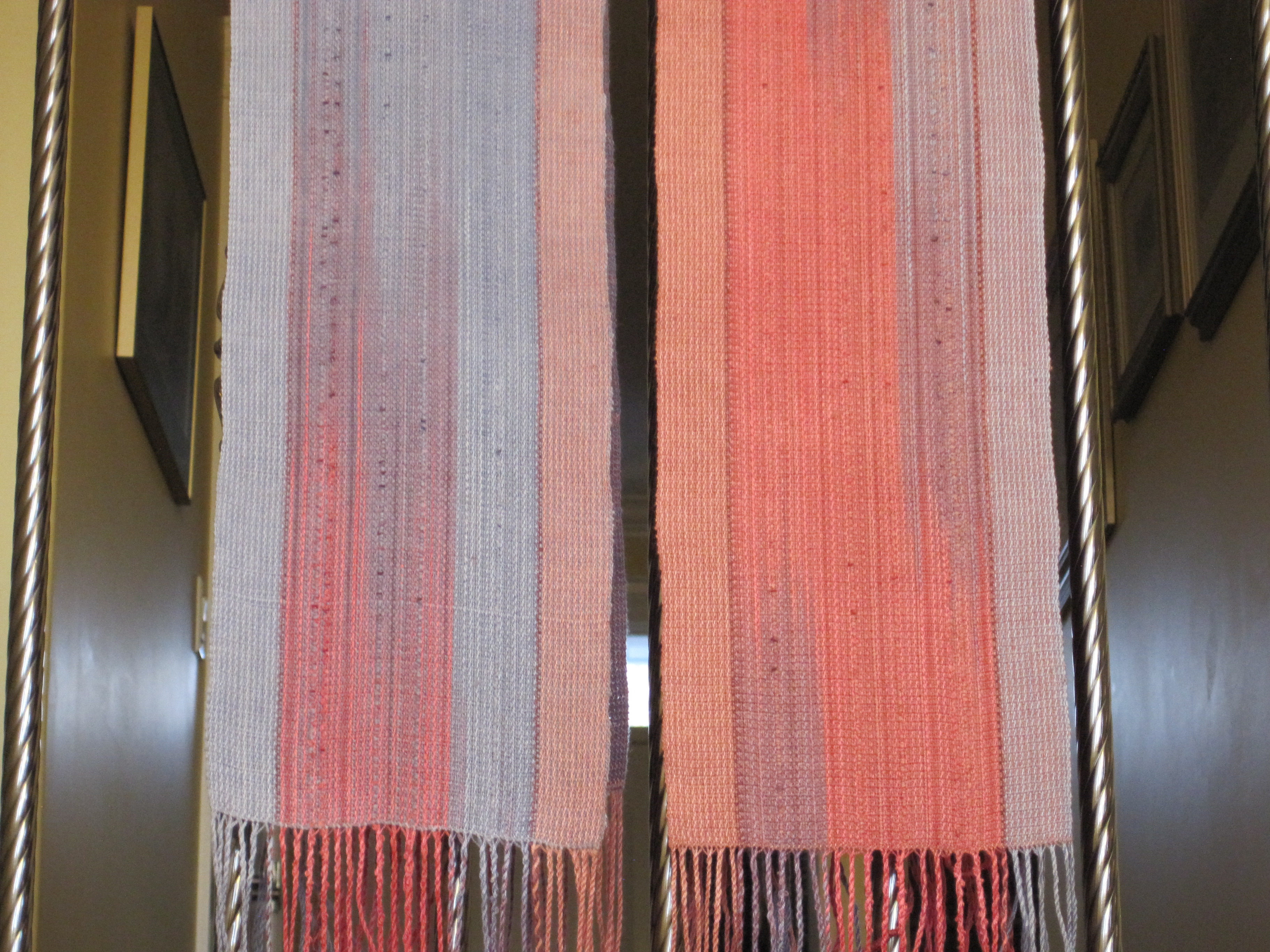
The silk scarves you peeked at last post are now completed, washed and ironed and ready for sale.  The warp is composed of a variety of weights of silk yarns, including silk boucle.  The yarn was dip dyed in reds and blues.  The weft yarns were dyed at the same time.  The weft for the blue scarf is a fine, 2 ply bombyx silk, and the weft for the pink scarf is a fine 2 ply tussah.

IMG_1384

Posted in Weaving | Tagged , , , , , , , , | 1 Comment

A Sad Week

This has been a very sad week for our family.  Earlier this week, my mother-in-law passed away peacefully.  She was both a complicated and simple person, and she lived for her family.  Her greatest joy was holding a baby on her lap.  She will be missed by her children, her grandchildren and her great-grandchildren.  I imagine her now reunited with her beloved mother and brother.  Rest in peace, Nora.

Within 12 hours of his grandmother’s death, our nephew Ryan Mitchell was involved in a bad traffic accident, which left him with a crushed knee, broken bones, bruises and burns.  While not life-threatening he will take time to heal.  We wish him a speedy recovery, and hope he can be back home soon.

Posted in Uncategorized | 2 Comments

Weaving and the Language of Visual Art

At lunch with hand-weaving and spinning friends the other day, the conversation turned to the vocabulary we use, and whether the language of painters and other visual artists can also be applied to weaving.  When creating a hand-woven work, whether it is a household item like a tea towel, a piece of clothing, or something for the wall or floor, it doesn’t hurt to look at some of the language that describes visual arts and turn a critical eye to our woven work.  Take out a piece of your own hand-woven, and/or examine a piece of ethnic weaving (say a Navaho rug), or historical weaving (the Bayeau Tapestry), or the work of well-known hand-woven textile makers (Anni Albers), and see how the following terminology can be applied.

Line

A line describes a visual or implied pathway that moves the eye through your work.  When you think about it, weaving is composed of nothing but lines, often crossed at 90⁰ by other lines.  Weaving designers are challenged to either use the lines as given or to visually or literally bend and deflect these lines so they no longer appear straight.  Plain weave invites the eye to move up and down, or across the cloth, whereas a simple twill weave draws the eye in a diagonal direction.  Lace weaves allow threads to pull together or push apart to create patterns of tiny holes in the fabric.   Deflected double weave uses the characteristics of the yarns and weave structure to encourage the yarns to expand or collapse or react in ways that will pull the warps and wefts away from straight and linear lines.

In addition to the lines created by the threads themselves, a weaver can create lines through the use of colour, texture, and the structure of the weave.   Think how stripes and plaids change the way the eye moves across the fabric.   Shadow weave encourages your eye to see light and shadows within the straight lines of the weave.  A change in texture from smooth to bumpy, or from mat to shiny can influence the eye as it moves across the fabric.  Weave structure: plain weave, twill, undulating twill, overshot, crackle weave, summer and winter, block weaves, double weave, and all the ways we weave affect the line of the cloth.

As weavers we also know that this line may change as we examine the evolution of the cloth from how it appears on the loom to how it appears after the washing and finishing of the final item and through to its intended use – a rug on the floor examined from a standing position, a napkin on the table, or clothing on the human body that moves with the wearer.

Shape

Shape is considered to be the two dimensional area that is taken up by the object.  Handweavers, through the use of a loom and how it functions are most often working with rectangles – long warp threads crossed with weft threads, limited by the weaving width and capacity of the loom.  Within our rectangles we weave patterns from simple to complex using colour, texture and weave structure to create the illusion of other shapes (circles, squares, triangles, etc.).

Form

If shape is the two-dimensional area of an object, form is the three-dimensional space.  Form follows function.   Our weaving, which is two-dimensional on the loom, may take on three-dimensional form in its everyday use – a shawl is draped over shoulders, a tea-towel drying a dish, a pile rug laid out on the floor – all these objects change with how they are used, and how we look at them.  We plan and design our weaving in anticipation of its future use and form.  Our woven rectangles may be used as is, or cut up and sewn and shaped and manipulated to achieve the final form and function.

Colour and Value

Colour is a broad subject and will be revisited in all its complexity.  In simple terms, colour is what the eye sees when the light, striking an object is reflected back to the eye.  The colour is composed of hue (the name we give to it – red, yellow, blue and so on), intensity (the strength and vividness of the colour), and value (the relative lightness or darkness of a colour as it moves toward white or black).  The weaver’s choice of colour will set the impact, the flavour and the tone of a piece and will affect the viewer’s reaction to the cloth.

Texture

Texture brings in our sense of touch – weavers are drawn to touch and feel the cloth, to run their hands over the surface.  We want to know if the fabric is smooth or bumpy, cool or warm, soft or crisp, matt or shiny.   We choose the materials to use in our weaving based on the smoothness, or bumpiness of the yarns.  Texture can both affect and reflect the mood of the maker and convey emotion.

Space

Space is defined as the area within the borders of the woven work.  Our rectangle of cloth is defined by the length, width, and perceived depth of the weaving.  These may or may not be altered by the final use or function of the piece – bright colours may fade and soften through use, pieces are folded or draped, changing the space they occupy.  Background may change the perception of space – the same piece will look different when seen against a bright summer day or a cold winter night.

Balance and Harmony

We arrange the elements within our hand woven materials to create a feeling – of stability, of comfort of elegance, of symmetry or asymmetry – to call out to, or to invite the viewer in.

Posted in Essays | Tagged , , , , , | 2 Comments

Soft & Squishy

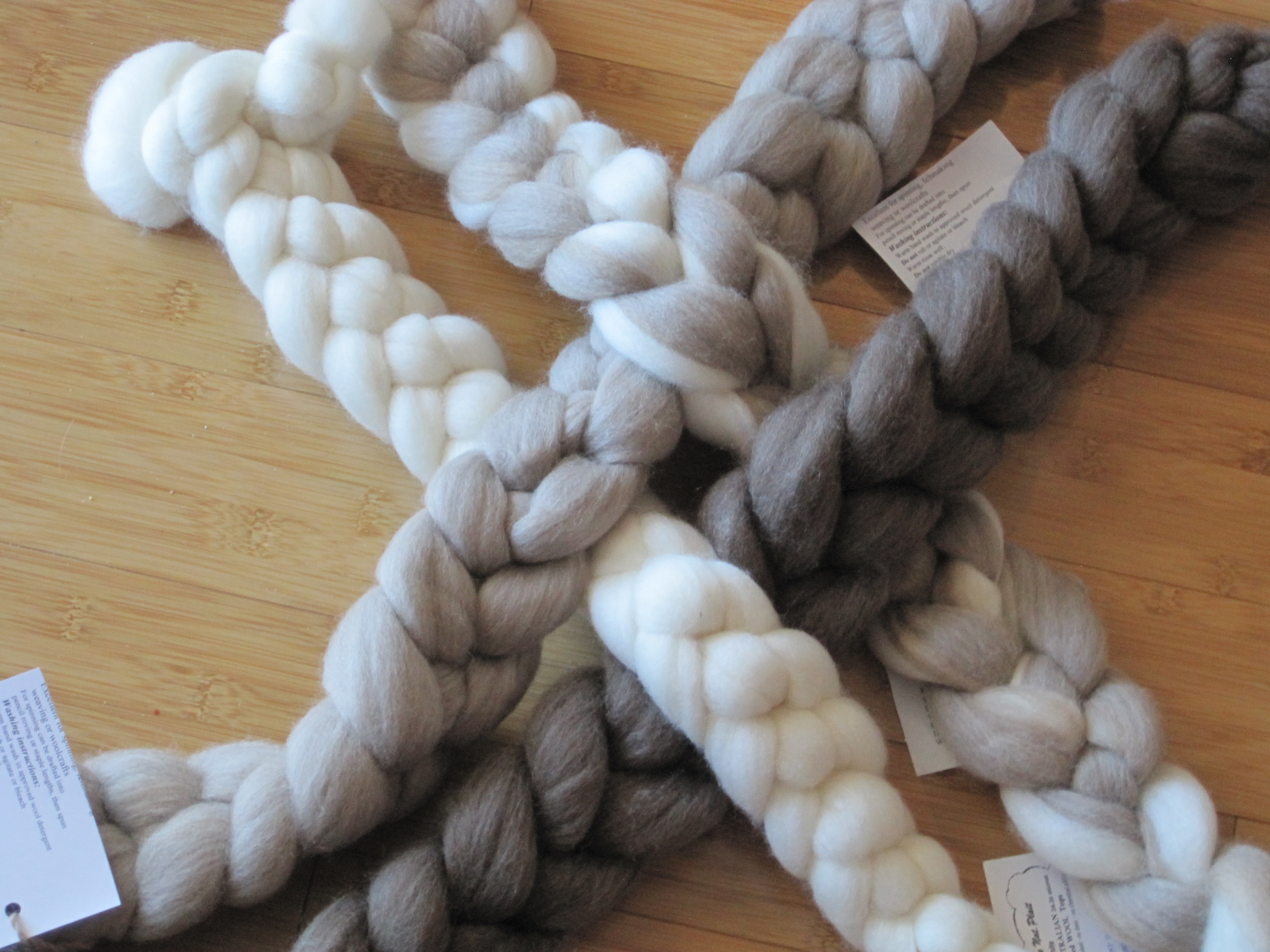
Remember this?

IMG_1019


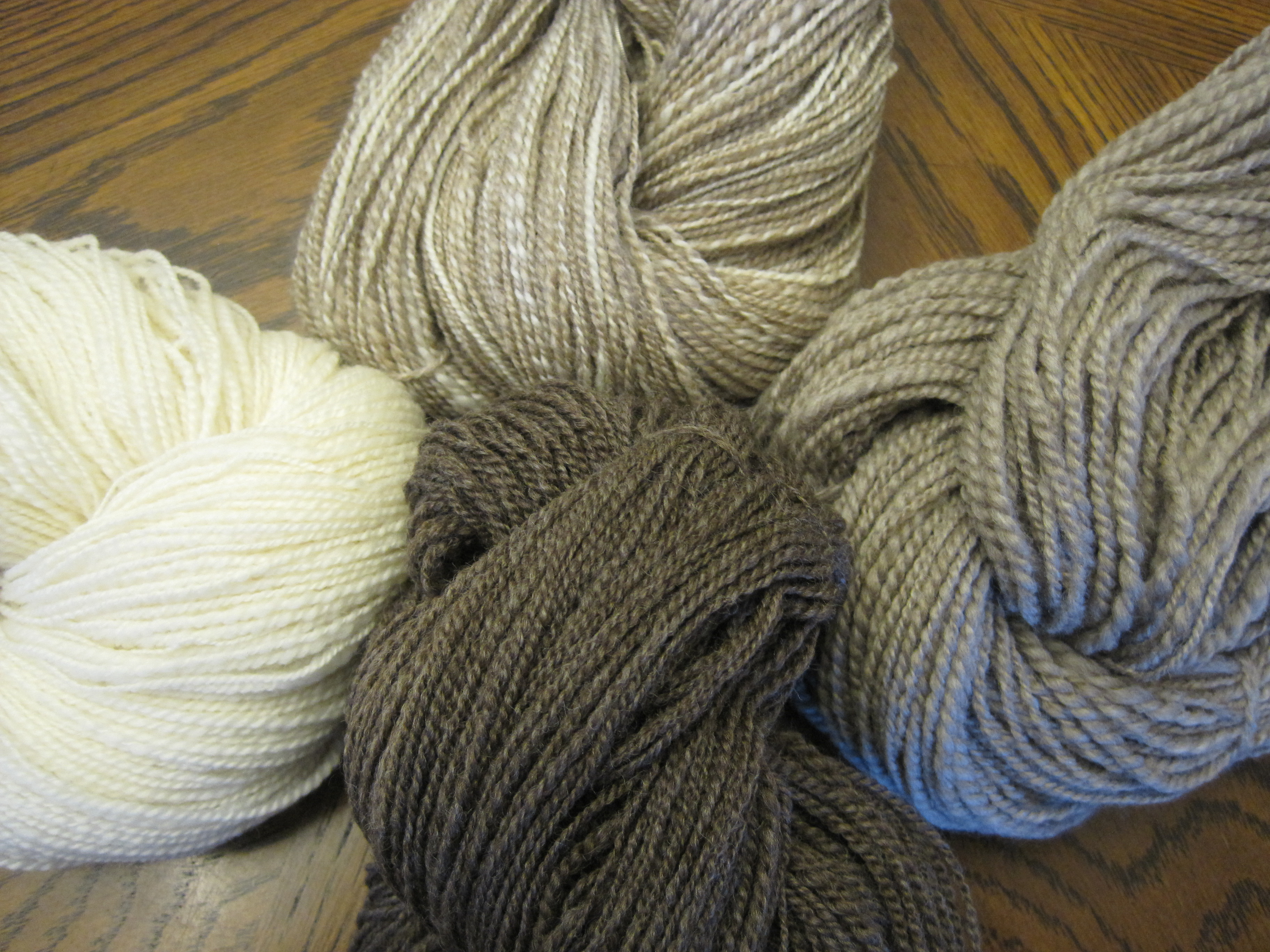
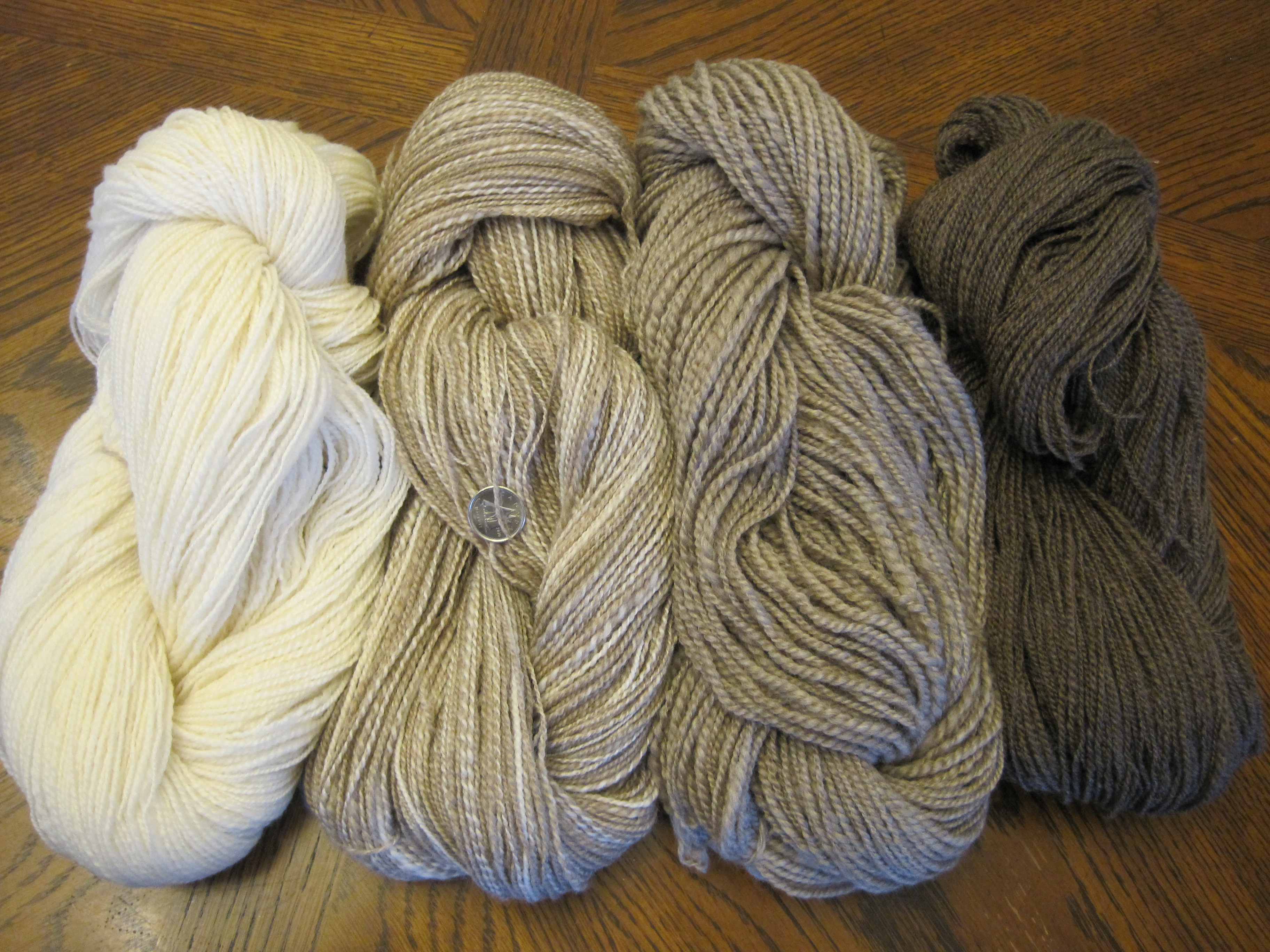
It is now this:  four yummy skeins of soft and squishy woolen spun yarn.

IMG_1357  IMG_1359  IMG_1356

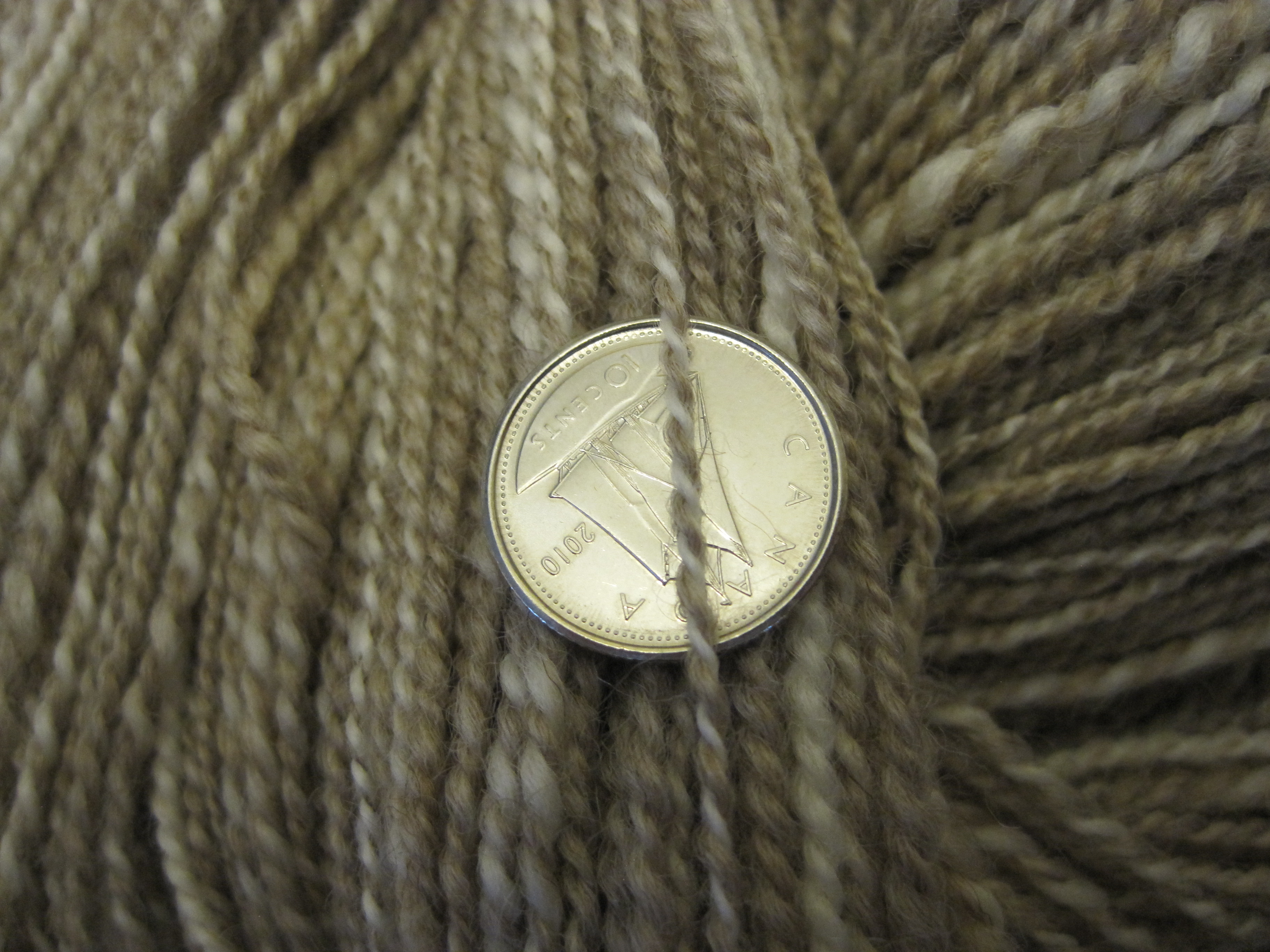
I’m not sure what I am going to make with it yet, but loved the experience of spinning these natural coloured Moorit wools from Western Australia.  It spun up so easily, and I believe the wool is a Corridale/Merino cross.  Yardages vary, getting thinner and smoother as I went along: Silver-196 yds; Light – 353 yds; White – 367 yds and Charcoal – 470 yds.

Anyone have any suggestion on what they would like to see this yarn made into?

And, here is a sneak peek at what’s on my loom today:

IMG_1332

Posted in Spinning | Tagged , , , , | 1 Comment