June Towels Underway

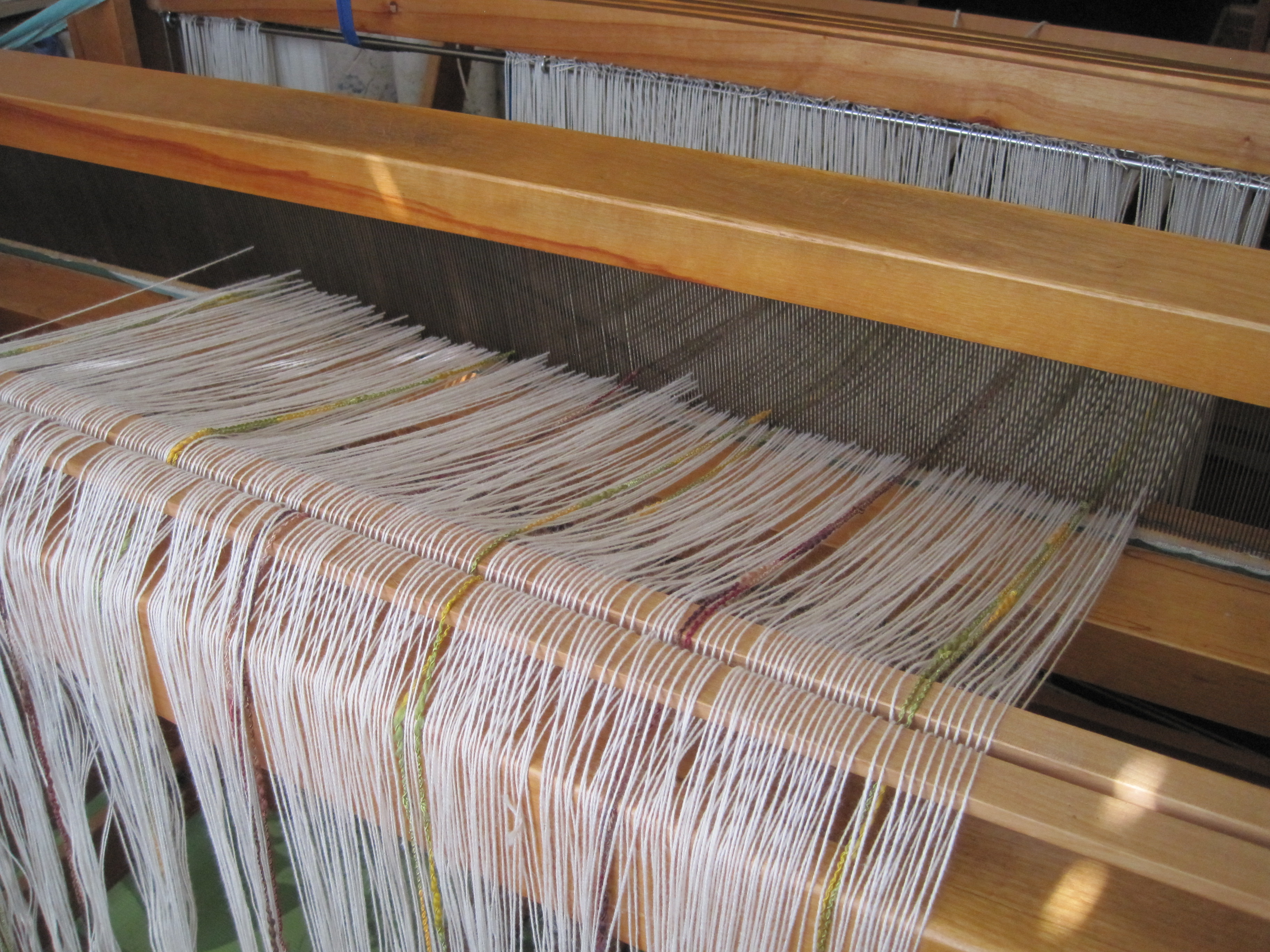
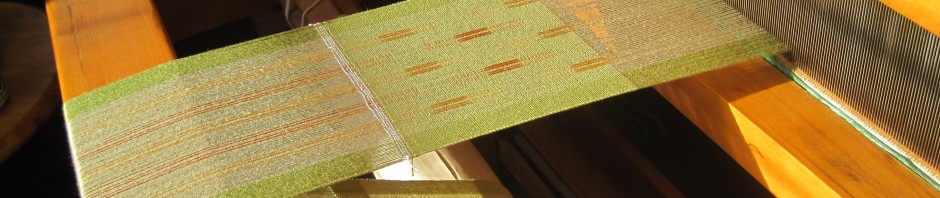
The June towels are on the loom and underway.  I have a shorter warp this month, 4 yards, which should allow me to make three towels.  I have about six inches of the first towel woven so far, and it looks like it is going to work.

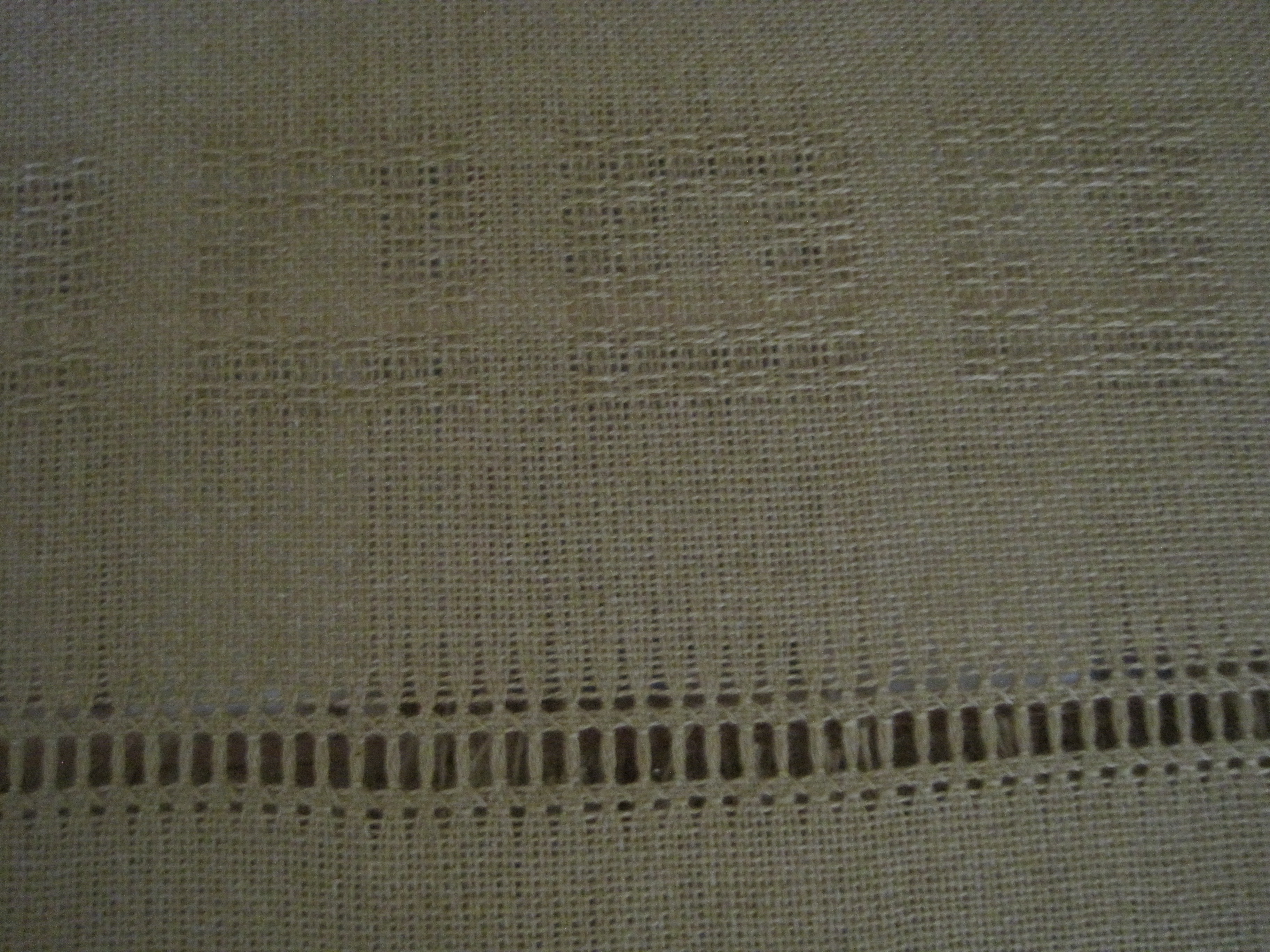
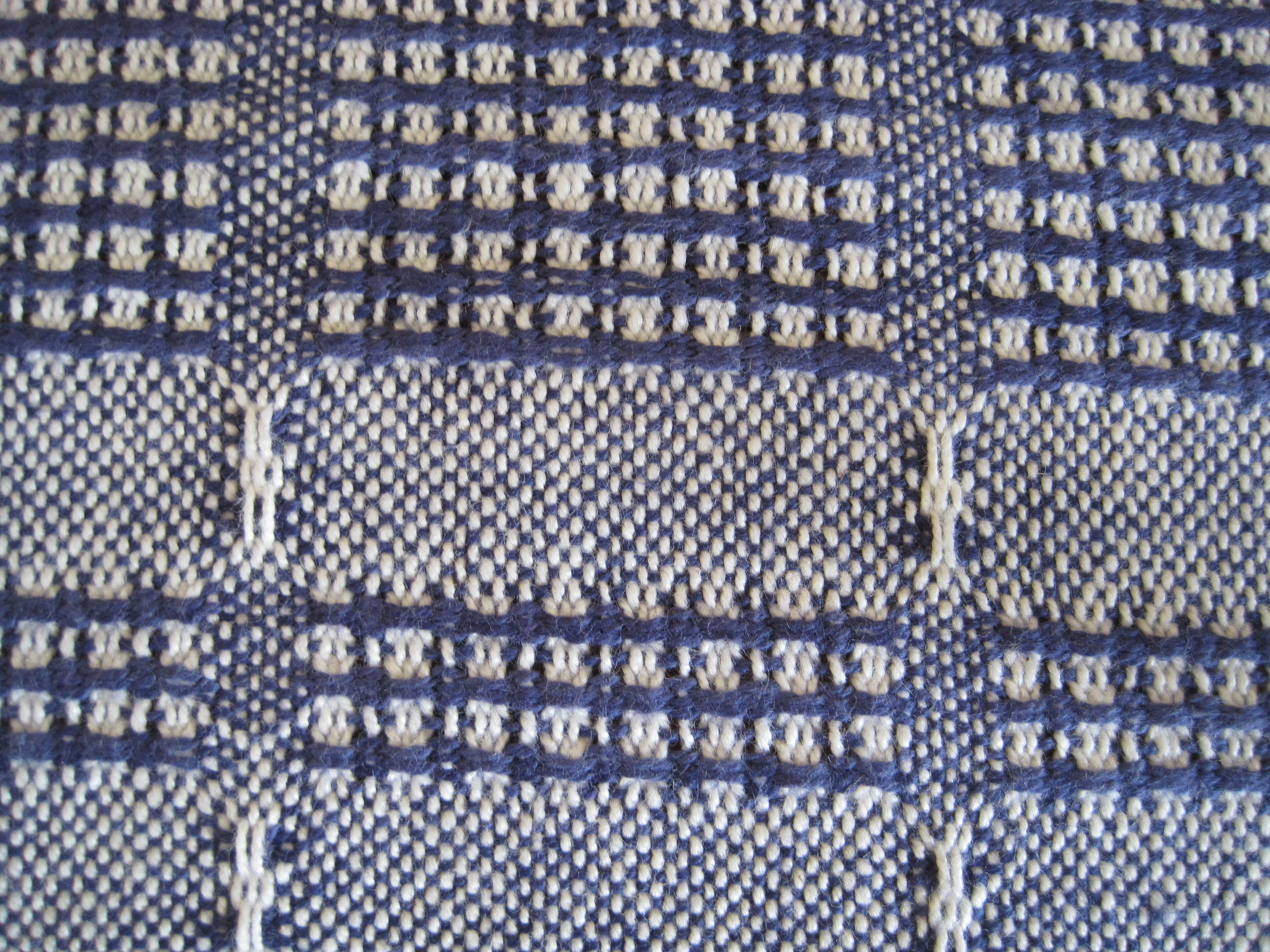
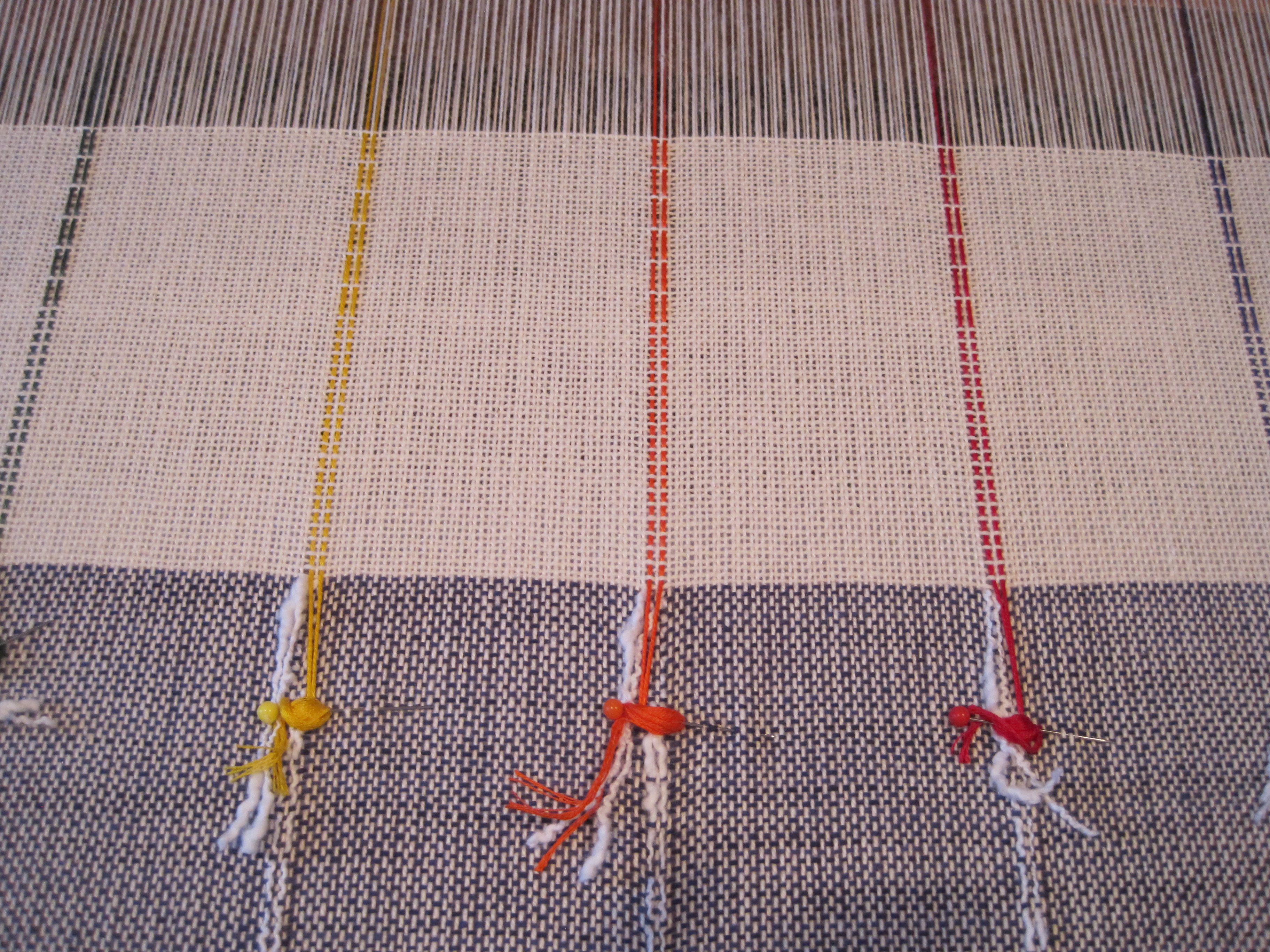
I decided to add a ladder hem-stitch to the towels to reflect the lace squares.  It takes a little longer though, because two rows of hemstitching are needed at each end.  Still, I think it will be a nice effect.  The lace will open up when taken off the loom and washed.

IMG_3107


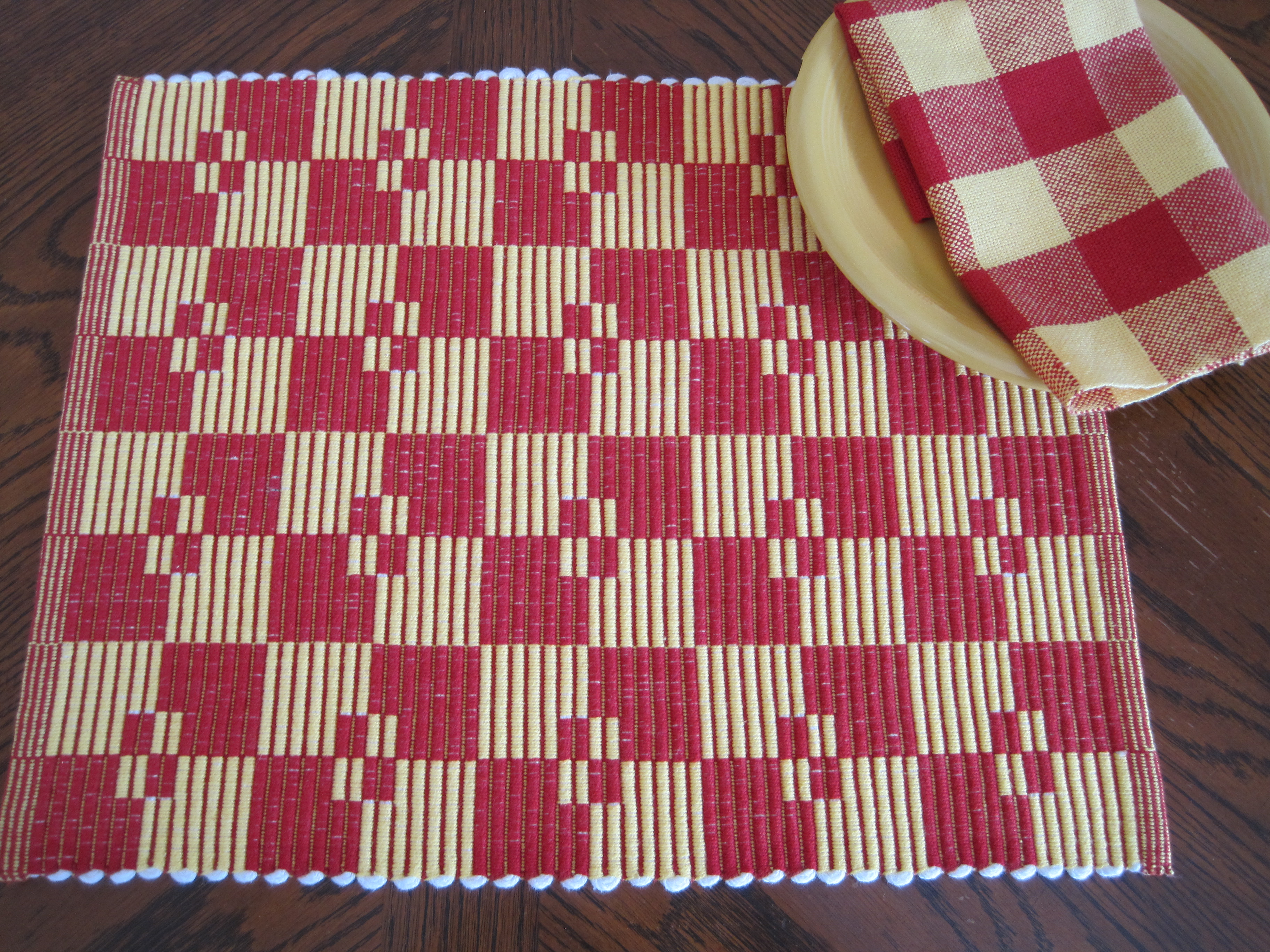
I also have been working on  some rep weave mats.  Going for a vintage look in red and yellow.  The materials are 2/8 cotton, with mop cotton for the thick ribs and 2/8 cotton again for the thin ribs.

Because rep weave is based on a double weave structure, I was able to weave the coordinating napkins on the same warp, by weaving one above the other in two layers, in plain weave.  Imagine these at the breakfast table, with a yellow cereal bowl, cornflakes and bananas, toast and fresh strawberry jam!

IMG_3088  IMG_3089  IMG_3090

This was based on an old upholstery pattern from Lilly Mills  first published in the 1960s.

Posted in Weaving | Tagged , , , , , , , , , | 1 Comment

June Towel of the Month – a little lace

This is a lovely towel woven in Atwater-Bronson Lace, where the lace forms small frames around a plain weave centre.  This is done in two blocks on four shafts.  I decided to use some Fox Fibre naturally coloured cotton for these towels.  The cotton is 12/2; with a soft hand, so I am setting it at 20 ends per inch.  The colour I chose for the warp is called Dessert Storm and is a blend of 50% natural and 50% green.  These colours darken when washed.

Again, the resource for the pattern is found in the article, “Weaving Towels as a Means of Learning the Basic Four-Shaft Weaves”, by Clotilde Barrett, Weavers Journal, Fall 1983, Volume VIII, Number 2, Issue 30, pages 11- 19.  The link is: https://www.cs.arizona.edu/patterns/weaving/periodicals/wj_30.pdf

With Atwater-Bronson Lace every other thread is threaded on shaft 1, so make sure you count your heddles before you start.  Shafts 3 and 4 are used to generate floats, and shaft 2 is the tie-down shaft.  Lace can be woven in Block A, Block B, or both Blocks A and B at the same time.

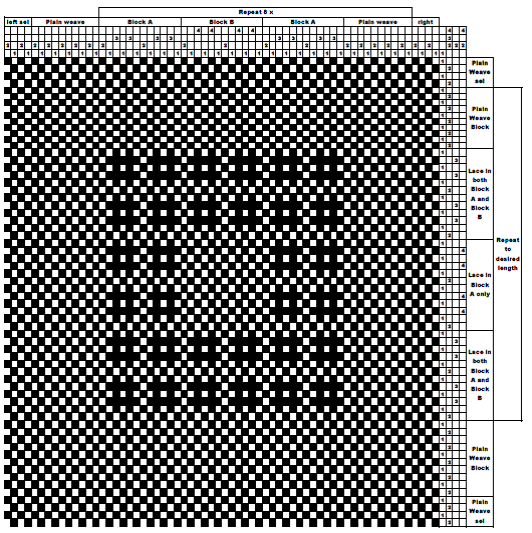
My adaptations to the draft are included below.

Warp and Weft: 12/2 naturally coloured cotton from Fox Fibre, sett at 20 ends per inch

Each towel will be woven 20 inches wide and 32 inches long, which will accommodate a 1 inch hem on each end.  The warp is 4 yards long, which will allow 3 towels and 1 yard for loom waste and take-up and sampling.

june picture

Sorry that the draft picture isn’t clearer. You can enlarge it or see the draft in the accompanying article.   The threading draft is 8 ends on shafts 1 & 2 for the right selvedge; then repeat the following 8 times [10 ends on shafts 1 & 2 for plain weave; Block A (1-3-1-3-1-2; 1-3-1-3-1-2); Block B (1-4-1-4-1-2; 1-4-1-4-1-2); Block A (1-3-1-3-1-2; 1-3-1-3-1-2)] finish with 10 ends plain weave, then 4 ends for right selvedge.

Start with two inches of plain weave, then follow the repeats of plain weave, Lace in Block A and B together, Lace in Block A only, Lace in Block A and B together.  Weave to 30 inches and then finish with two inches of lace weave.

Happy weaving.


Posted in Weaving | Tagged , , , , , , , , , , , | 2 Comments

May Towels Completed

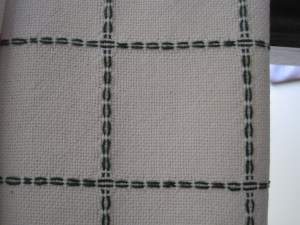
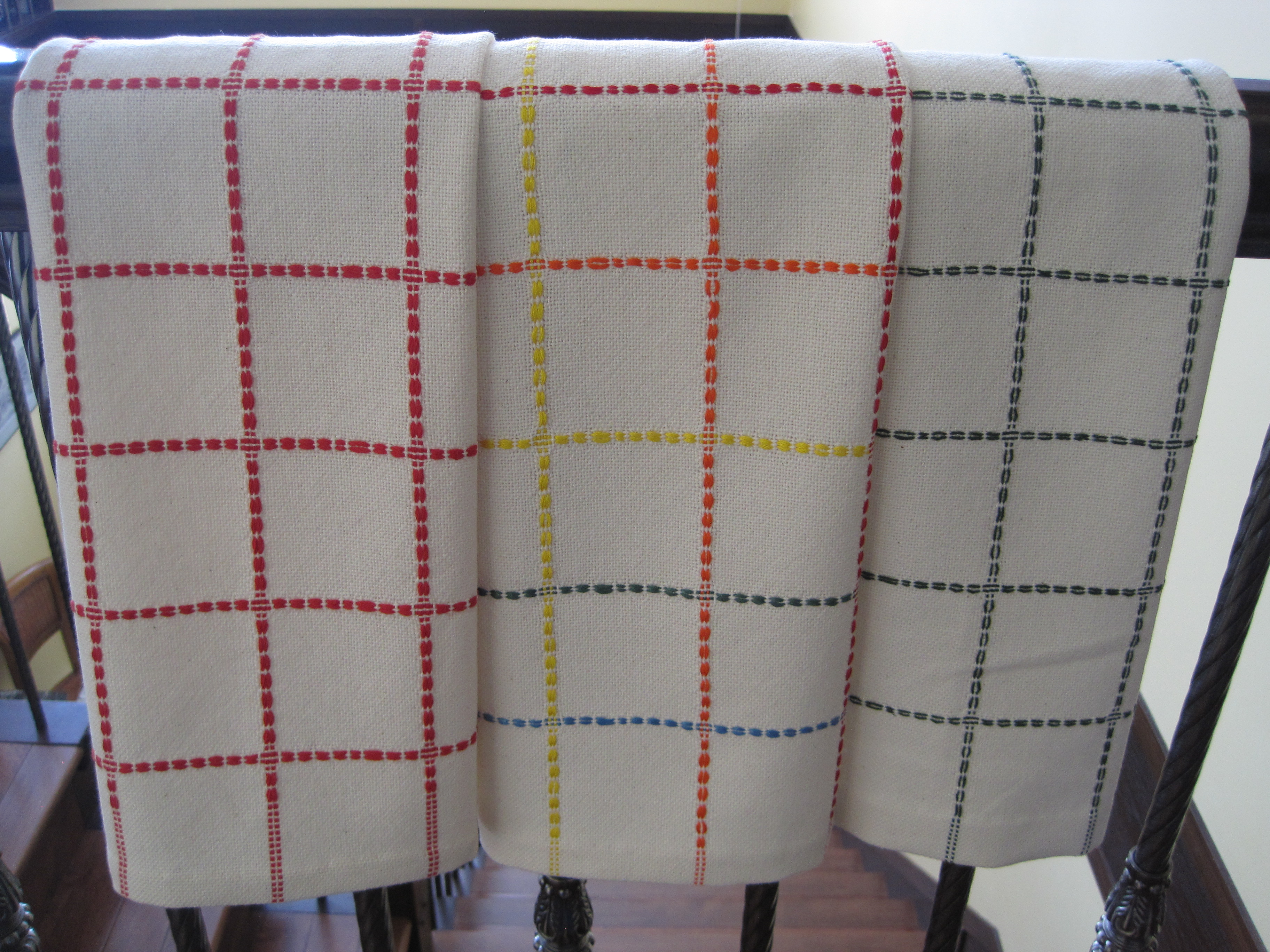
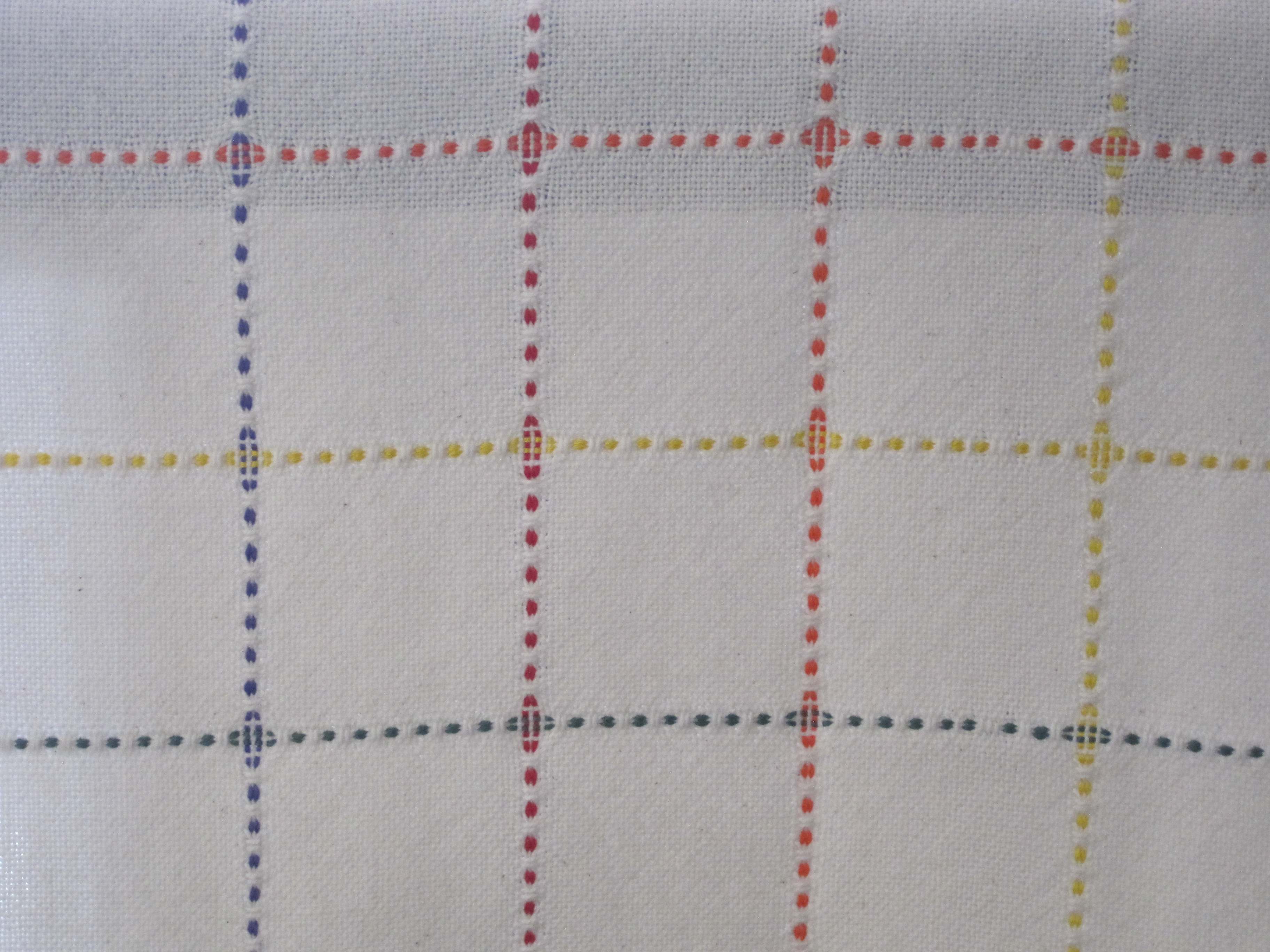
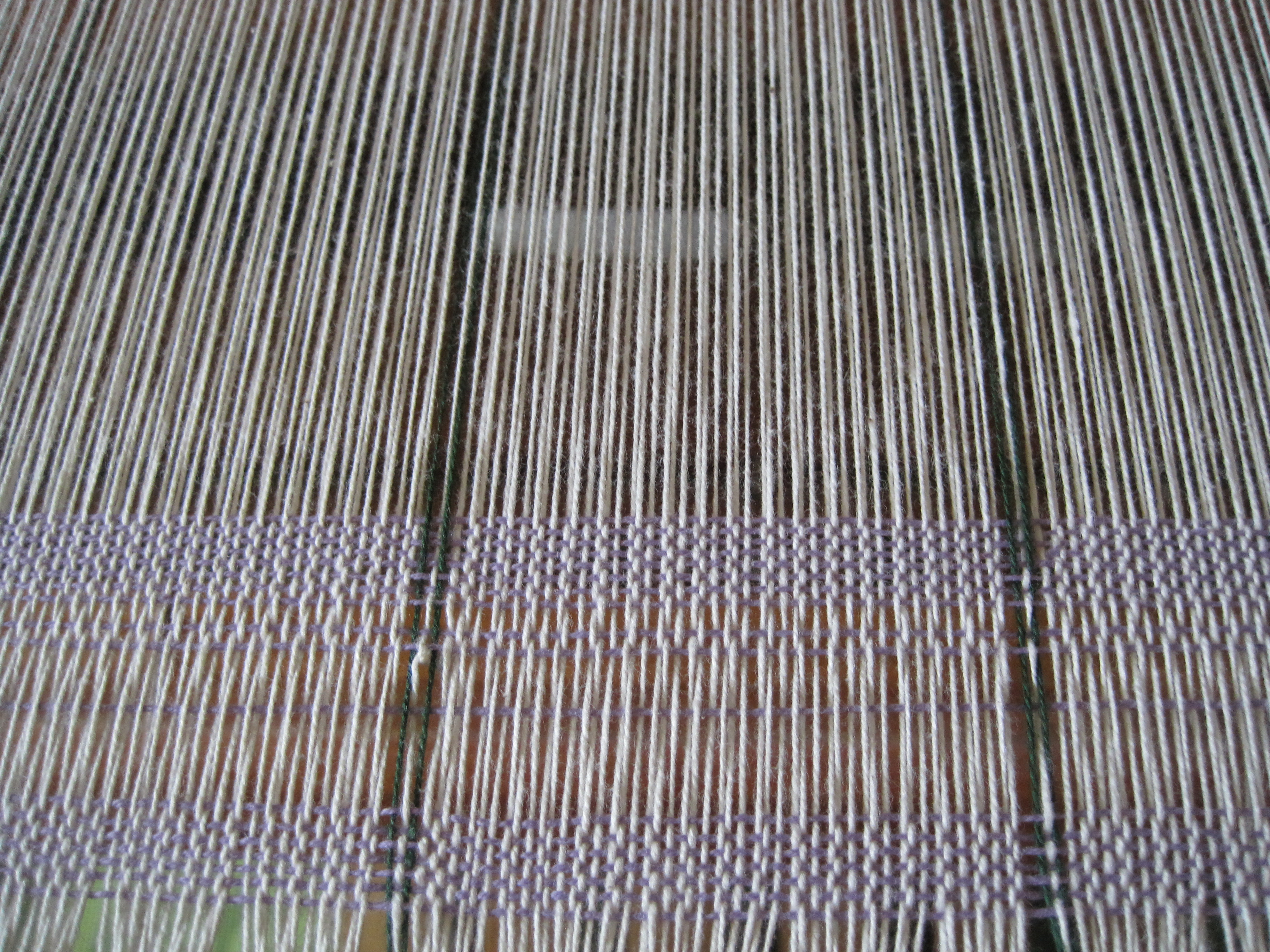
After the warp was finally on the loom correctly the weaving itself was fairly quick and easy.  For the first towel, the decorative threads were 2/8 cotton in dark green.  The design showed up as lengthwise lace threads in the warp direction, and crosswise lace threads in the weft direction.  I squared up the blocks to achieve 2.5 inch squares.

IMG_3093

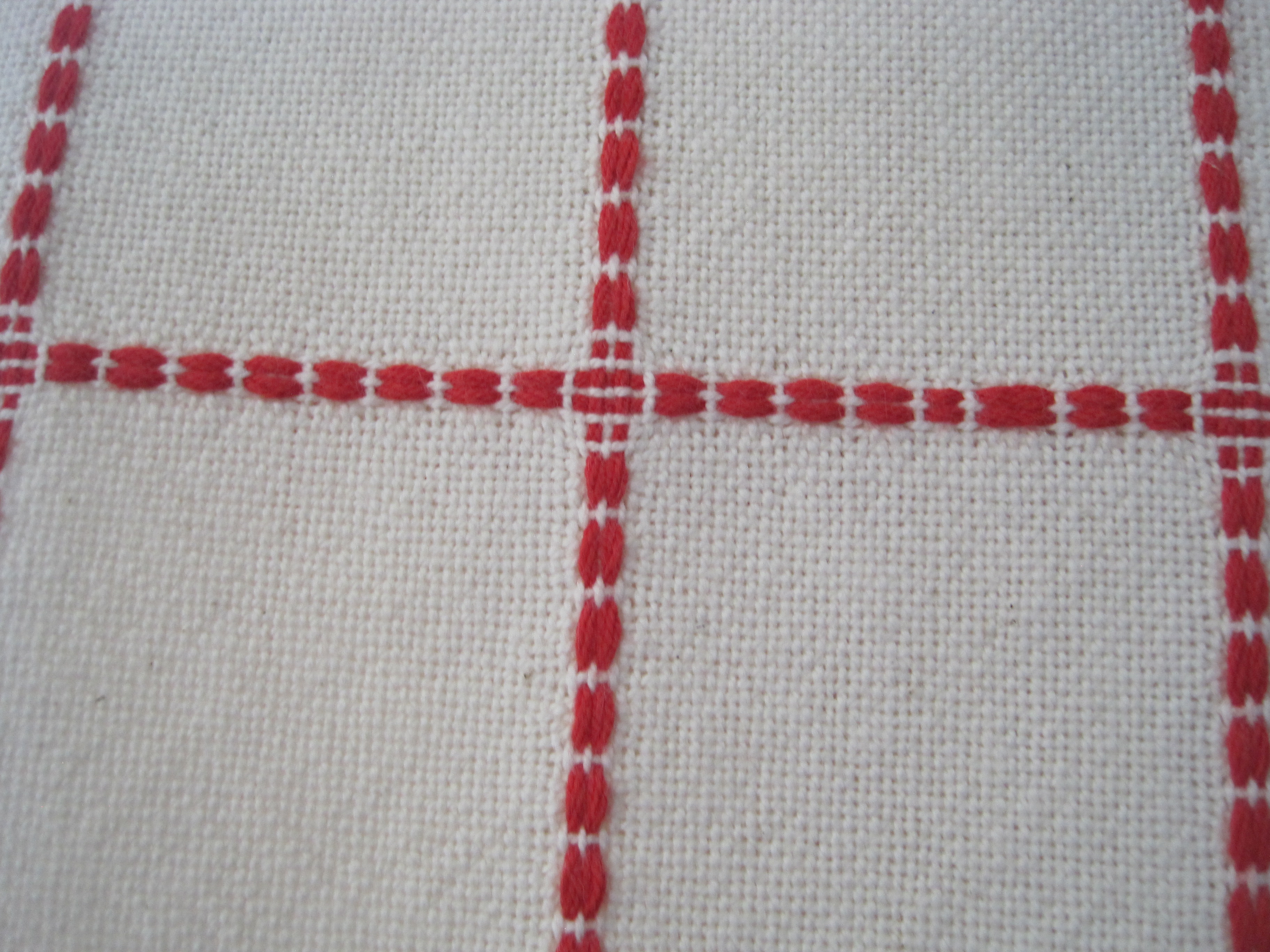
For the second towel I used 2/4 cotton in red.  This gave a more textured feel to the decorative grid as the 2/4 cotton is thicker than the 2/8 cotton used for the plain weave sections in the towel.

IMG_3095

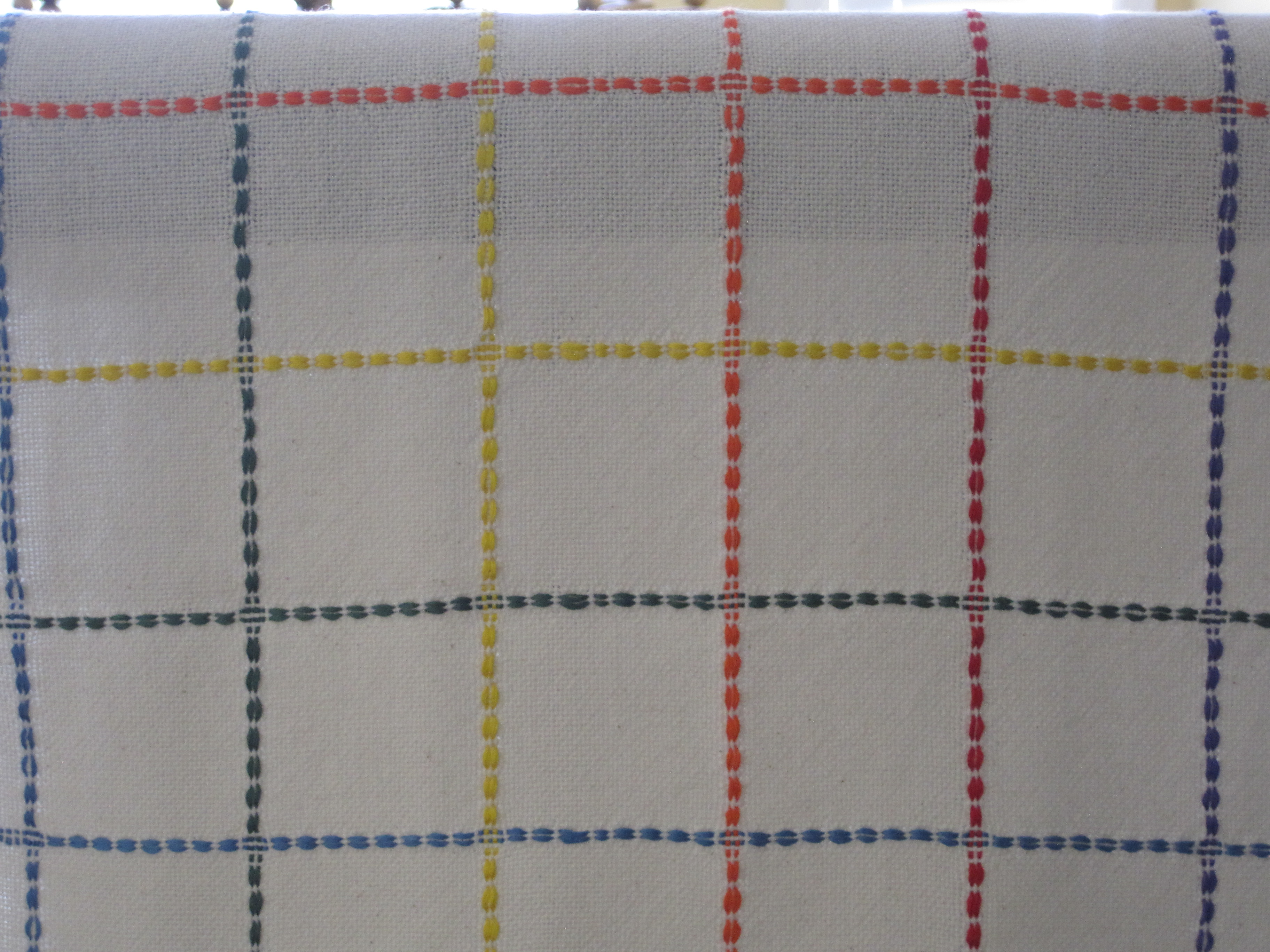
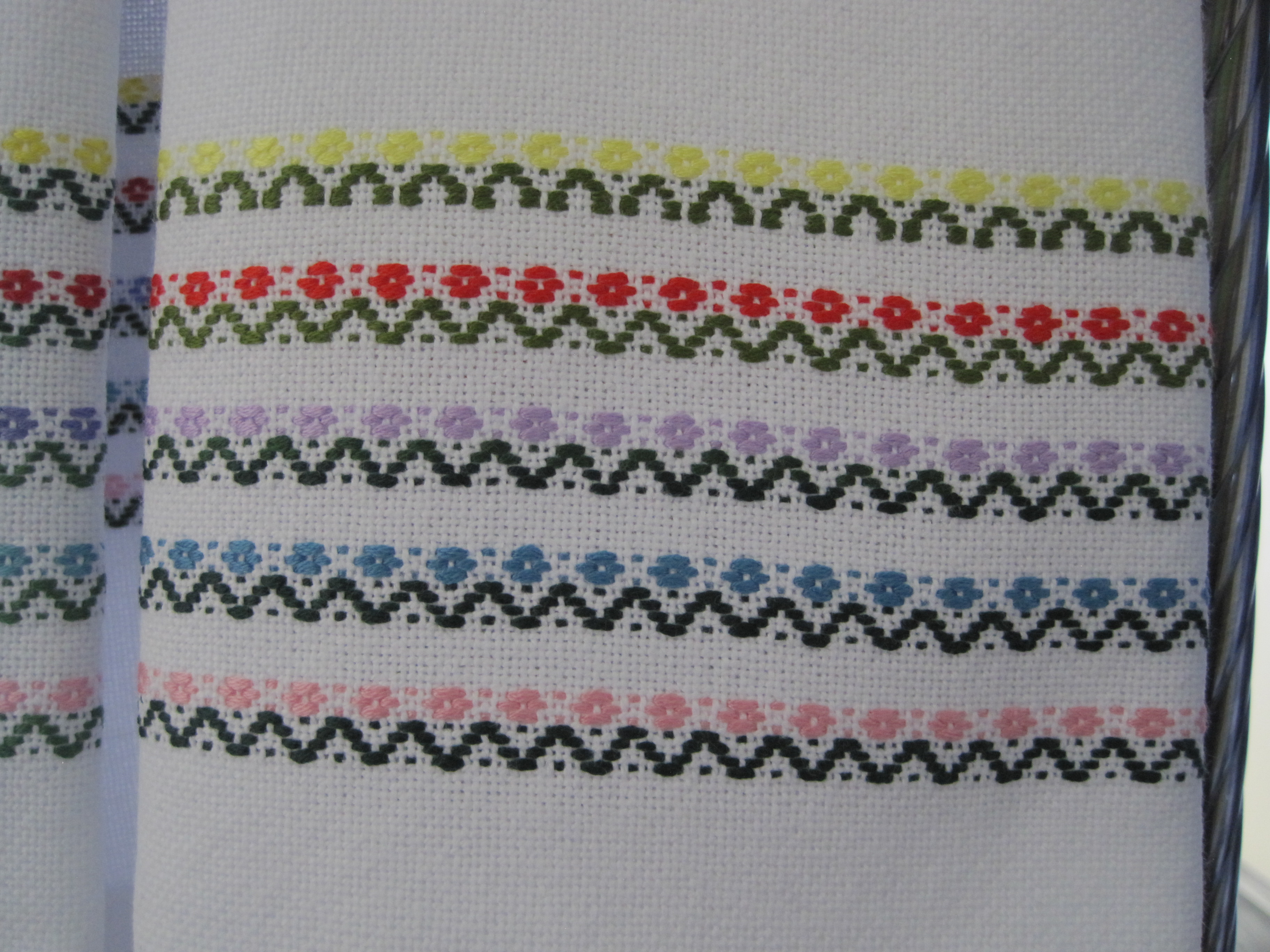
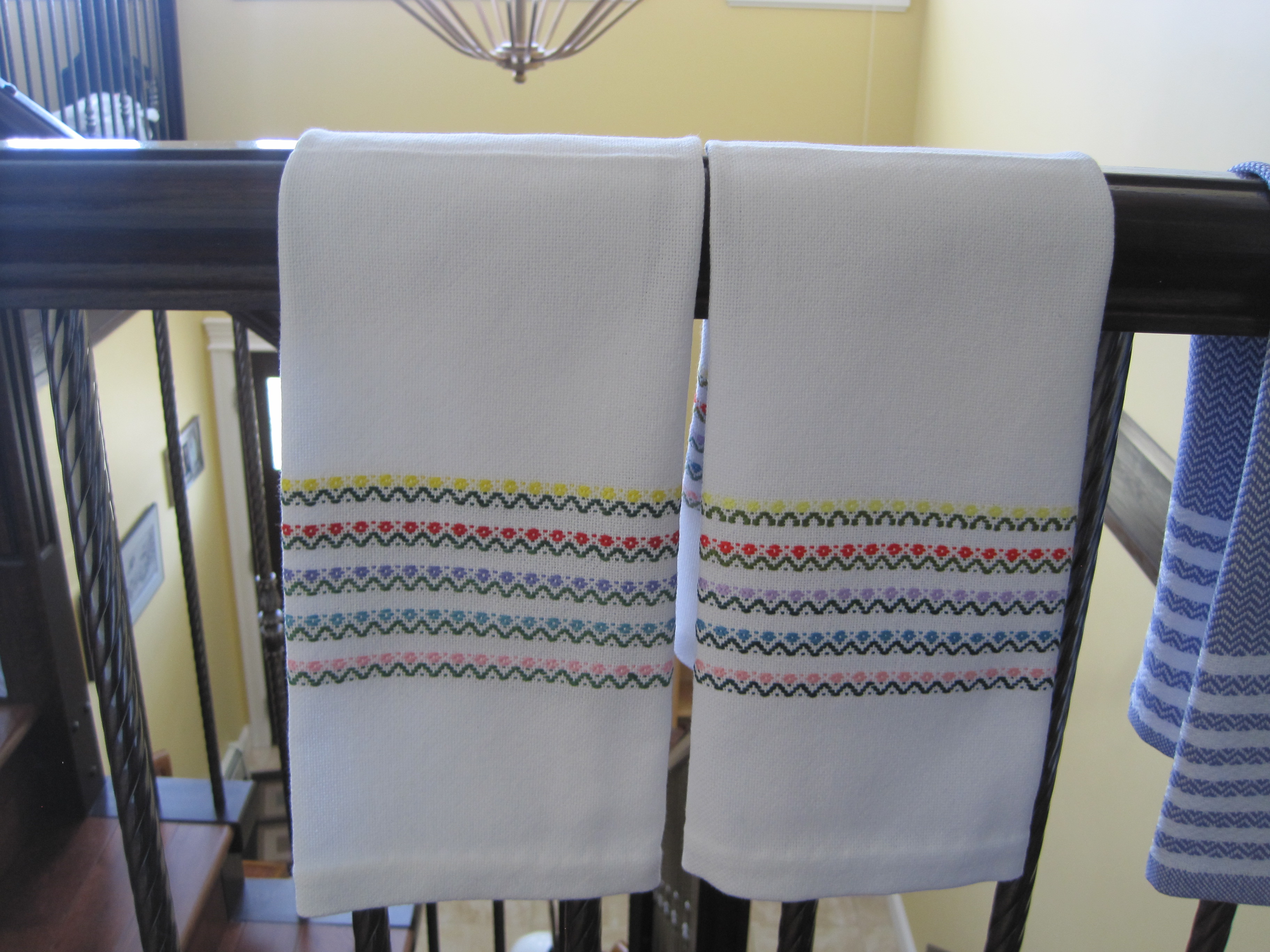
For the third towel I used DMC embroidery floss in primary and secondary colours.  This turned out to be my personal favourite.  The colours and shine of the floss just make me happy.

IMG_3103

In truth these towels didn’t look like much on the loom.  I was worried that the grid would be too large, that the sett of 18 e.p.i. would be too loose.  But a hot wash and a good pres, and the towels are exactly what I wanted.

IMG_3092

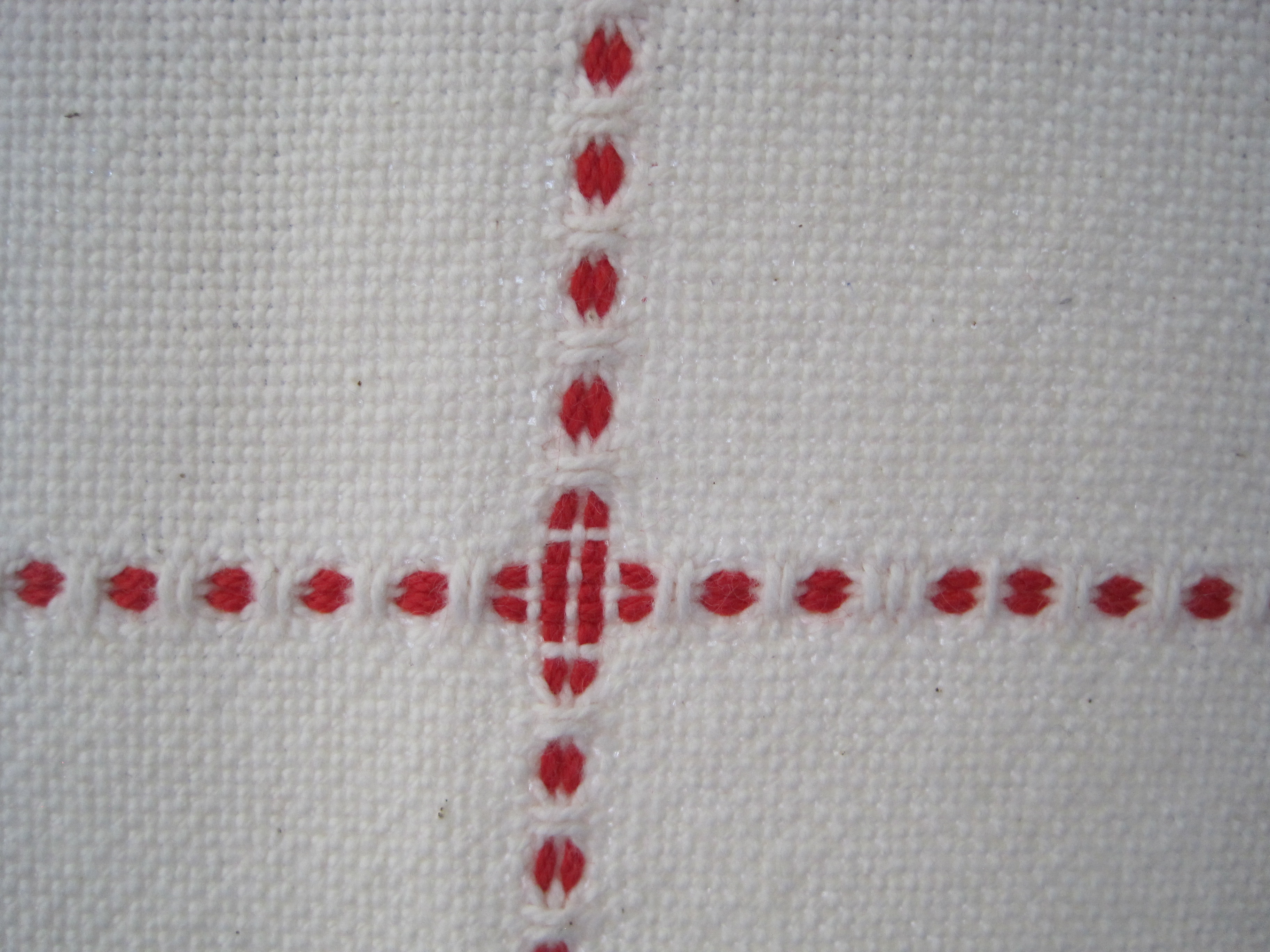
and the reverse side looks pretty too.  I like the pattern formed where the decorative threads cross one another.

IMG_3102    IMG_3099

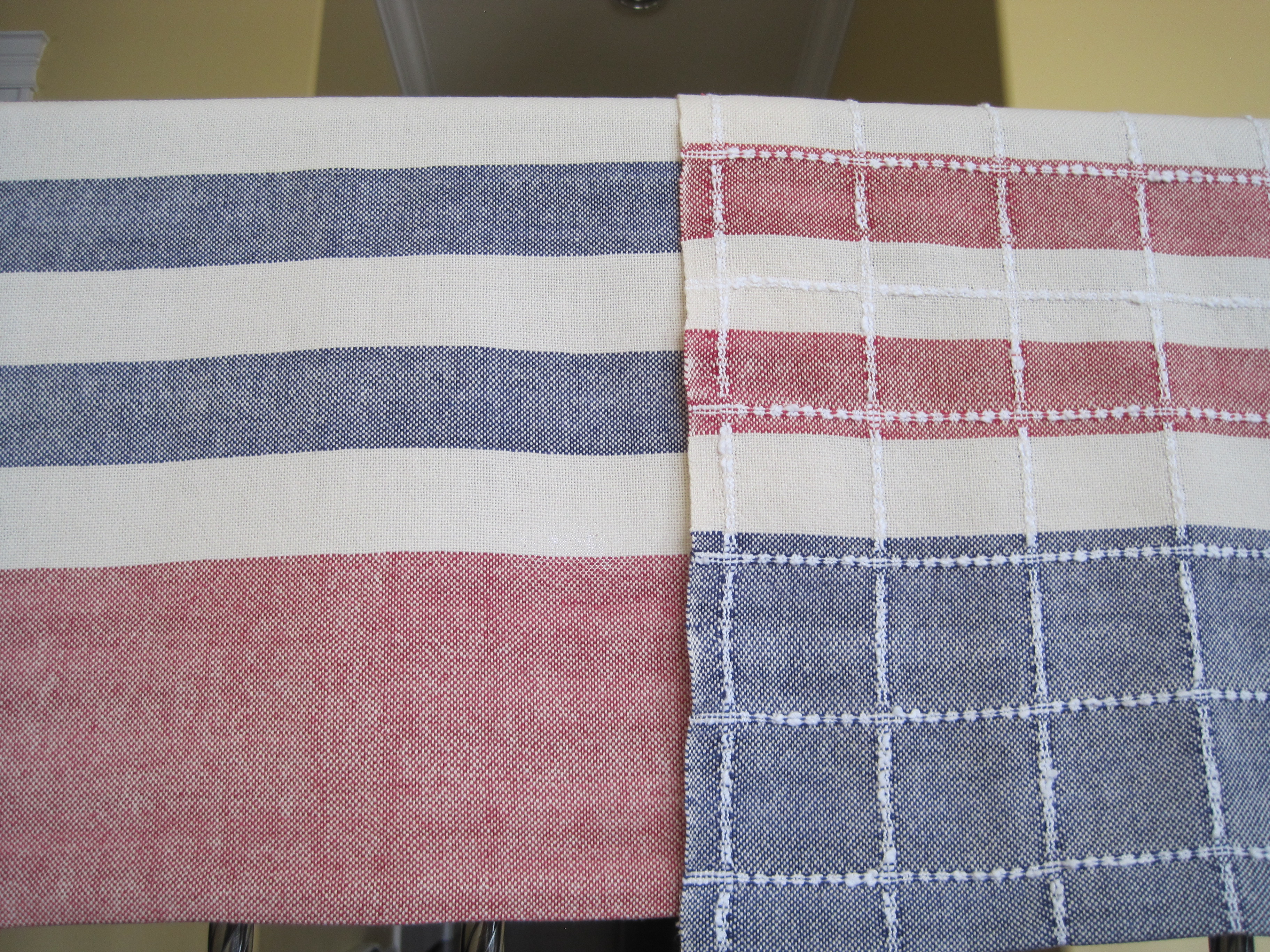
I still had some warp left, so I next experimented with adding some colour stripes to the background, and used a soft cotton boucle as decorative threads.  As I only had enough boucle in my stash for one towel, the last towel was completed in plain weave colour stripes in reverse colours of towel 4.

IMG_3083

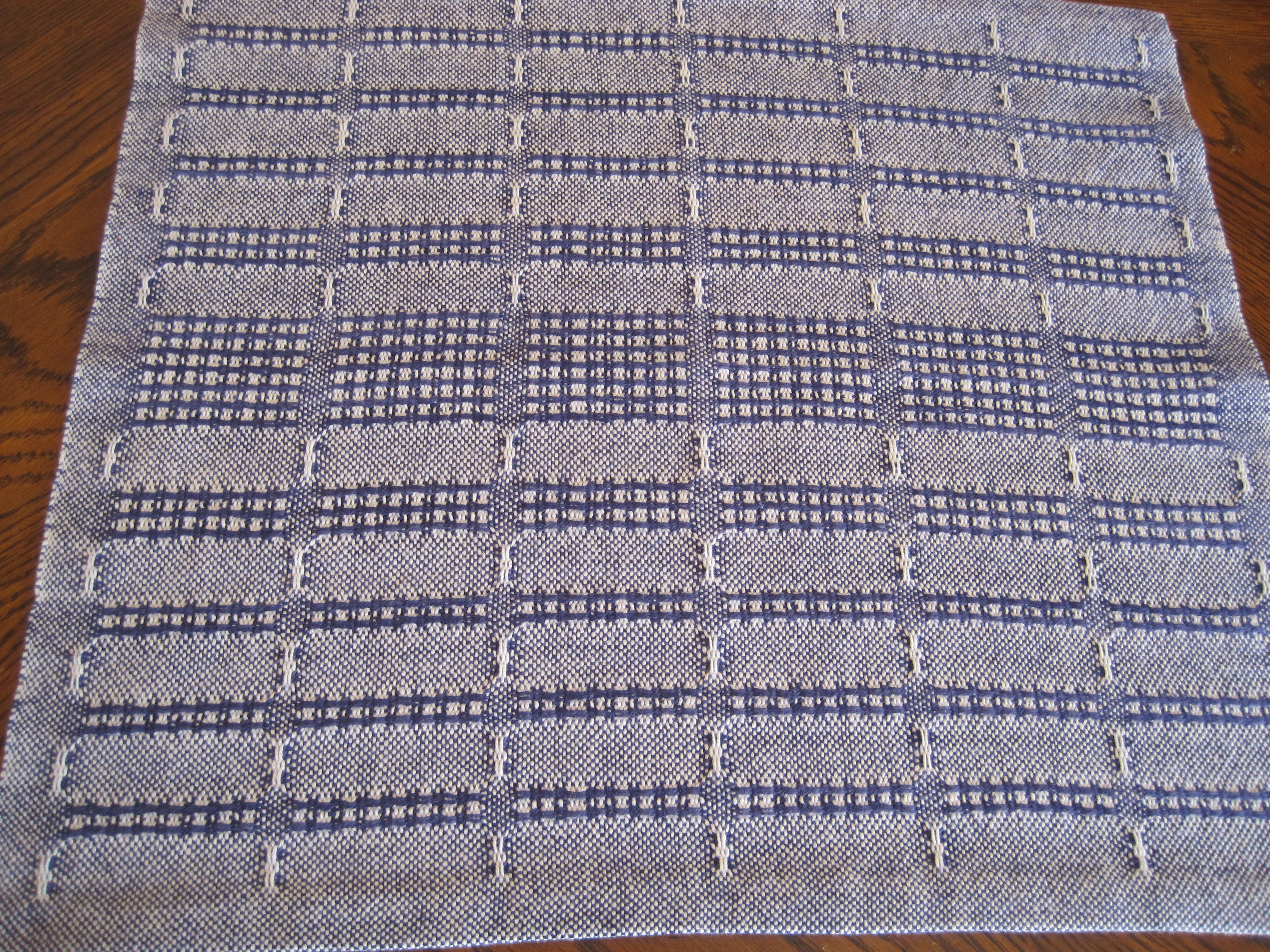
I only had about 15 inches left on the warp, so I played around with the lace to make a square that could be used as a bread-cloth, or table mat.

IMG_3085  IMG_3086

For those who want to know how I was able to change the decorative threads for each towel, here is how I did it.  After weaving a towel, I cut the decorative threads and tied on the new yarn.  I pulled the new yarn through the heddles and reed and then anchored the new yarn to the web at the front of the loom with pins, and weighted the yarn at the back of the loom using empty baby food jars or coin-weighted prescription bottles.  the excess yarn was tucked inside the jars/bottles, and pulled out as I advanced the warp.  There were only 7 pairs of threads that needed replacing across the warp so it really wasn’t much extra work.

transition of decorative threads, anchored with pins

                 transition of decorative threads, anchored with pins  

IMG_3081

So simple.  Six yards of warp produced 5 tea towels and one square cloth, with lots of room to play and experiment.


Posted in Weaving | Tagged , , , , , , , , , , , | 4 Comments

Solitude

Ron and I took advantage of the long Victoria Day weekend to spend four days camping on the south Washington coast at Ocean Beaches.  We had a wonderfully quiet and peaceful camping spot away from internet, phones, and any kind of technology.  An opportunity to find rare uninterrupted time to spend just with each other.   The first long weekend of the summer.  We enjoyed visiting the local interpretive centre and learning about the indigenous sea life, birds and mammals that inhabit the south Washington coast.

IMG_3070   IMG_3073

A weekend of contemplation and reflection.  We are just entering our senior years, and spent some time talking about our plans for the next few years together.  What is important to us? Where will we live?  Where will we travel to?  Should we sell the house and downsize or stay where we are?  What legacy will we leave to our children, grandchildren,  and community?

We do believe in having a retirement career, and are thinking about how to start a business that will provide for us, not only financially, but also mentally, and emotionally.  We have skills that we want to share with the next generation.  Of course I will continue weaving, spinning and teaching, while at the same time supporting my husband and family.  Ron is my best friend, the one person who knows every part of me, and I know every part of him.  We do not always agree, of course, and are individually very strongly opinionated,  which can lead to loud discussions, but ultimately, together, we are an unbreakable force.

So, a weekend of exploration, renewal, and love.  I look forward, with positive anticipation to the next few years.

Posted in Essays, Travel | Tagged , , , , , | 2 Comments

May Towel Finally on the Loom

I finally have the “May Towel of the Month on the loom after a couple of false starts.  I made the choice to use 2/8 cotton in natural colour for the body of the towel, and a very pretty cable yarn in cotton and rayon for the accent.  The cable yarn has a thick and thin aspect, with the main part of the yarn about the size of 2\8 cotton, and some nubby parts a bit larger.  So, I went ahead and measured out the warp and proceeded to put it on the loom.  I had to pull the nubby bits by hand through the reed dents, and had no problems in the heddles, but obviously I was in denial about the fit and believed that once the yarn was taut the nubbies would just slide through the reed.IMG_3056

Big mistake.  Big, big mistake.  I had everything tied on perfectly, tightened the warp and started to weave.  The beater would not move.  I niggled the yarn by hand through each reed space.  The beater made it to the fell, the nubby yarn stretched and relaxed.  Now I couldn’t move the beater back to make the next shed.  I thought, “Will this improve with time?”  I tried a few more careful, tedious picks.  Better?  Not even in the slightest!

IMG_3057

So, with a heavy sigh, I cut out the offending threads and replaced the accent threads with 2/8 cotton in dark green.  At least I know they will go through the reed OK.  And, I started weaving again.  Now, I realized that when I threaded the nubby yarn, I put each one in a separate dent, so as not to let them tangle with the cotton.  Now the nubby was replaced with cotton, the extra space was noticeable.  Again, I cut out the weaving and re-slayed the whole warp to close up the gaps.  Now I am ready to get back to the weaving.  Third time’s a charm I hope.

IMG_3062

Let the weaving begin.

IMG_3063


And a note on the “turned” Atwater-Bronson Lace.  In Atwater-Bronson the weaving will have warp floats on one face of the cloth and weft floats on the other face.  When this is turned, both faces will have both warp floats and weft floats.

Posted in Weaving | Tagged , , , , , , , , , | 2 Comments

Invitation to Weave Along – May Towel of the Month

Weaving the towels shown in the last post challenged me to follow up with the article and weave a set of towels each month.  I extend the invitation to “weave along” to other weavers out there, both new weavers and experienced.

The resource for the pattern is found in the article, “Weaving Towels as a Means of Learning the Basic Four-Shaft Weaves”, by Clotilde Barrett, Weavers Journal, Fall 1983, Volume VIII, Number 2, Issue 30, pages 11- 19.  If you don’t have a copy of this old magazine, you can find it on the On-Line Digital Archive of Documents on Weaving and Related Topics.  The link is https://www.cs.arizona.edu/patterns/weaving/periodicals/wj_30.pdf

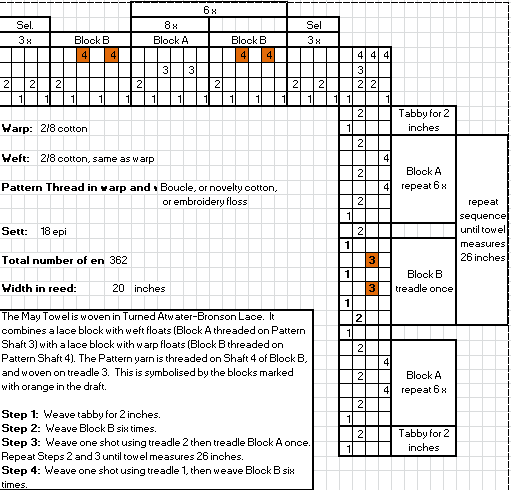
The May towel is woven in turned Atwater-Bronson Lace, in lace blocks. For my purposes, I changed the draft for the May towel to use 2/8 cotton sett at 18 ends per inch.  The revised draft is:

Draft may towels

Click on the picture to make it bigger.

I am in the process of winding the warp for these towels now, and will make my warp 6 yards long to make five towels.

As a weaver, I move between trying something completely new to me, and bouncing back into the traditional weaves.  I move around the circle back to the place where I began, but when I arrive back at the beginning, I am now a different person, with different experiences, so I see it through a different lens.

I have woven lace occasionally throughout my weaving journey, mostly with success.  Now as I look at the original draft from 1983, the notion that this is a “turned” Atwater-Bronson lace intrigues me.  In 1983, when I was a new weaver, I would have just followed the directions, seeking out the exact materials and methods, leading to a wonderful learning experience and a beautiful set of towels.  And that was perfect and recommended for beginners.

With that experience under my belt, I am now very curious about the difference between original “Atwater-Bronson Lace” and “Turned” Atwater-Bronson lace.  I’m off to do the research and will report back my findings.  Your comments, as always are appreciated.

Posted in Weaving | Tagged , , , , , , , , , , , | 4 Comments

April Flowers for Towels

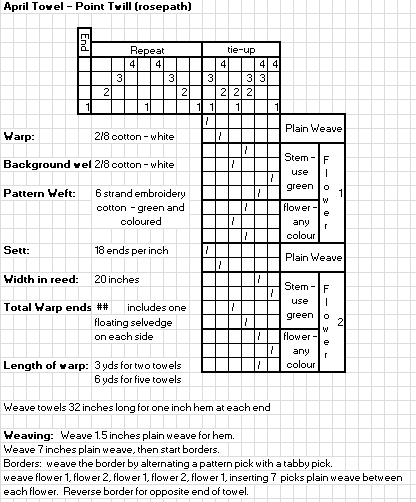
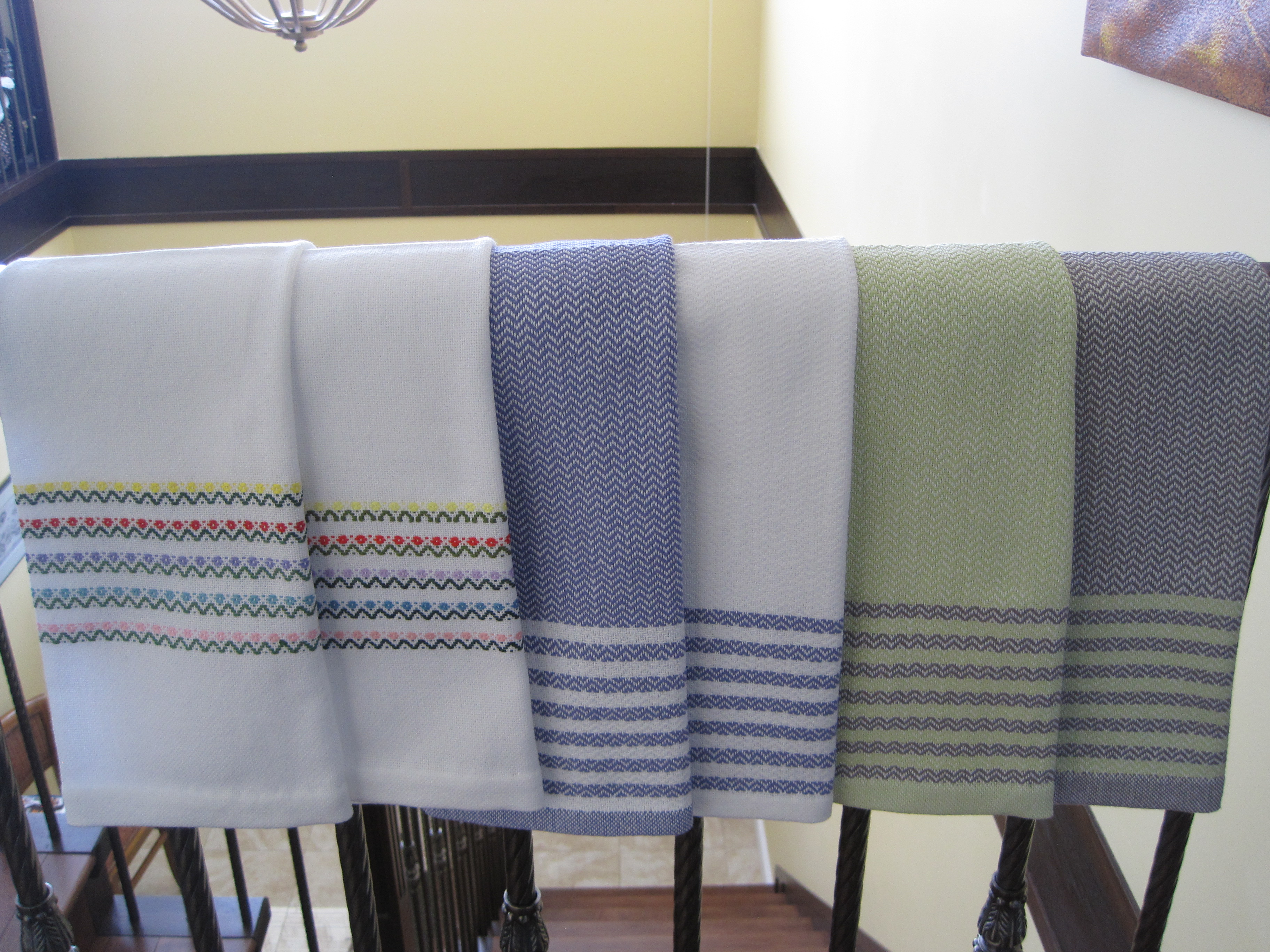
I’m so enjoying the warm, sunny days of Spring, and even a little rain has not dampened my spirits.  I was in the mood for some fresh kitchen towels, both for myself, and for future sales.  These towels are based on a Rosepath threading, which is really a point twill, and with added pattern threads in embroidery floss, woven as if it were overshot, make pretty little flowers for the borders.

IMG_3041  IMG_3040

These are the April towels found in “Weaving Towels as a Means of Learning the Basic Four-Shaft Weaves”, by Clotilde Barrett, Weavers Journal, Fall 1983, Volume VIII, Number 2, Issue 30, pages 11- 19.  The towels in the article used linen as warp and weft, so I changed the draft slightly to accommodate using 2/8 cotton sett at 18 ends per inch.  My draft is:

April flowers draft

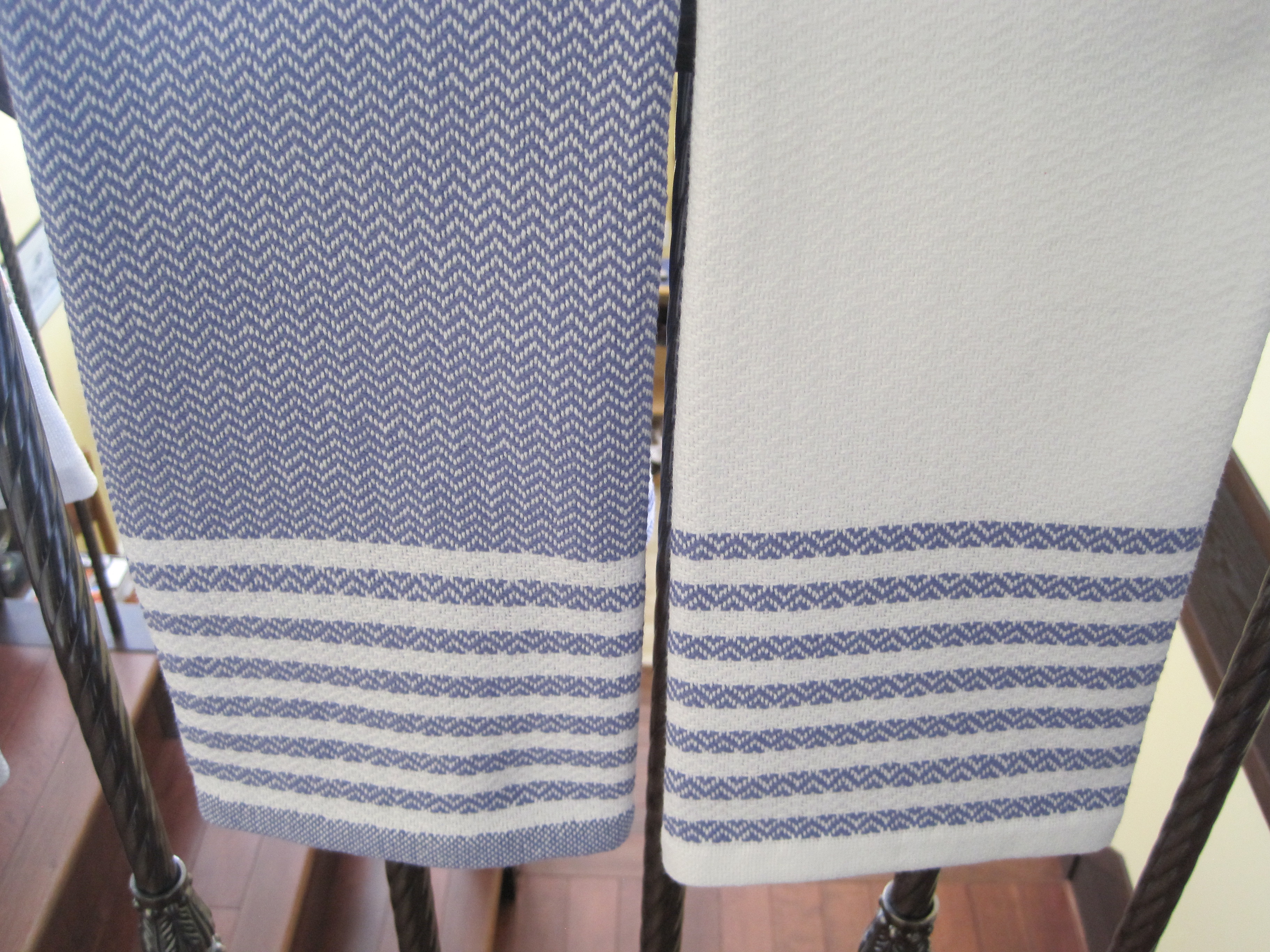
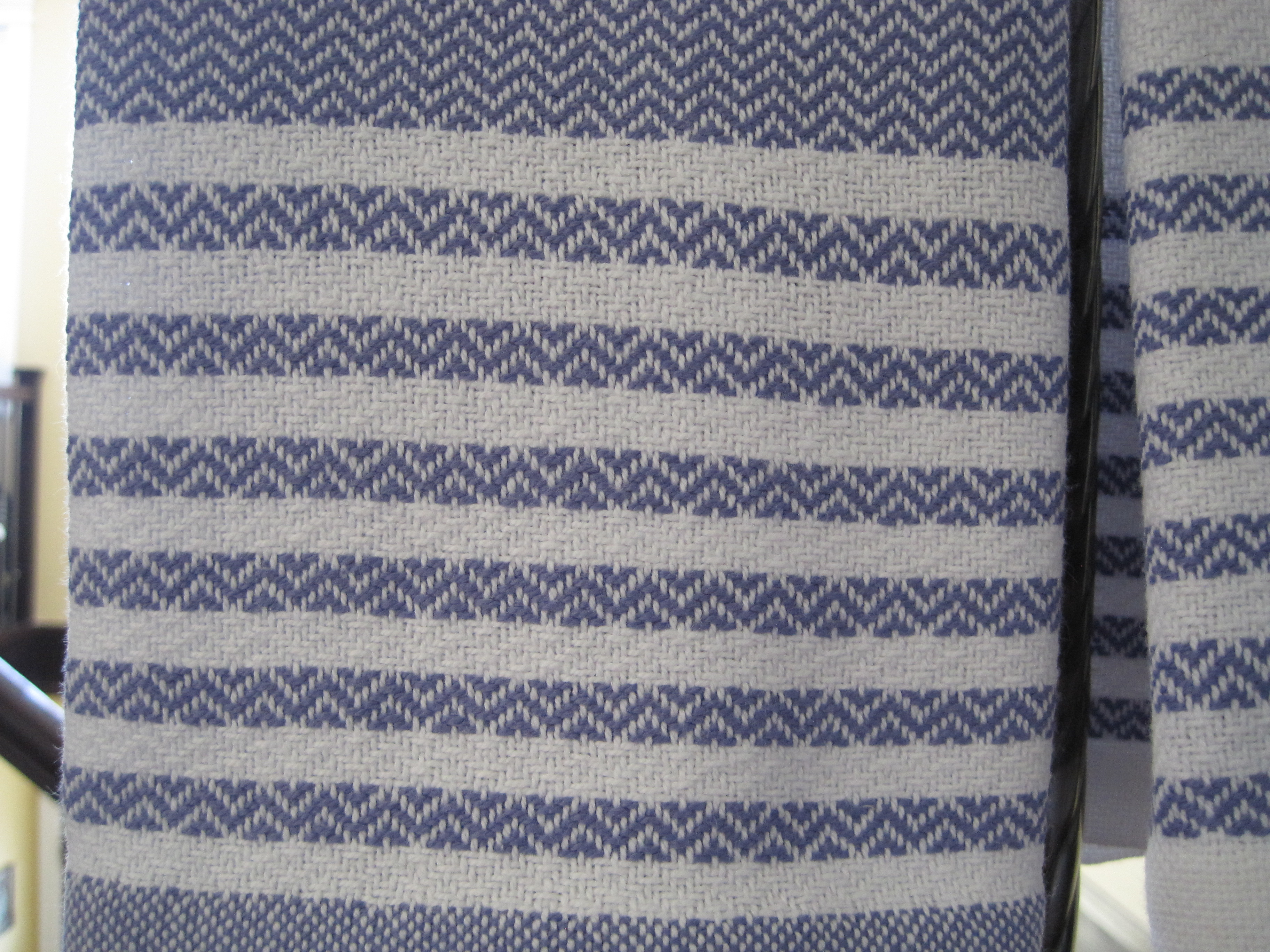
I had put on a six-yard warp, so after making the first two towels as shown in the article, I played around and made companion towels in twill stripes.  First I put blue-striped borders on a white ground, and then white-striped borders on a blue ground.

IMG_3043  IMG_3042

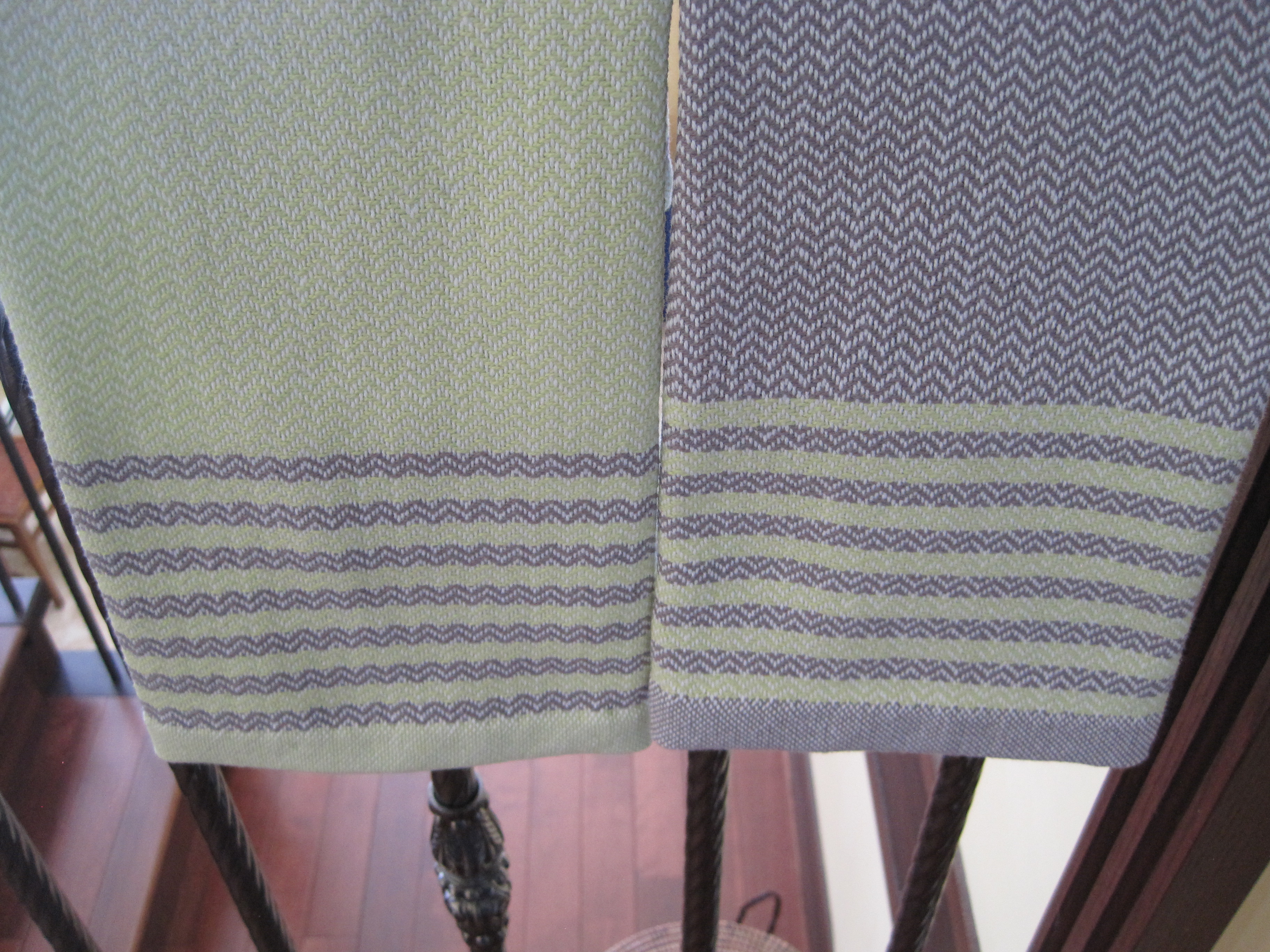
I thought these were pretty and fun, so I followed up with a green striped border on a gray ground, then finally a shorter gray-striped border on a green ground.

IMG_3044

Six towels in all.  Five are twenty inches wide by 30 inches long, and the last towel is 20 inches wide by 25 inches long.

IMG_3045


Posted in Weaving | Tagged , , , , , , , , | 10 Comments

Camel and Silk

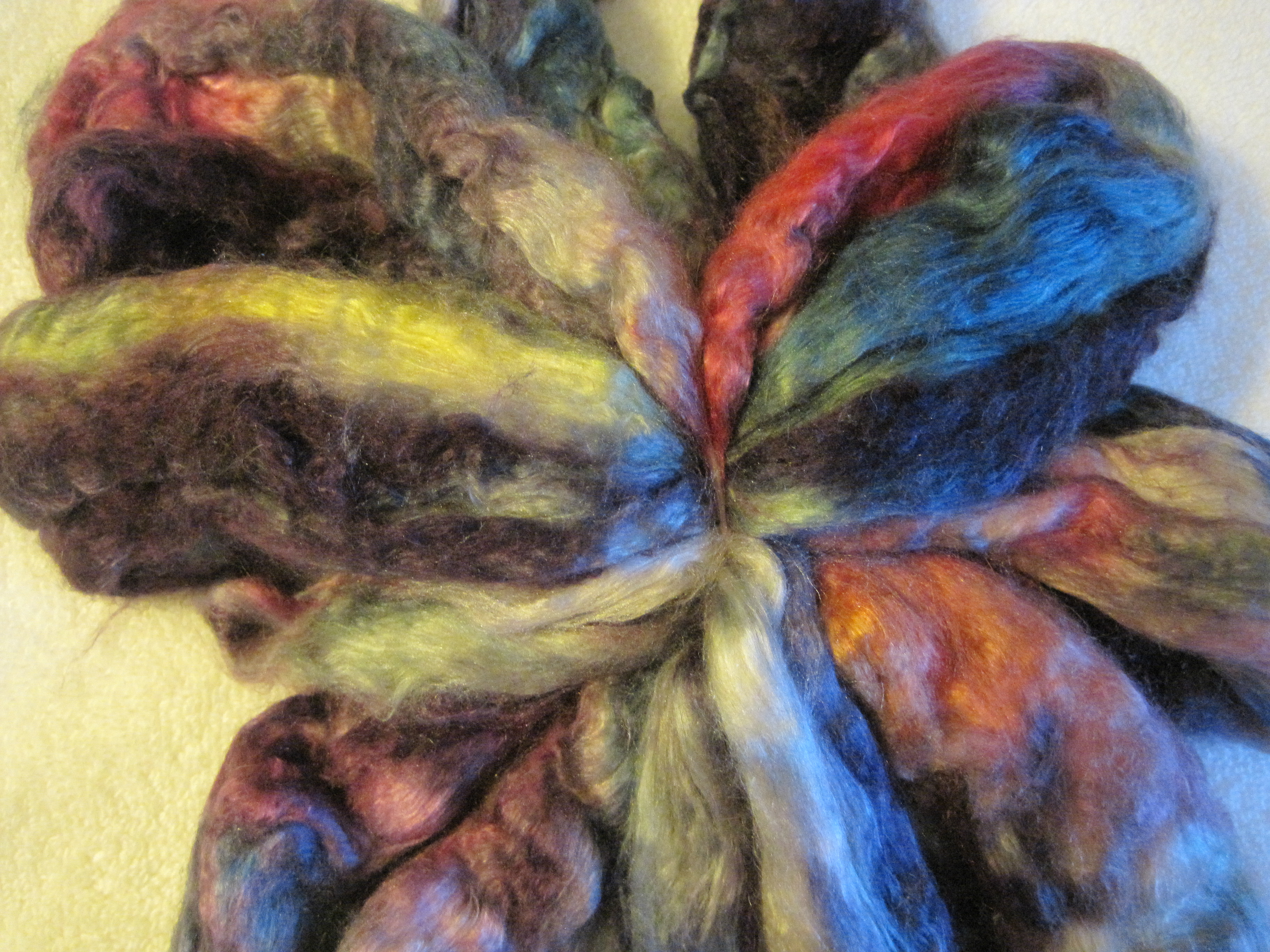
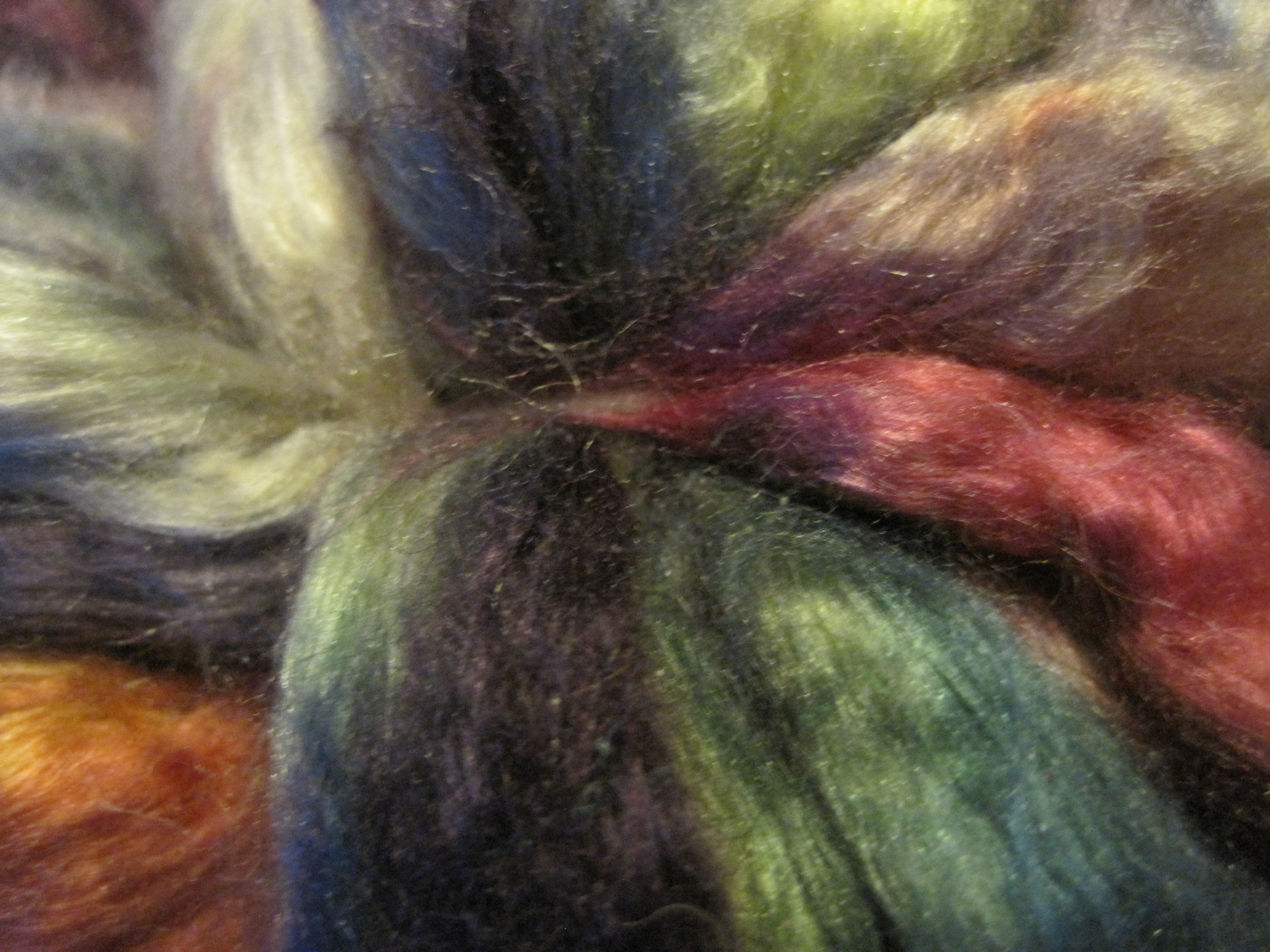
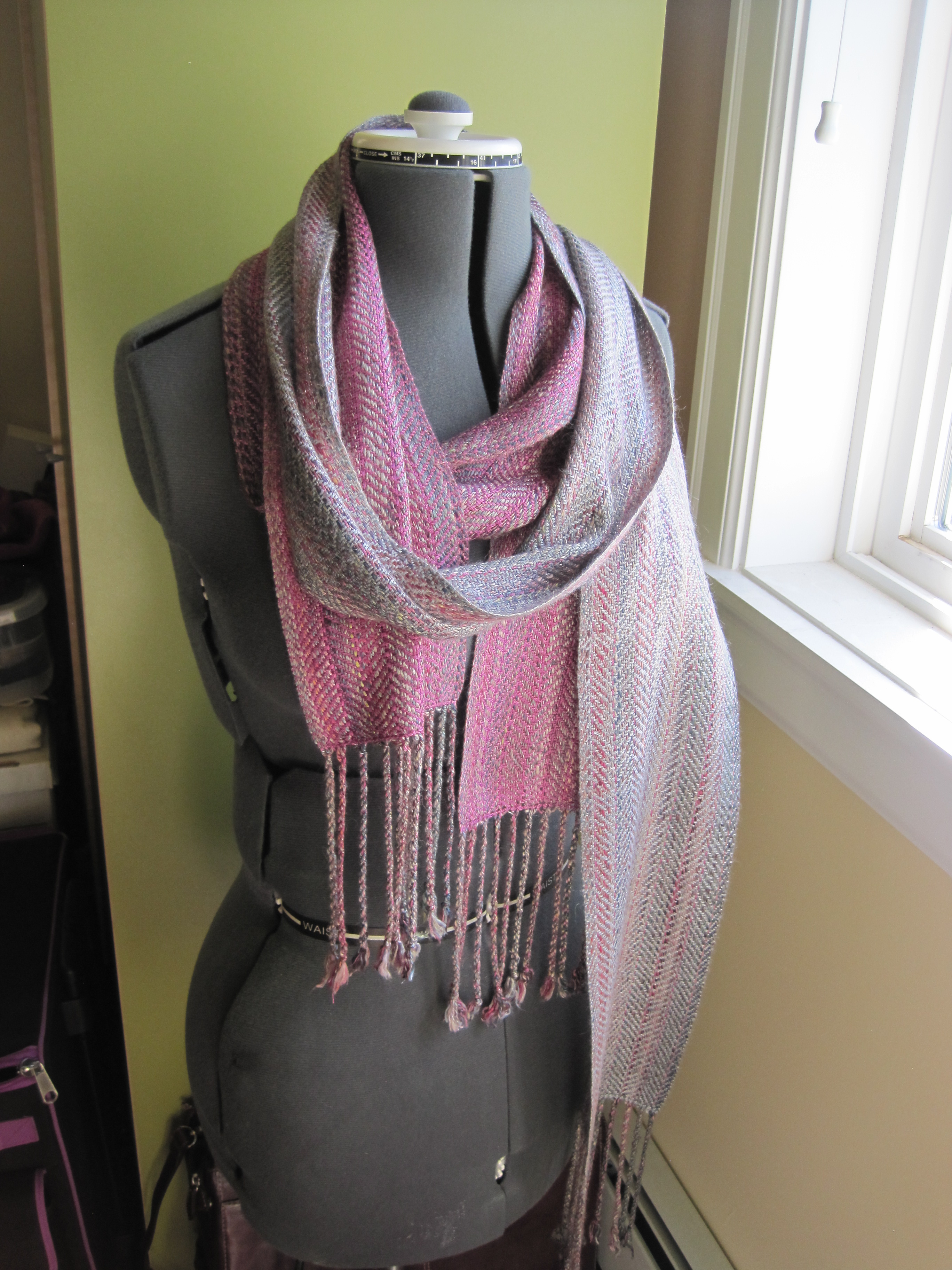
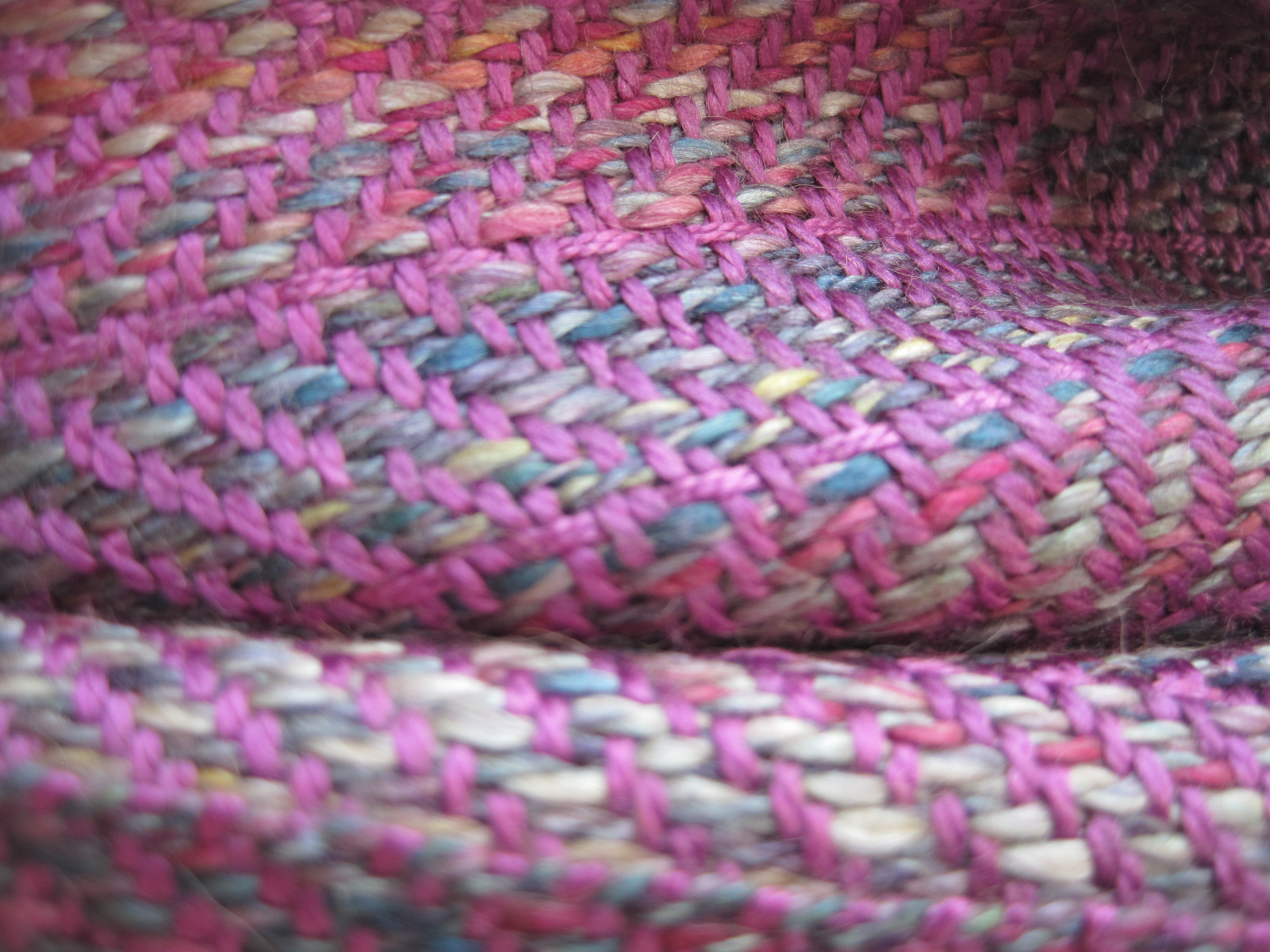
I was first struck by the “feel” of this fibre – an amazingly soft and lustrous fibre of 50% camel and 50% silk, purchased from West Coast Colour and Carding at Fibres West.  Lynne has a fabulous way of dyeing that produces so much more than “What you see is what you get”.  What you see on the surface of the roving are deep, intense colours – in this case, reds, greens, blues, pearls, pinks, purples, and an occasional flash of orange.  What I get through spinning are incredible variations on a theme and colours that do not repeat but instead change across and up and down the roving.  For me this fibre was “love at first sight.”  As I spun it made me think about a tumultuous, tumbling ride along the rapids, reaching slow, calm, waters, and then pulled into the rapids again.  I just kept spinning, eager to see where it would take me, just like being caught in the rush of a new love.

IMG_2879  IMG_2882  IMG_2880

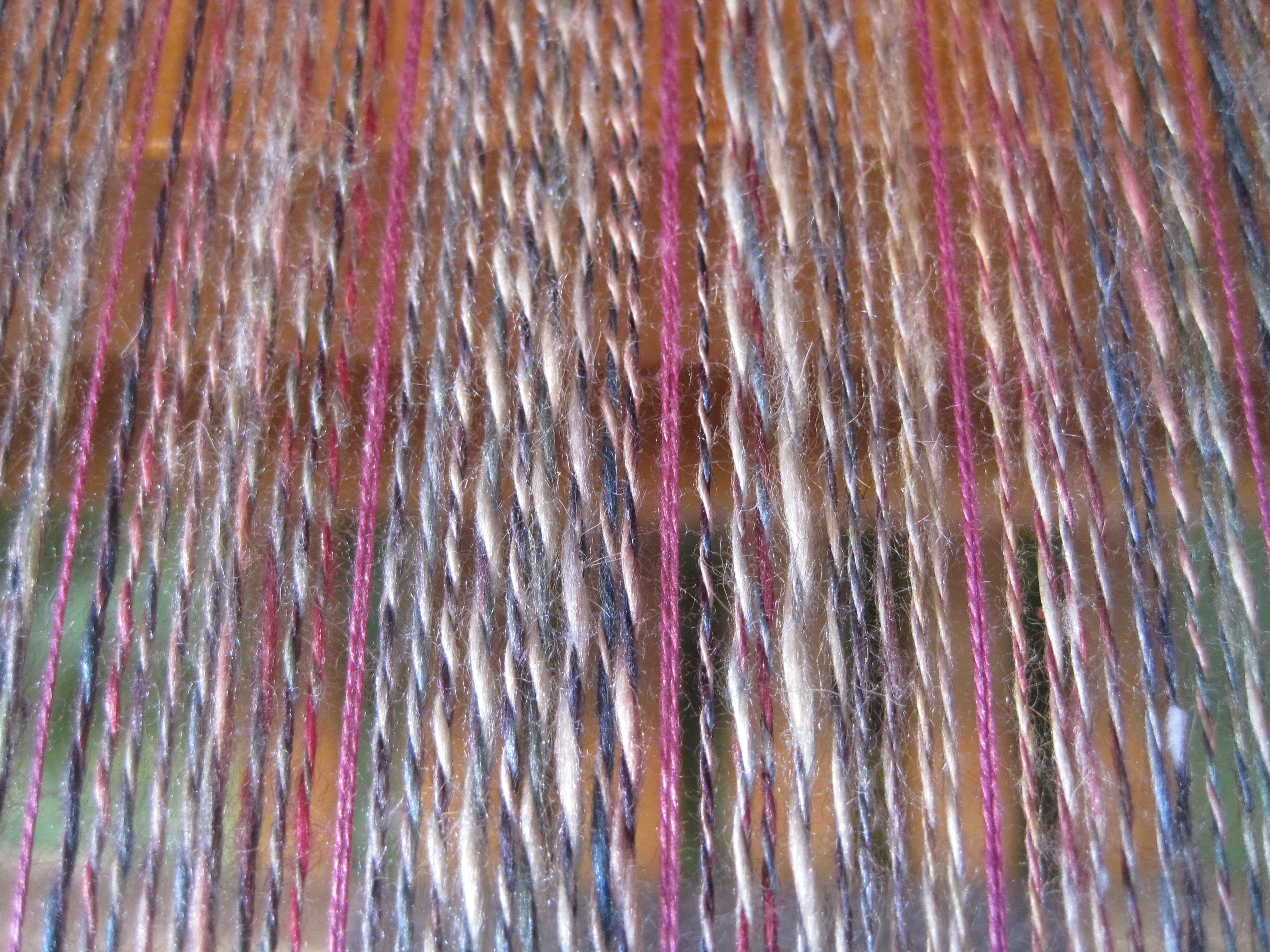
I decided to spin this fibre fine, emphasizing the luster of the silk, intending to use it for weaving.  I got a beautiful random variegated yarn, and made a 2-ply yarn.  I used a short forward worsted draft for stability while weaving.  The fibres drafted easily creating a slippery, high luster yarn.  I continued spinning, moving through colours from fuchsia lipstick to stormy grays.  It was so interesting to spin because the colours were constantly changing.  The resulting yarn is lace-weight, and I ended up with 493 yards of 2-ply from 113 gms (4 oz) of fibre.

And so, on to the weaving.  I wanted to use the handspun as warp and I wanted to create two related scarves.  I wound a warp 5 yards long, and sett at 15 ends per inch.  I was about 10 threads shy of my desired width of 7” for the scarves, so I added 10 doubled ends of 2/20 fuchsia silk spaced out through the warp.

IMG_3015


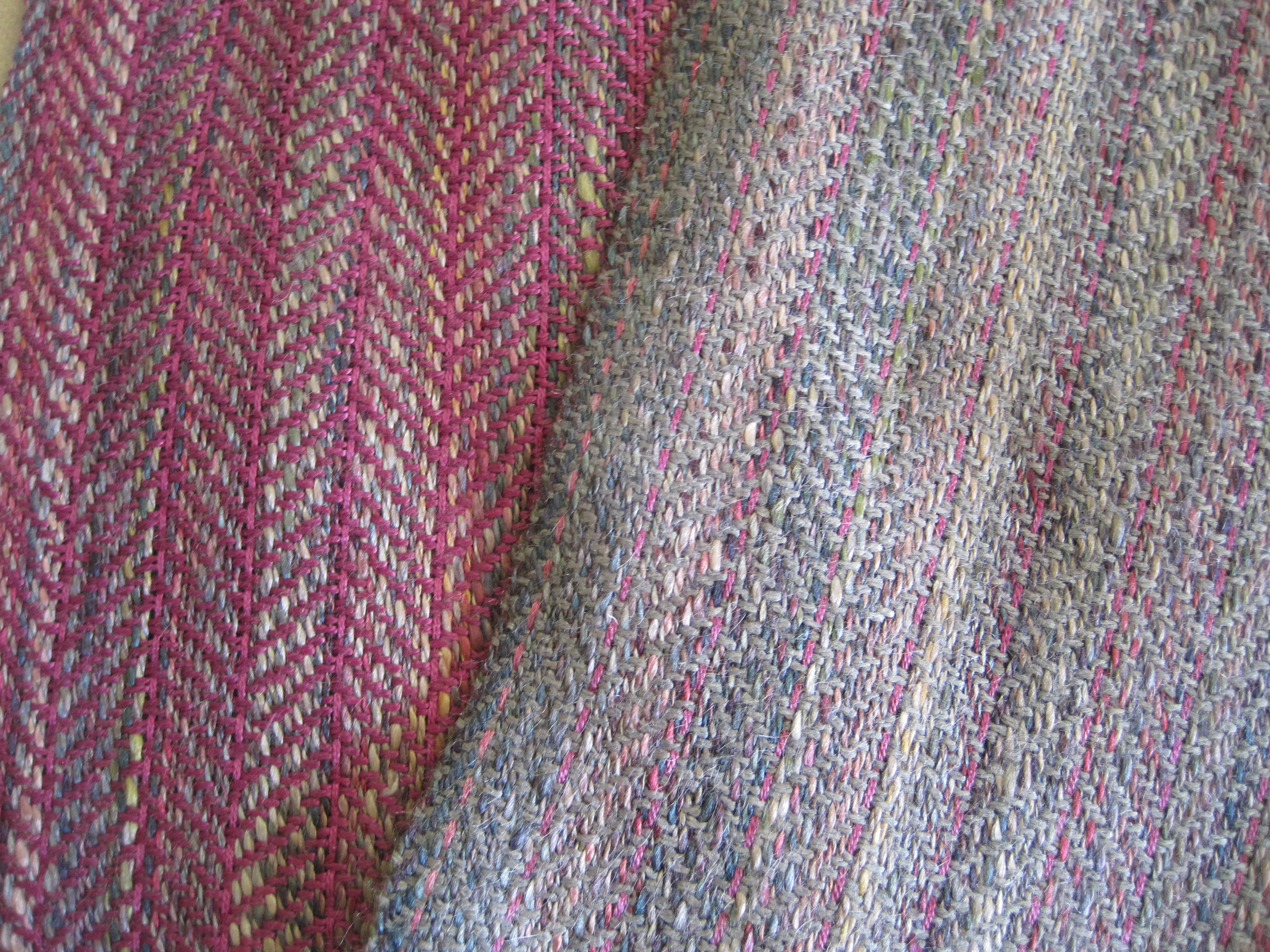
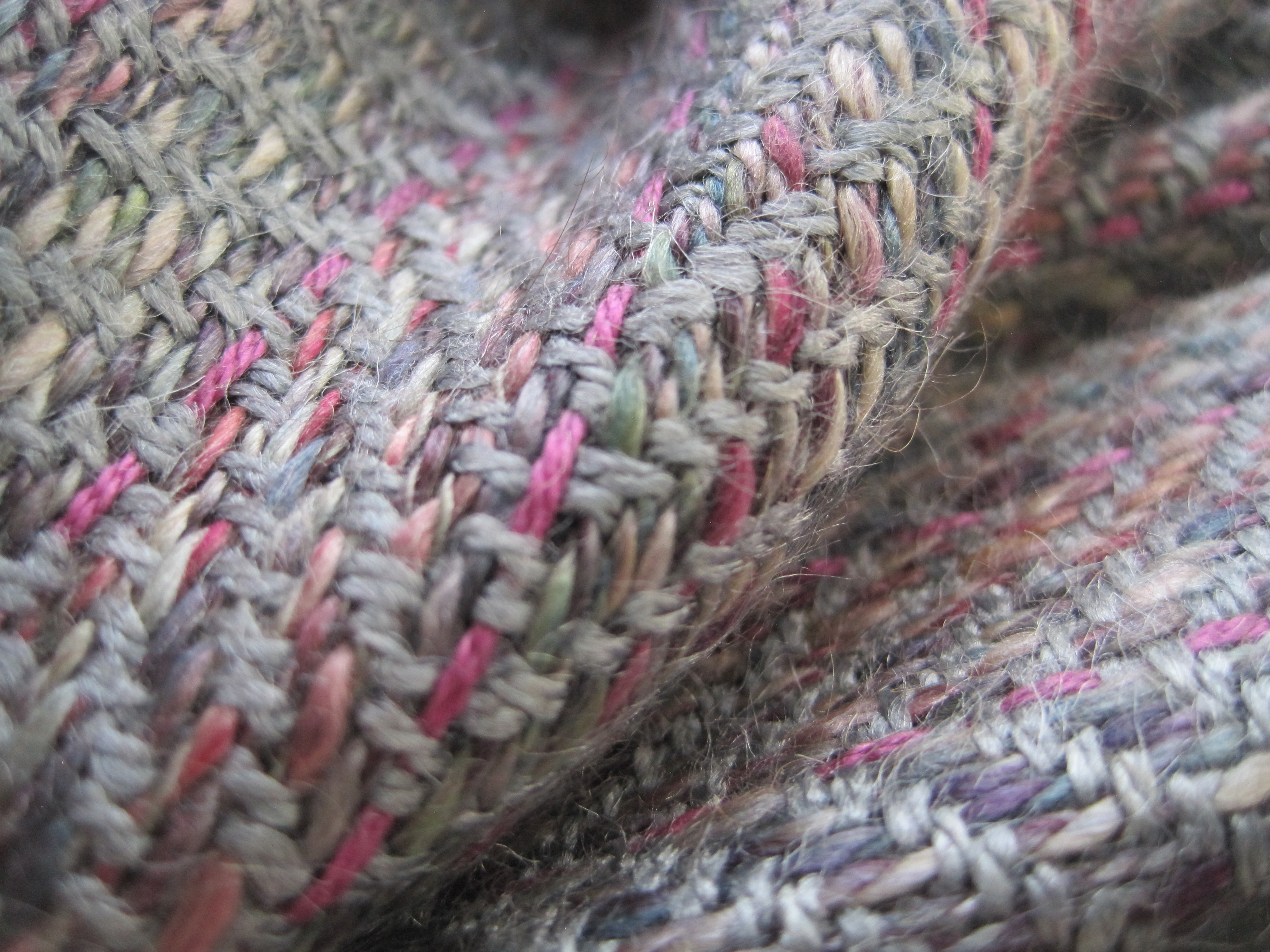
Woven on my four shaft loom, I selected a broken herringbone twill.  I tried to insert a copy of the draft here, but it is in Excel, and will not copy to this format.  I need to research hows to make this work.

For weft I chose 2/20 silk in pale blue-gray for the first scarf and fuchsia for the second scarf .  Both were woven at 15 picks per inch for a length of 72 inches on the loom, excluding fringes.  The ends were twisted and then the scarves were finished with a hand wash in a warm bath with mild agitation to full the yarns, laid flat to dry and ironed while slightly damp with a warm iron set to silk.  Two finished scarves, soft to the skin, with good drape and a pleasure to make from start to finish.

IMG_3021  IMG_3031  IMG_3026  IMG_3029

Posted in Spinning, Weaving | Tagged , , , , , , , , , , , , , , , | 4 Comments

The Beautiful Southwest

Ron and I are just back from a quick trip, one week, in the beautiful southwest of the USA.  This was more of an exploratory trip, with time spent in Arizona, New Mexico and Nevada, looking at places we would like to come back to and revisit.  My focus, of course is on Arts, Culture and History of the region, and Ron’s passion is sports and history, so we both have reasons to want to spend time in this beautiful region.

Travelling around Arizona, and in Sedona we had the opportunity to see the beautiful red rocks, and the opportunity to see how nature shapes the environment.  Nature, wind, water, and centuries of time have created this vista:

IMG_2890  IMG_2896

While in Sedona we visited the ruins of the prehistoric Honanki: Legacy of the Sinagua site.  Tribes of hunters and gatherers, the Sinagua occupied this area from as early as 8,000 BC to about the 15th century AD, building their communal homes under the relative safety of the cliffs.  this really defines “keeping the wall at your back”. Forgoing doors, the people used ladders to climb to the roof of their buildings, and ladders again to climb down inside.  At any sign of danger, the ladders could be taken in, making attack very difficult and providing safety for the families.  I stood in this spot and tried to imagine what life must have been like for the women, particularly, as they worked hard to provide food, clothing, shelter and comfort for their families.  It makes me appreciate even more the luxuries I have in my own life.

IMG_2913  IMG_2903

IMG_2908

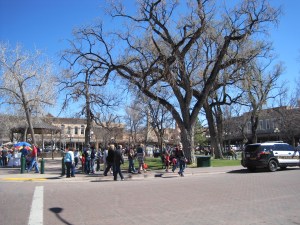
Next stop was Sante Fe, New Mexico,  a wonderful, artistic, beautiful, exciting book of cultural magic.  We only stayed overnight here, so I really only got to see the cover of the book.  I definitely want to come back here and spend more time to explore the volumes it has to offer.   Great food too!
IMG_2939 IMG_2940

IMG_2941  IMG_2938


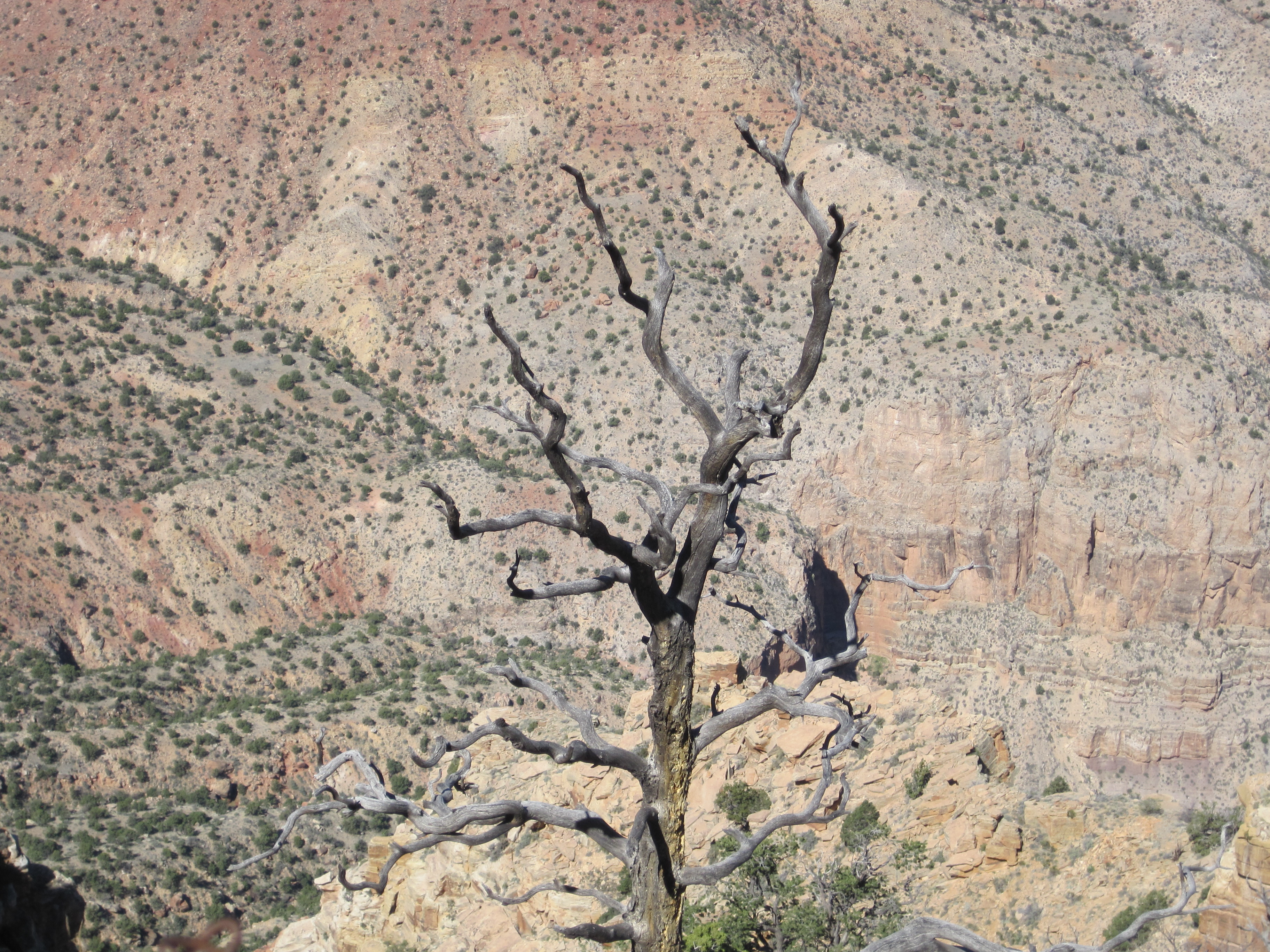
Next stop was the Grand Canyon.  What can I say?  It took my breath away.

IMG_2944  IMG_2961

IMG_2994  IMG_2968

Then on to Las Vegas.  Hmmm, not really my cup of tea.  Too many people, getting pushed and jostled, and overwhelmed by the buzzers and bells and flashing lights.  I swear the hotels are designed to make sure you can’t walk directly from point A  to point B, but need to take a long circuitous route around designed to pass as many slot machines as possible.  I’m not a gambler at all. For me, I worked really hard to earn my money, and don’t want to throw it away on a five minute dream.  That said, our room was very well appointed, and we did get to see the Cirque du Solier Michael Jackson One show which I really enjoyed.

Back to Scottsdale for out last night, delicious food, great service, and then home again. Home with a pocket full of sights and sounds, colours and tastes and smells and a head full of artistic ideas.  Looking forward to seeing more of this area in the future.
 

Posted in Travel | Tagged , , , , , , , , , | 1 Comment

Spring Break Spinning

Well, Winter Sessions have finished and Spring Break brings a much needed teaching break.  This was my first year teaching the Spinning and Dyeing class at Place des Arts, and along with teaching some new Intermediate Weaving workshops, I experienced a very steep learning/teaching curve.  This meant preparing for class, spinning and weaving numerous samples, preparing dyes, making handouts, testing drafts, and general thinking about what to teach and how to teach, and most of all, making sure everyone had enough attention and materials.  I poured 100% of my focus and passion into this and was constantly reminded of why I love, love, love teaching.  The students were happy and said that they enjoyed the classes, and learned a lot.  Not everything went perfectly, of course, and I have notes and feedback that will help the next sessions run even smoother.
Fibres West 2015, held last Friday and Saturday, was a wonderful 2 day event, with shopping available from over 50 vendors, classes available in felting, knitting, spinning and lace making, and demonstrations from both guilds and makers.  The colour seminar from Jane Stafford opened my eyes to new ways to put colours together simply and effectively, and I certainly will try some of her suggestions.  I particularly loved walking around and talking to friends old and new.  I brought some of my work to show to the vendors I purchased materials from last year how I used the fibres and yarns.  I also really enjoyed seeing the work of some of my students – fabulous fun to see where they pushed the boundaries.  Lately, I’ve been spinning:

Superwash Merino and Silk

Superwash Merino and SilkIMG_2855

Merino/bamboo/silk

Merino/bamboo/silk

IMG_2867

current project, 50% silk, 50% camel

current project, 50% silk, 50% camel

These yarns from West Coast Colour and Carding, have marvelous depth of colour and subtle nuances, hard to see in the pictures, but wonderful in the yarns.  Reminds me of river rocks in the sun and dappled shadow.  The next challenge will be to actually make something from the yarns I spun!

And I have been weaving:

IMG_2834

Finished front of scarf

Finished front of scarf

finished back of scarf

finished back of scarf

This scarf is in deflected double weave, in Zephyr wool/silk, set and woven at 20 ends per inch.  It was so open on the loom, and was a challenge not to beat too hard.  Washed and finished, it has a lovely soft drape, you just have to feel it!

The rest of my weaving over the last two months has been for classroom samples.  More on that at a later date.

Posted in Spinning, Weaving | Tagged , , , , , , , , , , , , , , , | 6 Comments