Linda’s Blanket

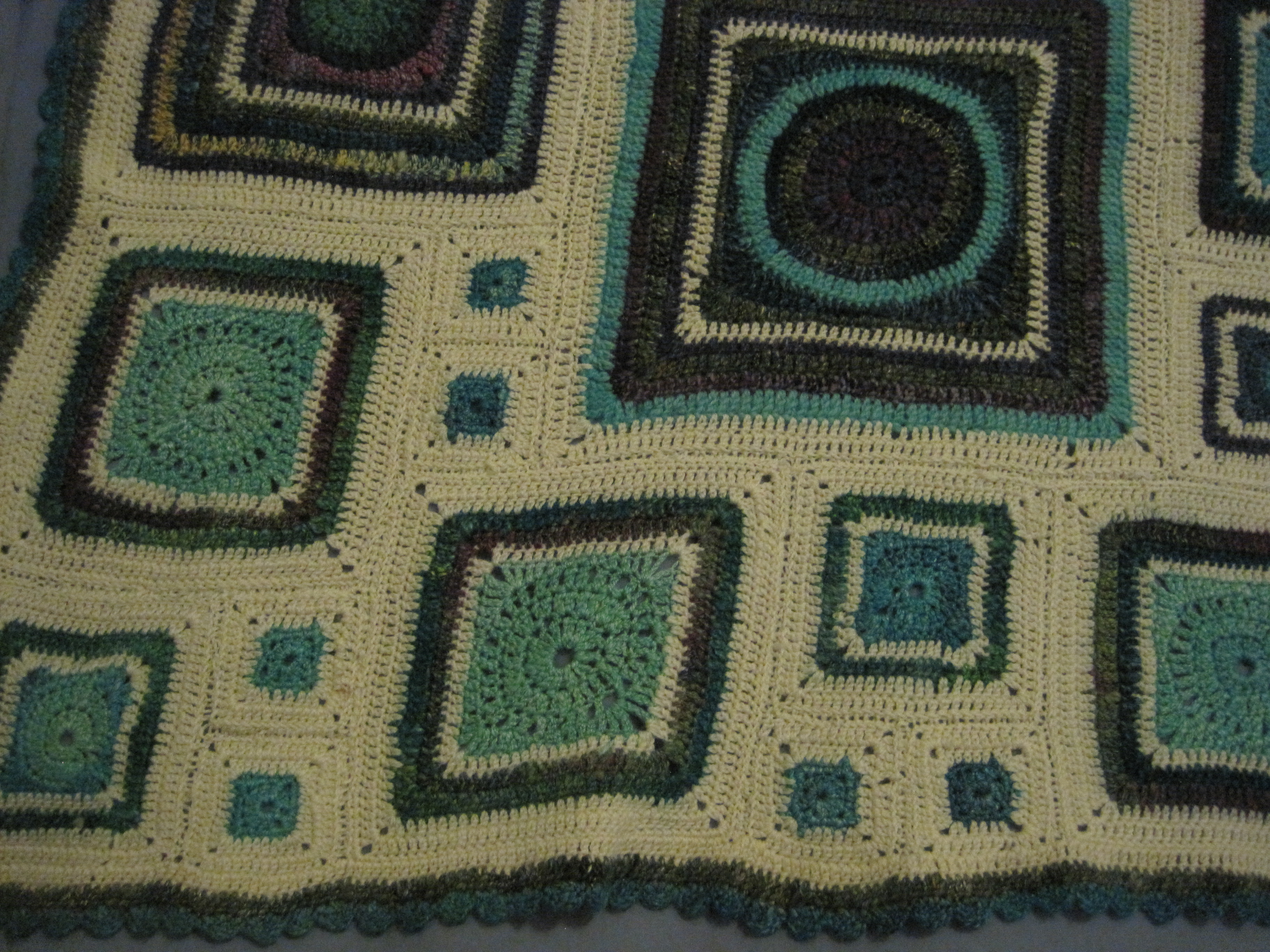
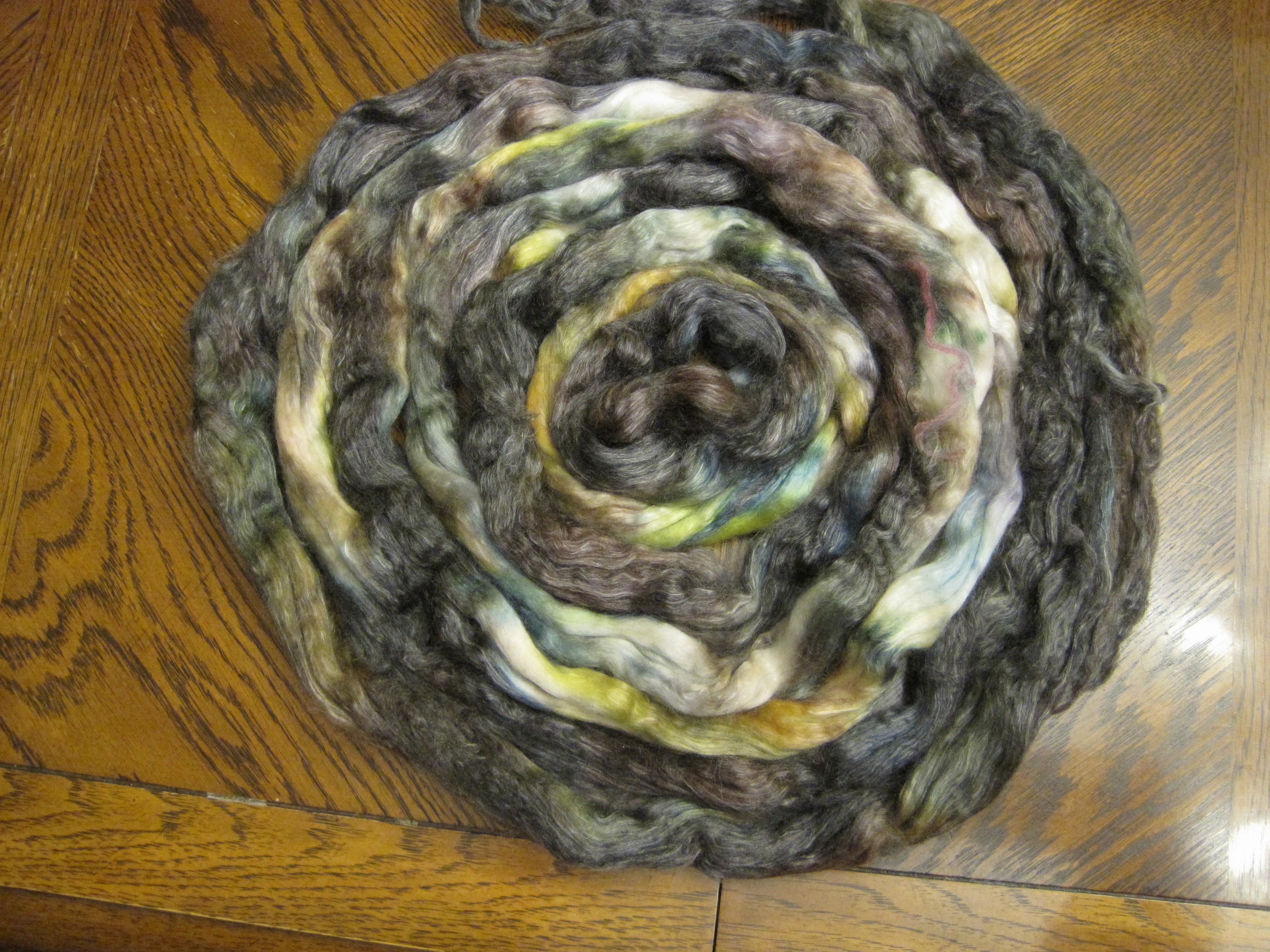
My sister Linda had always been a sassy, spunky gal, but in early July I got the call that Linda had been diagnosed with lung cancer (yes, she was a smoker), and was to undergo Chemo right away.  I hopped on a plane to Toronto to spend time with her while she underwent her treatments.  Before I left home I grabbed a skein of handspun, and my crochet hook, intending to keep my hands busy and to make a shawl or blanket for Linda’s recovery.
IMG_2571

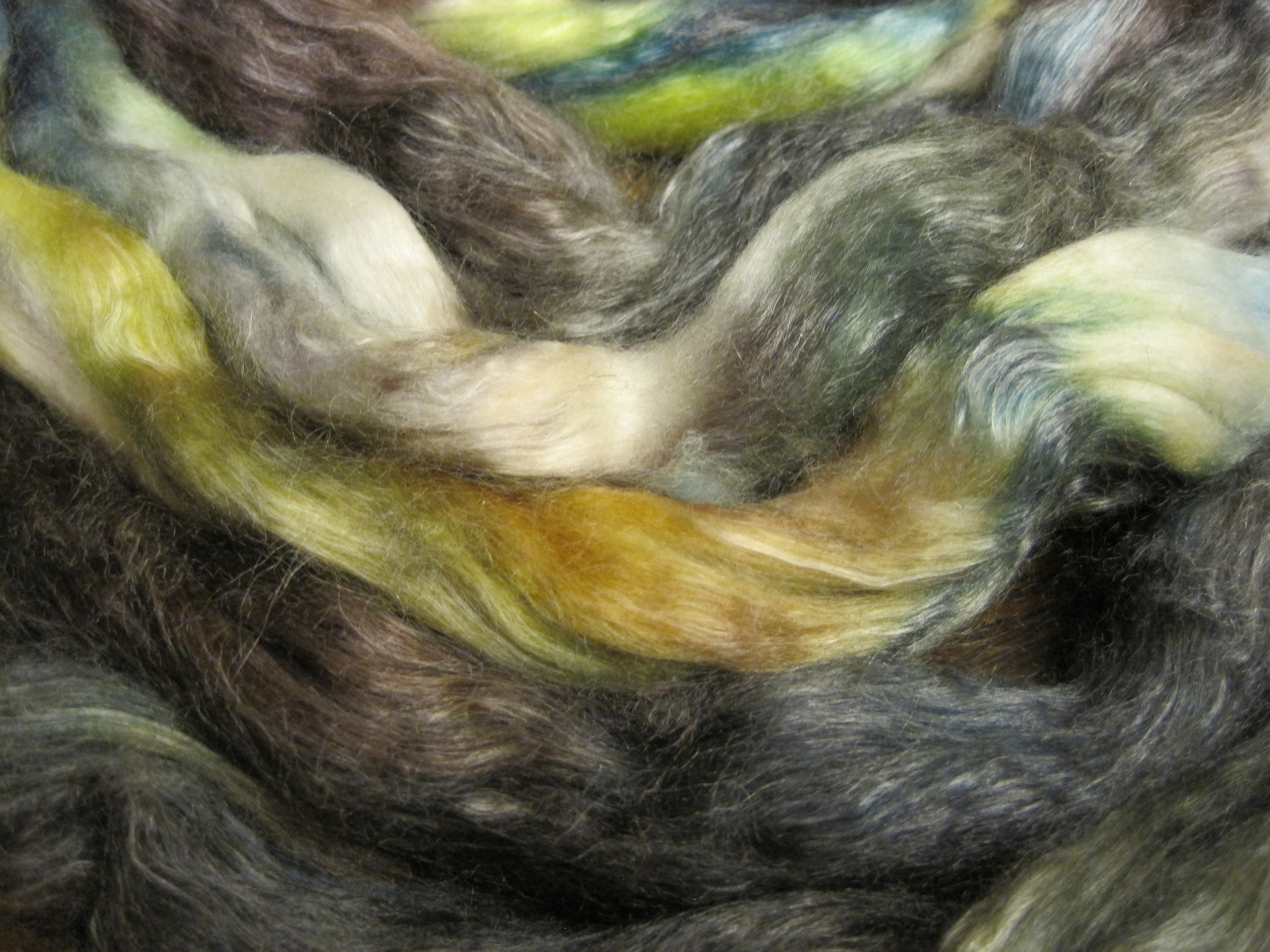
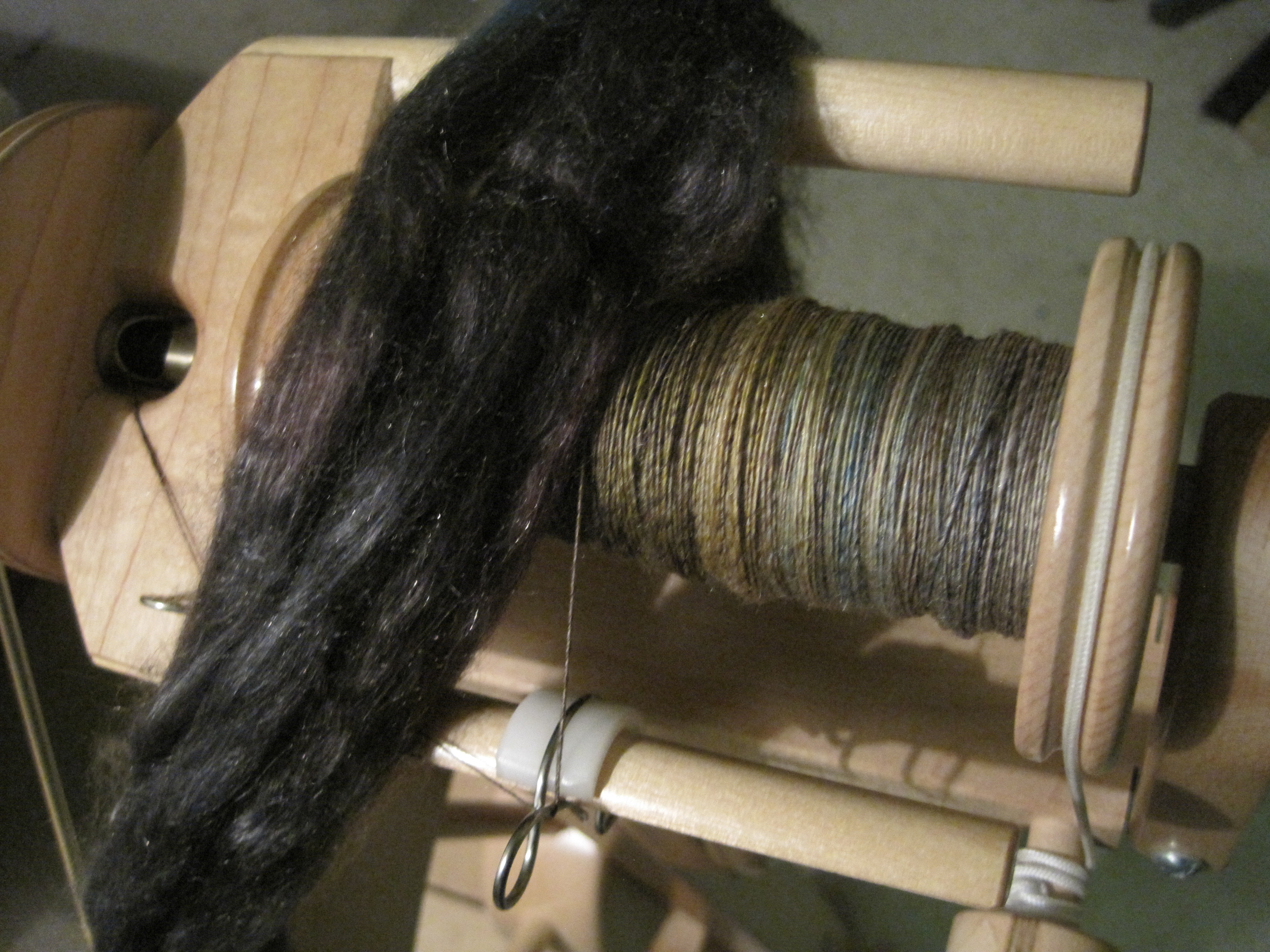
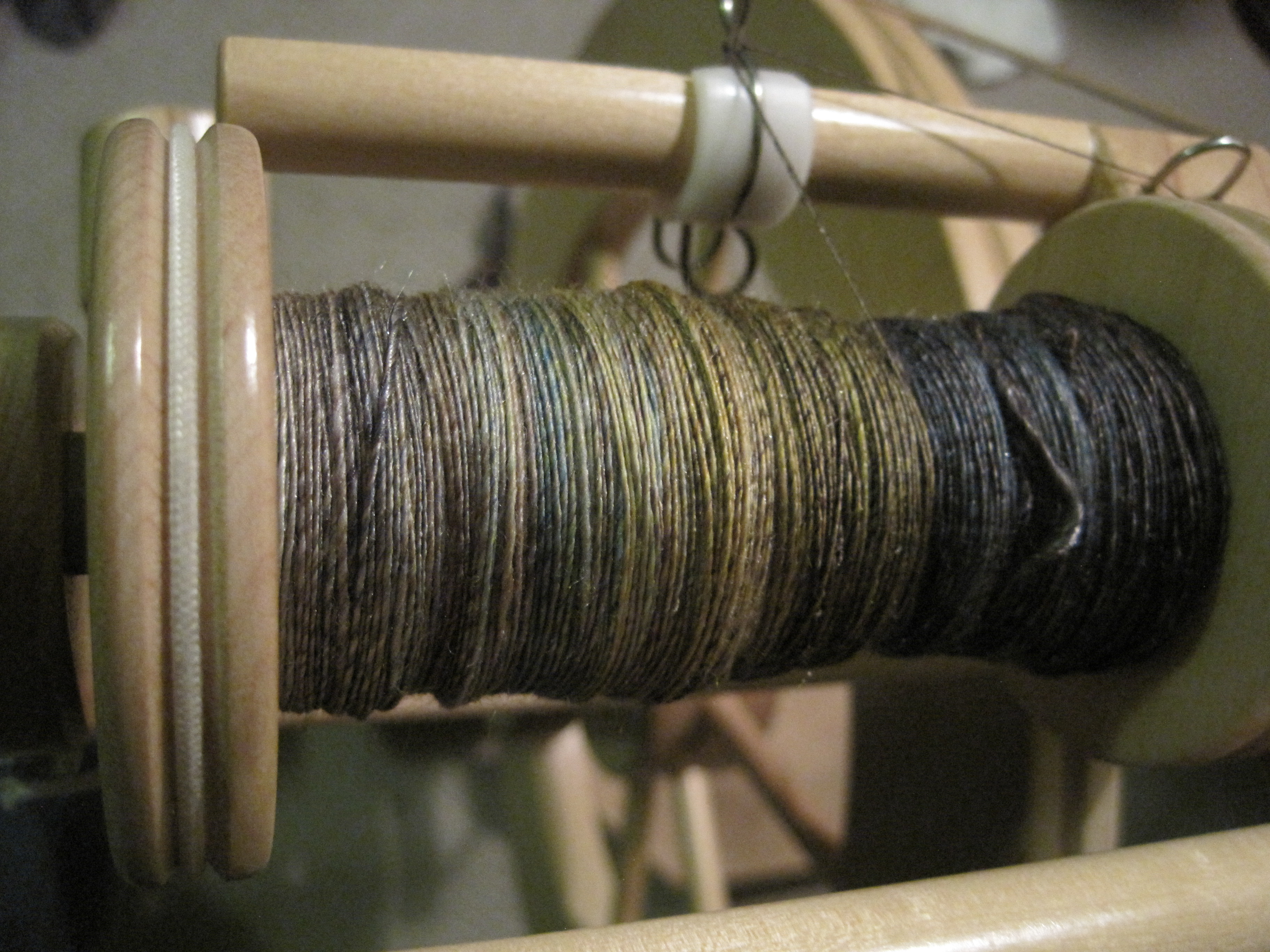
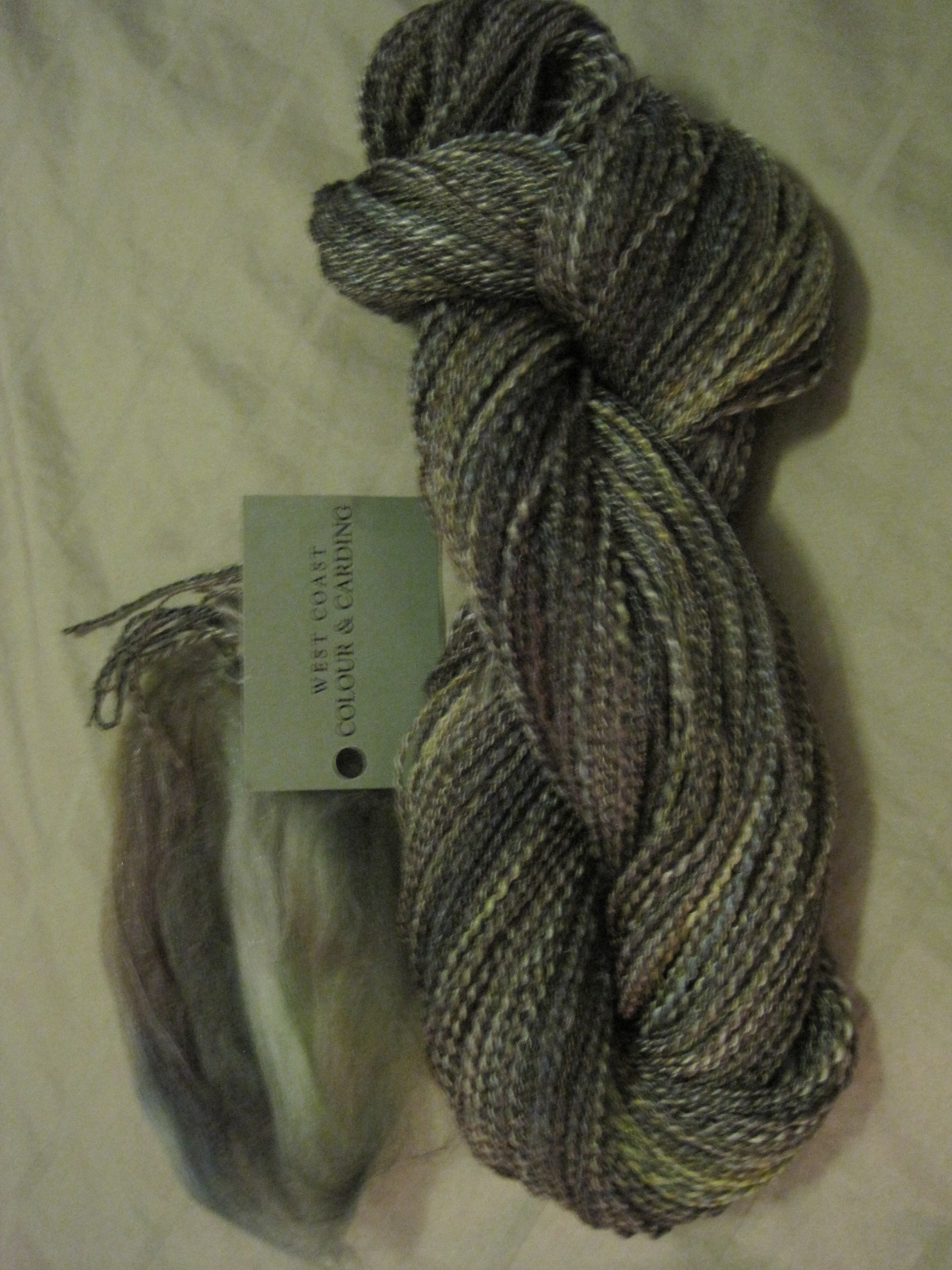
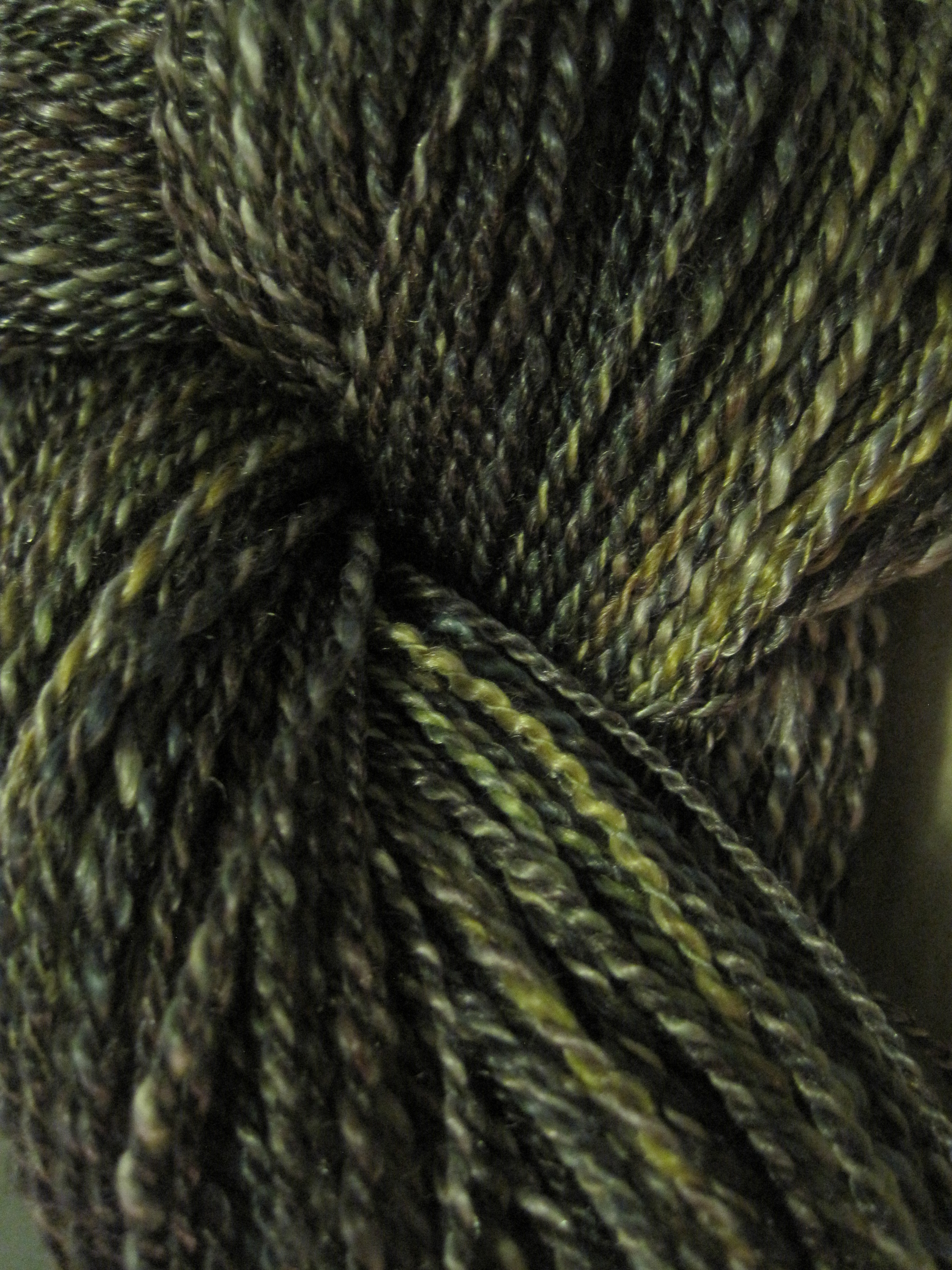
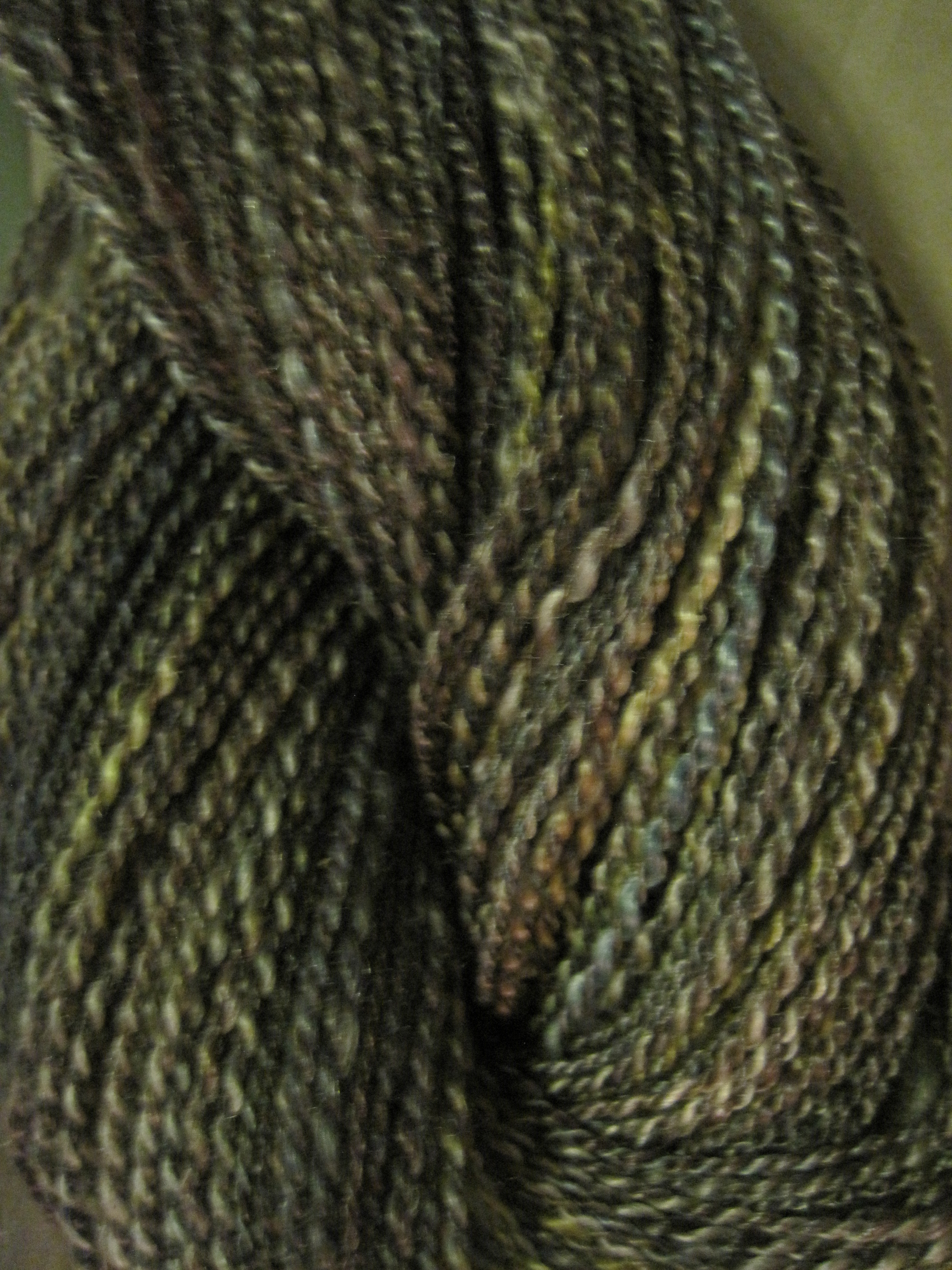
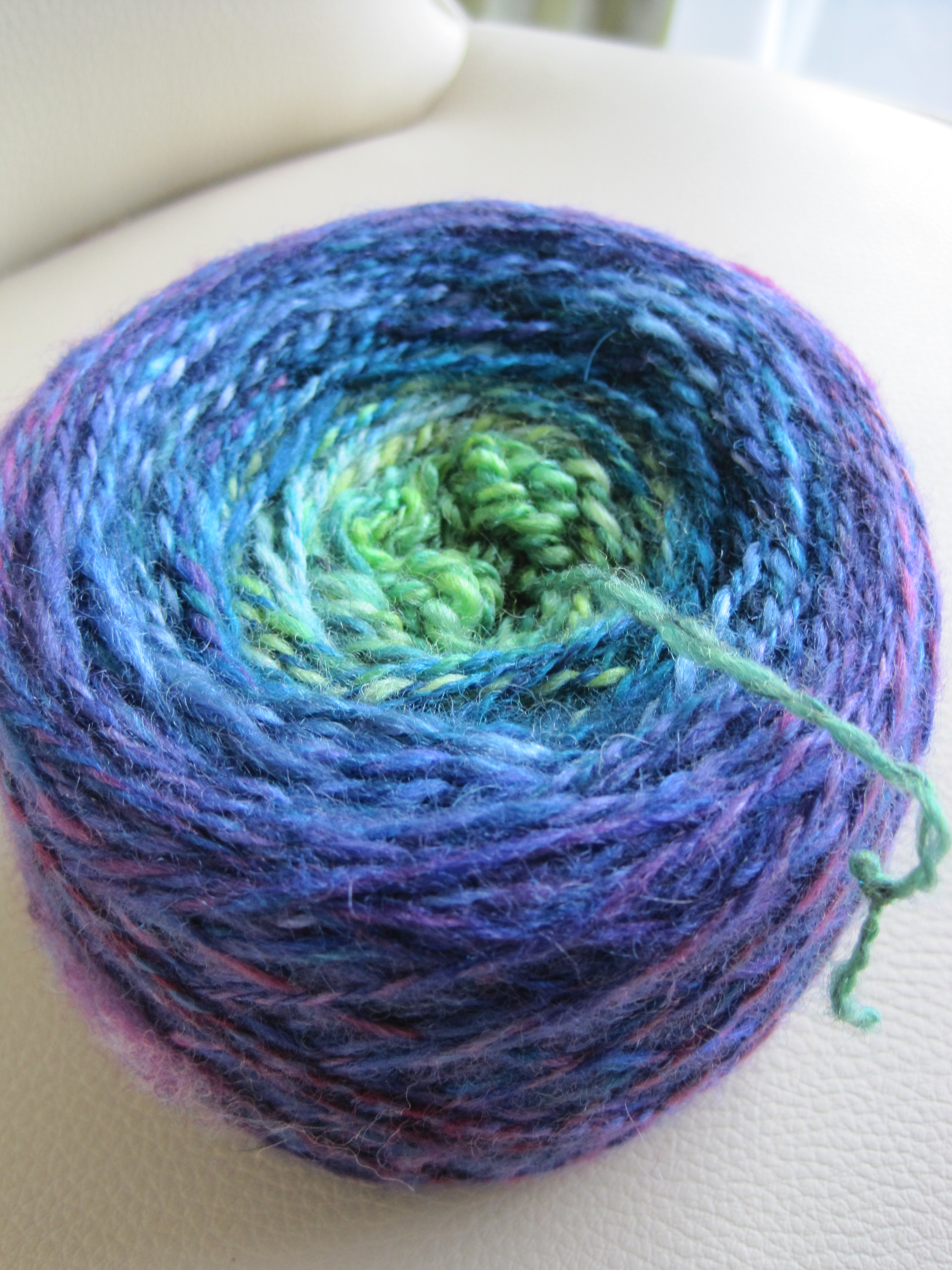
This is a very pretty Merino silk blend, spun 2 ply, and spun to move the colours from green-turquoise, through turquoise, blue and into purple-blue then purple. Calming colours of ocean and sky.

I started crocheting on the plane, touched down and rushed to the hospital to meet the rest of the family and received devastating news.  Linda needed emergency surgery to repair a tear in her bowel, and although she struggled bravely to recover, her body was not strong enough.  I had only a few days to be with her and then she was gone.

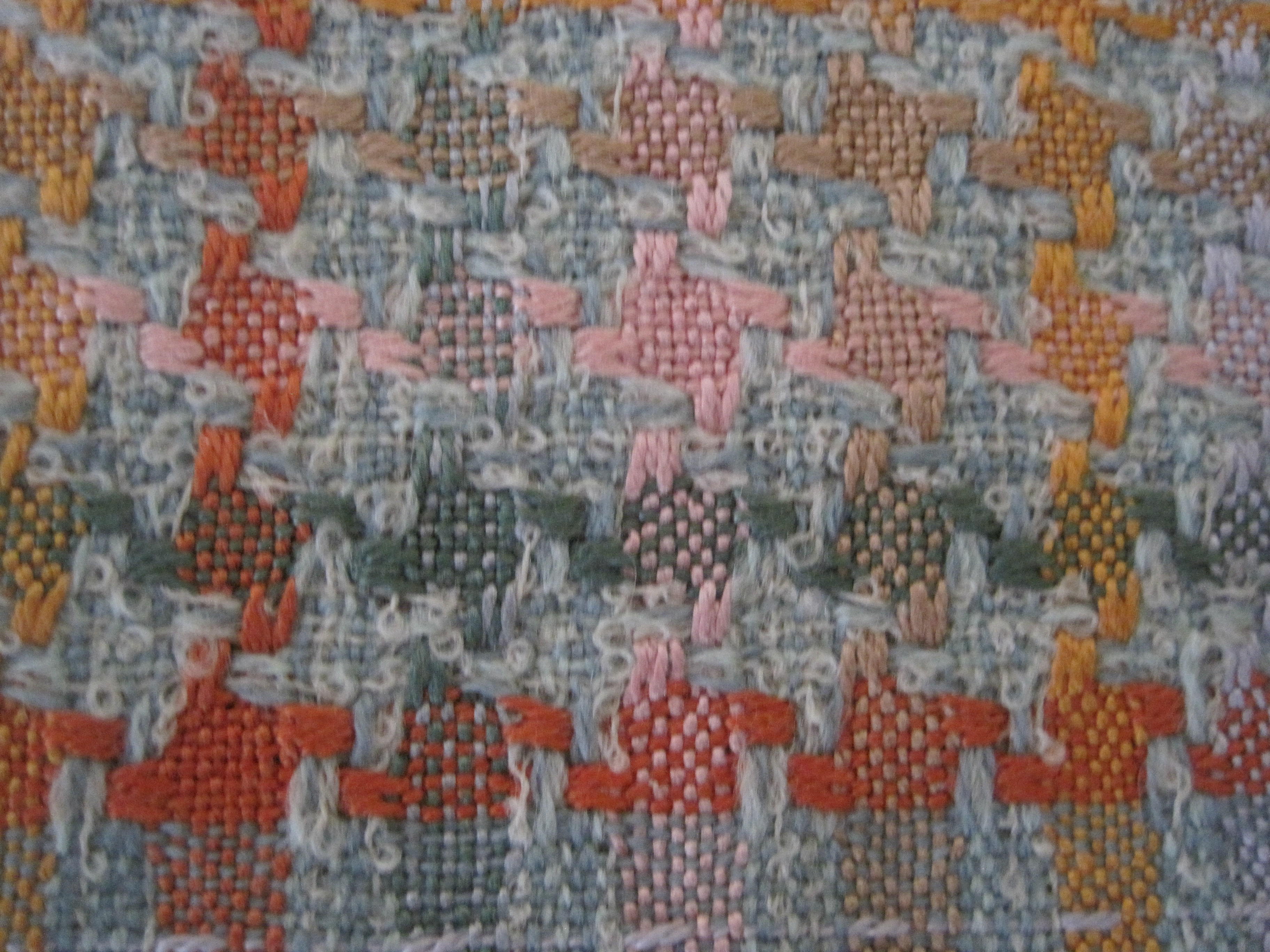
Now, instead of a blanket for Linda, this became a blanket of memory of Linda.  I continued to crochet, and as I made the squares, I thought of her, and the threads of our lives.  Linda and I were so close in age, and as sisters, we had a special, shared childhood, we were innocent together.  We shared a bed for most of our growing up years, and shared secrets and laughter and love as we whispered into the night.  From first tooth to first lost tooth, first love to first lost love we laughed and cried.  We shared dresses and dreams.

As adults we followed different paths and different lives and lived so very far away from each other, but family gatherings brought us back together and we stayed connected.

As I continued to crochet, thoughts of Linda were never far, and as I quickly used up the first skein, I added in more and more balls of handspun, reminding me that we are connected by threads to each person in our lives.  I worked through my grief and my recovery and I learned to slow down and appreciate every thread, both in the blanket and in life.  And now I have a beautiful blanket to wrap around me on a cold winter night.  A blanket that is soft, and warm and comforting.  Linda, this is about you.  I love you, and I miss you, and you will stay in my memory forever.
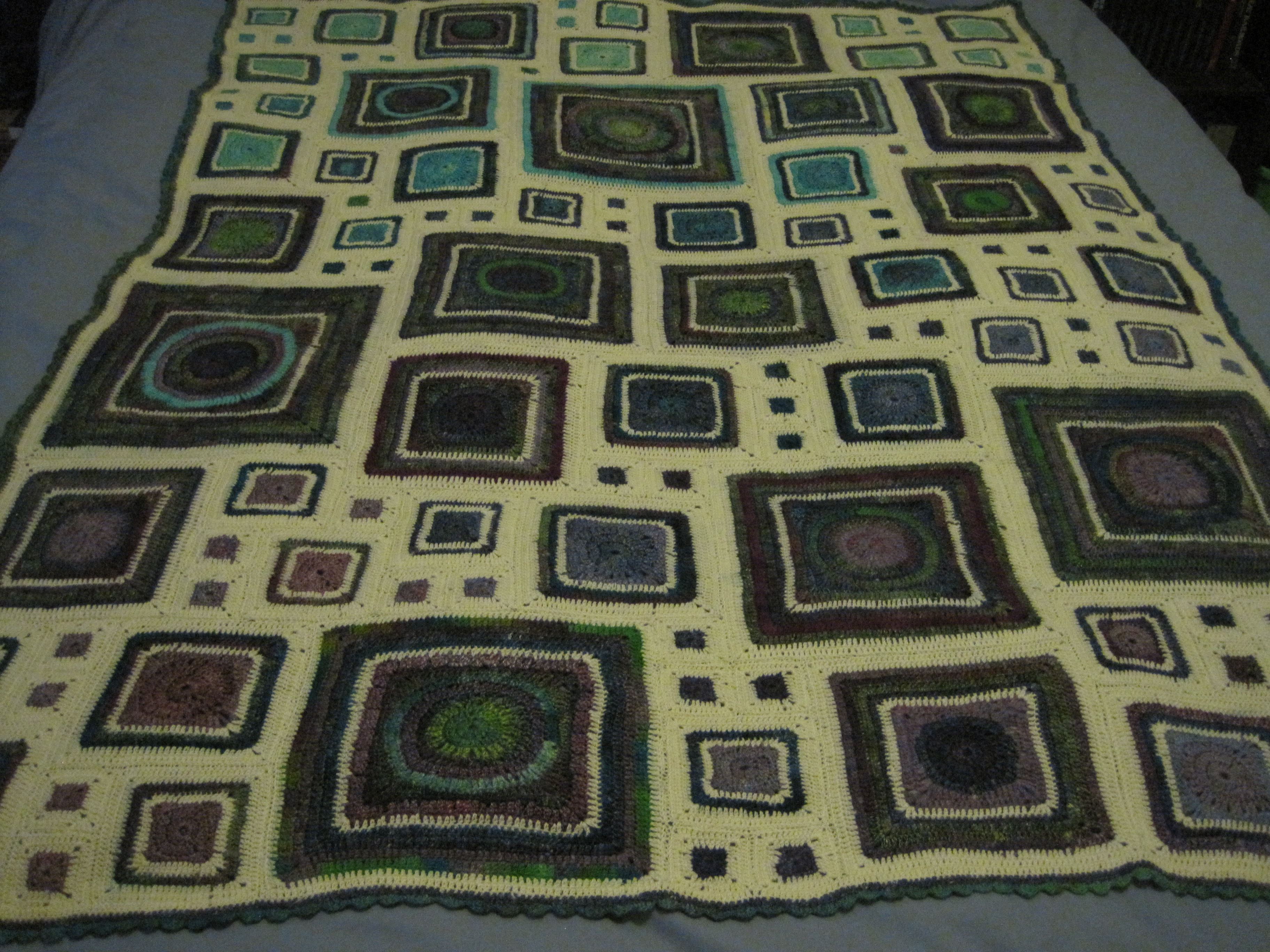
IMG_2818  IMG_2822  IMG_2821

Posted in Essays, Spinning | Tagged , , | 6 Comments

Autumn Towels in Summer and Winter

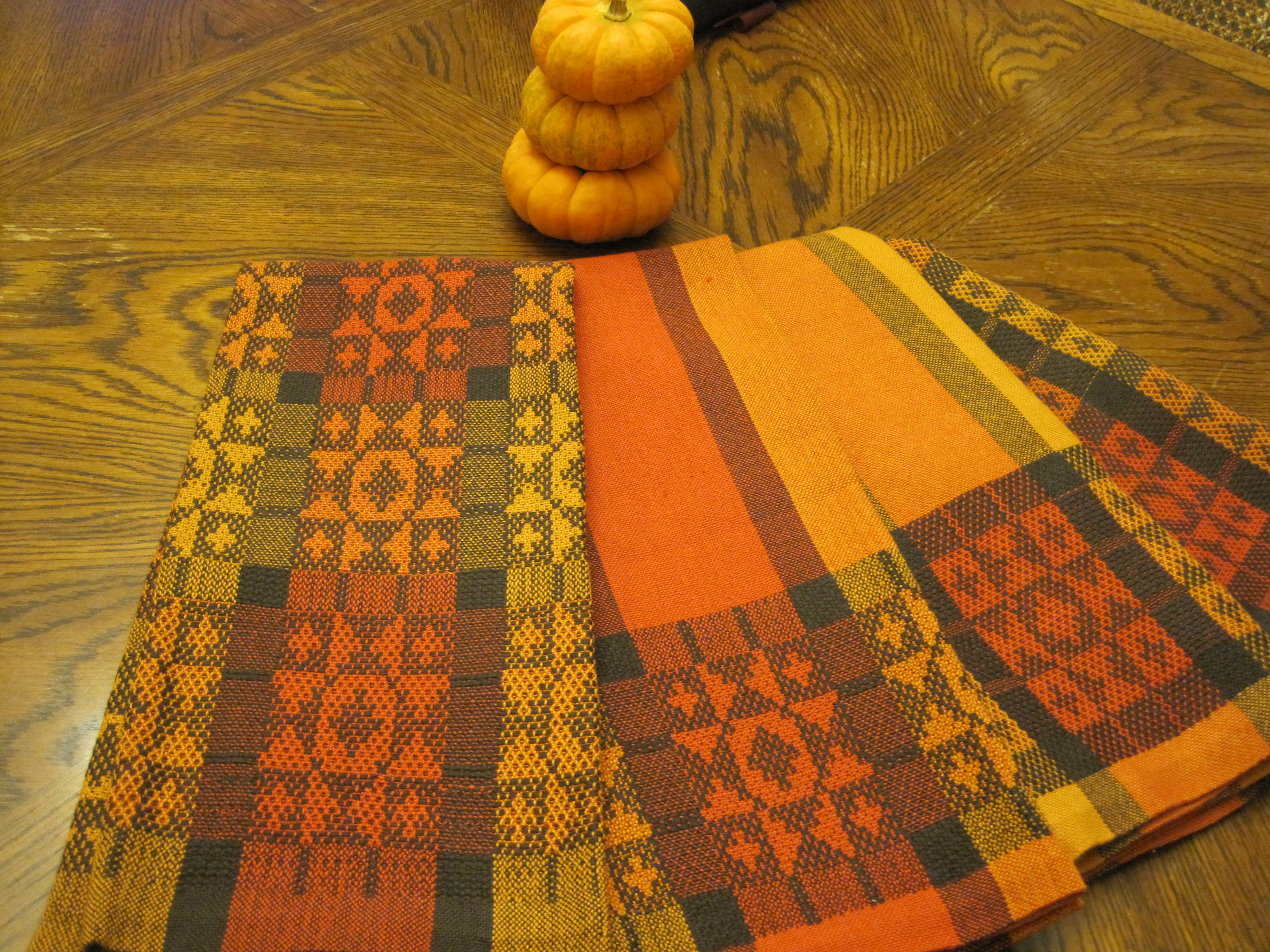
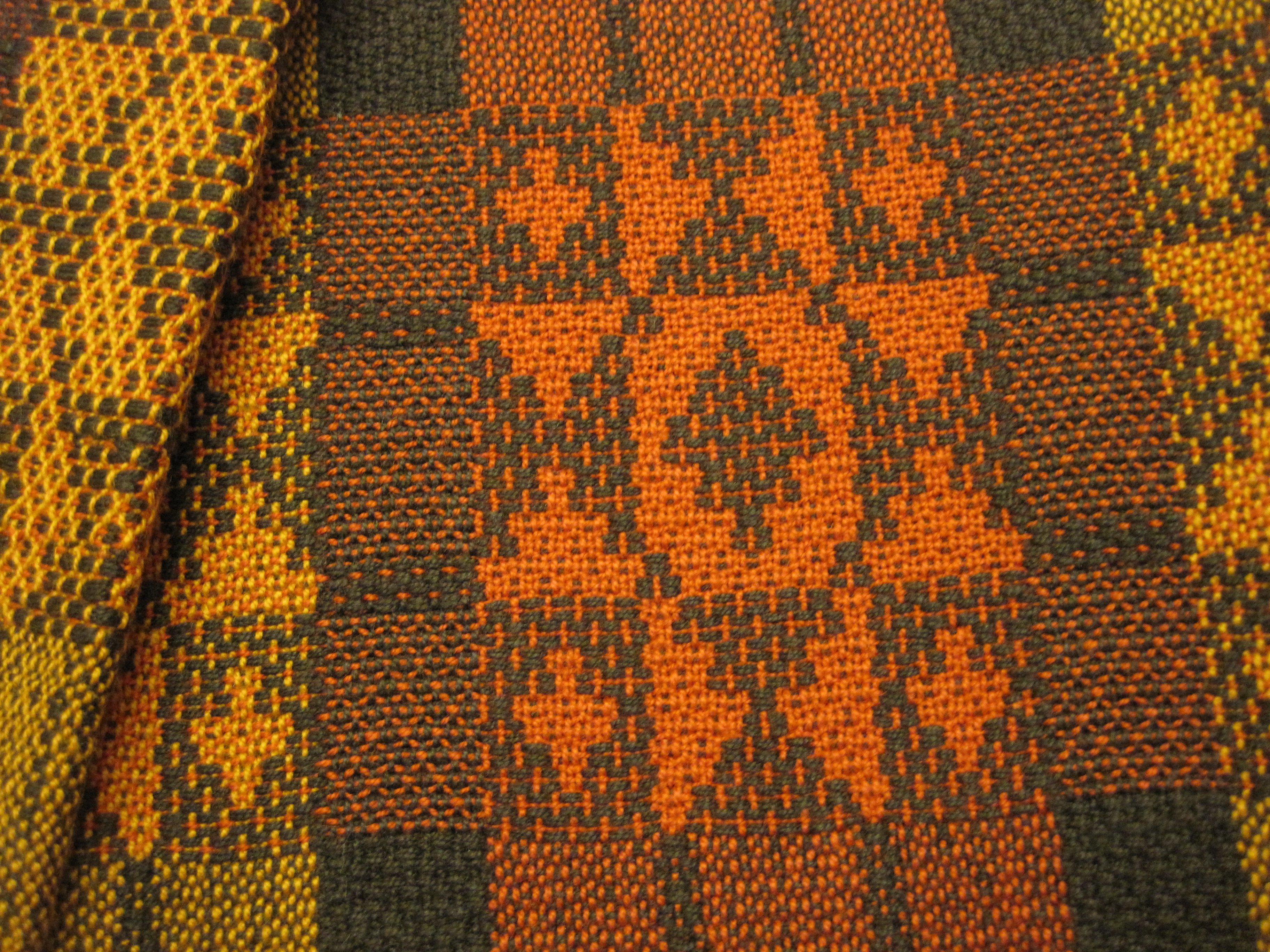
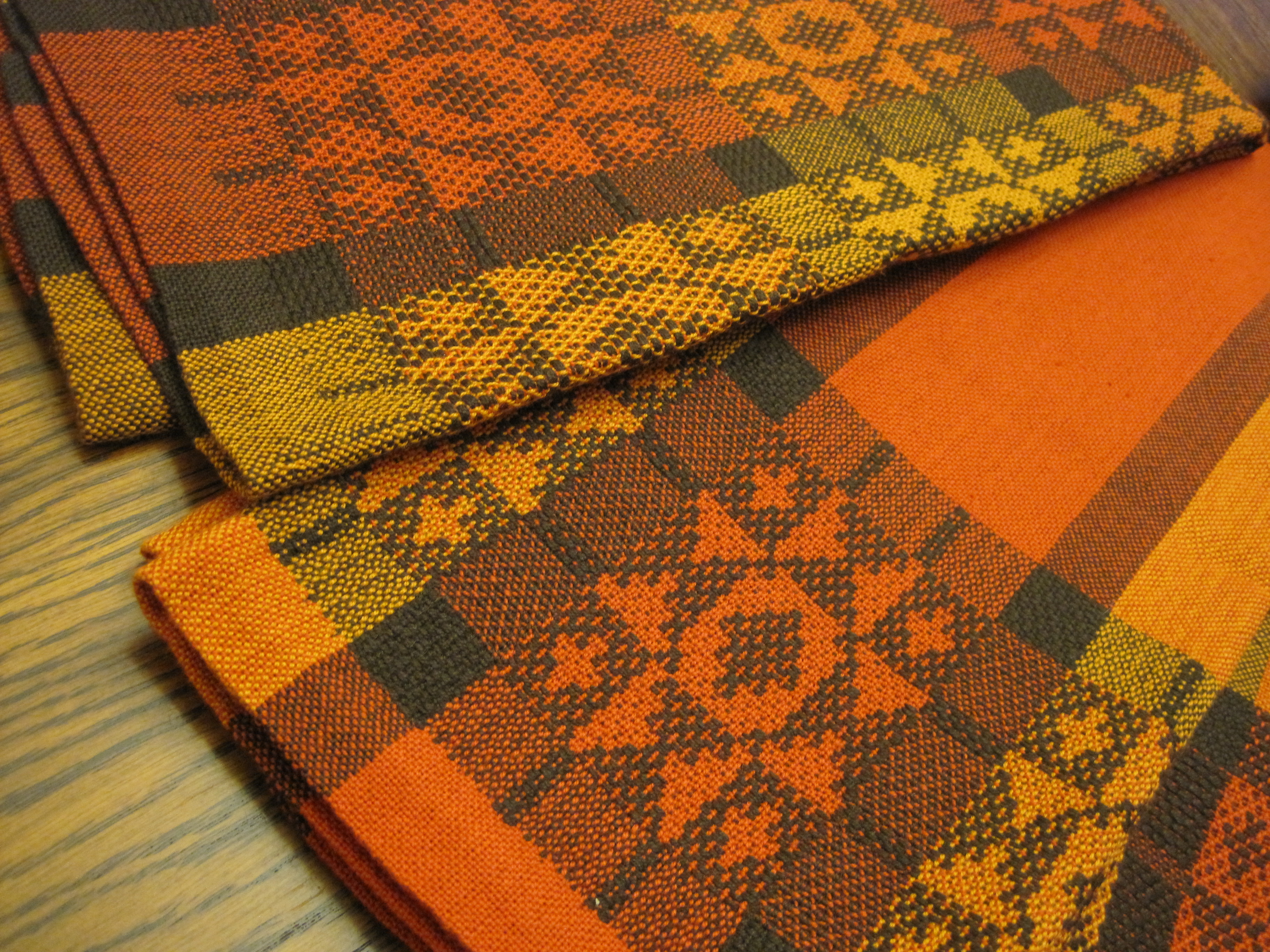
It is truly Autumn here in BC.  We had a long extended summer with lots of sunshine.  This week the rains started and the weather turned colder.  It happens every year, the leaves start to turn and then it rains and is windy and all the leaves are on the ground so quickly.  These towels capture the rich browns, golds, reds and oranges of the autumn leaves.  These are woven in Summer and Winter weave, inspired by the Quilt Blocks Towels in “Handwoven” magazine, Nov/Dec 1990, page 54/55.  This is woven in 2/16 cotton in dark brown, gold, and red-orange, and set at 25 ends per inch.  Woven on Loomella, my 8 shaft Baby Wolf loom.  The dark brown is doubled to use as the pattern thread, and all three colours are used singly as tabby.  Two of the towels have the pattern repeated through the length of the towel.  The other two towels have one pattern repeat at each end of the towel, and the rest is plain weave, using gold on one towel, and red-orange on the second.
autumn towels 1   Autumn towels 3  Autumn towels 5


I’m waiting for the rains to stop and dry up a bit, and then I can take a walk in the park.  My favourite part of Autumn is finding a cool, crisp, dry, sunny day, and crunching through the dried leaves on the ground, kicking them up in the air to watch the leaves swirl down again.  Great fun to play this game with the grandchildren, running and jumping through the leaves and hearing their laughter ringing in the air.   Then taking a break to bite into a crisp, juicy, fresh apple.  Oh, the sights, the sounds and the tastes of autumn.  These towels will remind me of wonderful autumn days.
Posted in Weaving | Tagged , , , , , , , , | 6 Comments

Spinning Dark and Twisty

I have been spinning this merino/tencel top from Lynne Anderson, West Coast Colour and Carding, in what she calls her dark and twisty colours.

dark and twisty 3    dark and twisty 1   dark and twisty 4

What a pleasure to spin.  Colours that look, from a distance, like a rich dark grey, are, in fact, the darkest tones of a rainbow of colours.  Toned down, but never quiet, the colours sang to me as they were spun, “Pick me, let me be your favourite!” sang the darkest red, “no, pick me” echoed the greens, blues and purples, and, oh, those yellows stole my heart.

The colours sparkled like waves crashing on the jagged rocks, each handful that I spun glistened and shone and it slipped through my hands and on to the bobbin.

dark and twisty 6    dark and twisty 7

I spun worsted, short forward draw for a cool, smooth yarn for weaving.  Over too soon, nothing left but to sit back and admire the finished skein.

IMG_2751   IMG_2752   IMG_2754

Posted in Spinning | Tagged , , , , , , , , , | 2 Comments

Wet Finishing for Weavers

As weavers we know that the project isn’t finished as soon as it comes of the loom.  We need to tidy it up, fix any errors, sew the hems or twist a fringe, and otherwise make it as close to perfect as we can.  And then we need to get it wet, and give it a first washing to set the yarn and make it usable.  This can cause us to procrastinate, to hesitate, to fear what might happen.  Perhaps it will shrink.   Maybe the colours will run.  What if it doesn’t soften up but just stays stiff as a board?  What if I hate it?  What if everyone else I know hates it?

Well fear no more.  Along comes Laura Fry to walk us through the wet-finishing process for all kinds of natural fibres.  If you had an opportunity to see her earlier limited edition book “Magic in the Water” you will know that wet-finishing a woven fabric properly is a passion of Laura’s.  And now she is about to launch her DVD “Wet Finishing for Weavers” to demonstrate how easy it is to finish our woven cloth.

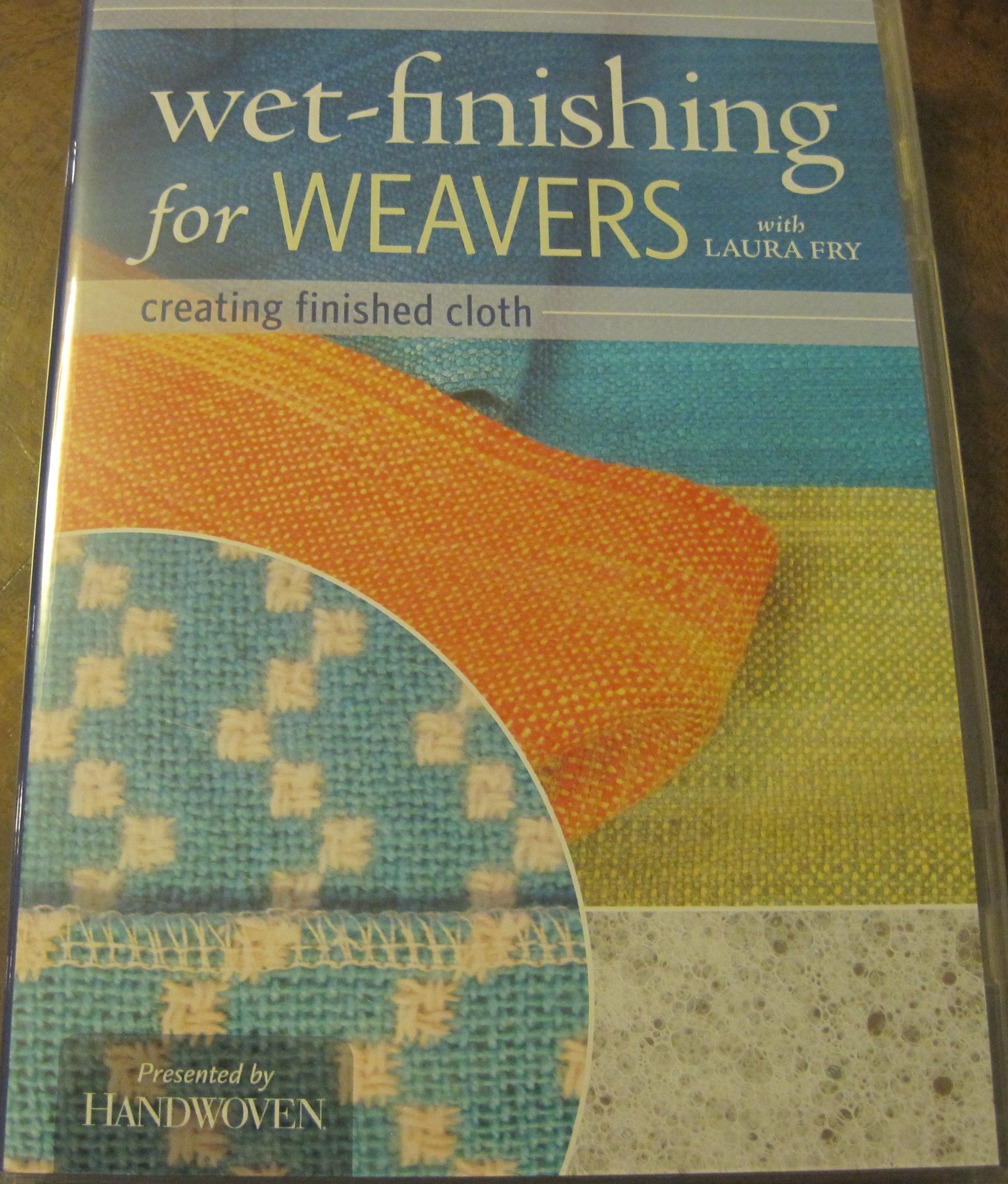
I had the opportunity to review an advance copy of the DVD “wet finishing for WEAVERS” by Laura Fry, presented by Handwoven.

wet finishing 1

Wet finishing gives instructions on how to use water to finish many types of woven fabric including woolen cloth, worsted cloth, cotton, linen, silk, and rayon.  Fabric as it comes from the loom is stiff and not very usable.  Through the wet finishing process it magically becomes soft, pliable, stable, and luxurious.

The information given in the DVD is clear and complete, and you can see the dramatic changes to the cloth throughout the demonstrations.  Laura Fry is very real and personable and I felt like I was standing right beside her as she worked.  Laura takes us well beyond just putting fabric in water, to teach us when to agitate a fabric and when to leave it alone, when to use hot or warm water, how to full a woolen cloth and how to brush a fabric to create a nap.  She shows us which fabrics need a gentle hand and which need a firmer hand, when and how to press, what to do about fringes, and explains how weave structure and finishing are related.  Laura’s tips and techniques show us why we do what we do to finish a cloth, and the order in which to apply the finishing processes.

By the end of the video I fully understood why I would choose a different method of wet finishing for each type of handwoven fabric.  It takes the fear out of finishing.  I definitely recommend “wet finishing for WEAVERS” as an excellent resource that will be referred to for many years to come as each project is removed from the loom.

Posted in Uncategorized | Tagged , , , , , , , , | 2 Comments

Silken Kaleidoscope

I recently attended Karen Selk’s Silken Kaleidoscope workshop, which was sponsored by the Peace Arch Weavers and Spinners.  Karen is a wonderful weaver, frequent contributor to Handwoven Magazine, and founder and former owner of Treenway Silk.

In addition to the workshop, Karen was the speaker for the Peace Arch Weavers and Spinners Memorial Lecture.  She talked and showed slides about her quest for silk as she traveled along the Silk Road in China, Asia, and India.  Karen was willing and fascinated to visit indigenous weavers in their own communities throughout the Asian regions, learning all about silk, and developing friendships along the way.  She also worked in partnership with manufacturers in the silk factories to research, develop and test exactly the silk yarns and fibres needed to supply the North American weavers and spinners with the silk materials we work with today.

Karen is a wonderful workshop facilitator and all-round interesting person.  In the workshop we learned so many interesting facts about weaving with silk, as she regaled us with stories of her travels and adventures.  Each participant wove eight samples on the looms, and we learned so much about working with different types of silk, how choice of weave structures affect the colour of the finished piece, and a whole lot about colour theory.  We played with matt against shiny, thick against thin, and colour against colour as we wove our way through the samples shown below.

1. Analogous, moving from one neighboring colour to the next:

Analogous

2.  Monochromatic, using one colour with tints, shades, and tones

IMG_2733

3.  Split Complementary, combining the chosen colour (in this case, blue)and the two colours that surround the complement of the chosen colour (red-orange and yellow-orange)

IMG_2734


4. Iridescence

IMG_2736

5.  Double Weave, contrasting thick and thin layers

IMG_2737


6.  Vibrating Colour and Weave

IMG_2738

7.  Medallions of silk, surrounded by natural cotton

IMG_2739

8.  8-Harness colour and weave – pinwheels of silk and wool

IMG_2740

Karen also had each person interpret a weave using an individual colour study that she assigned us.  Mine was to use yellow-green in a trapezoid tetrad combination.  So, that gave me yellow-green, orange, red, and blue-violet.  Quite challenging!  And here is my interpretation:

IMG_2741

Posted in Weaving | Tagged , , , , , , , , , , , , , , , , , , , , | 2 Comments

An Australian Visit

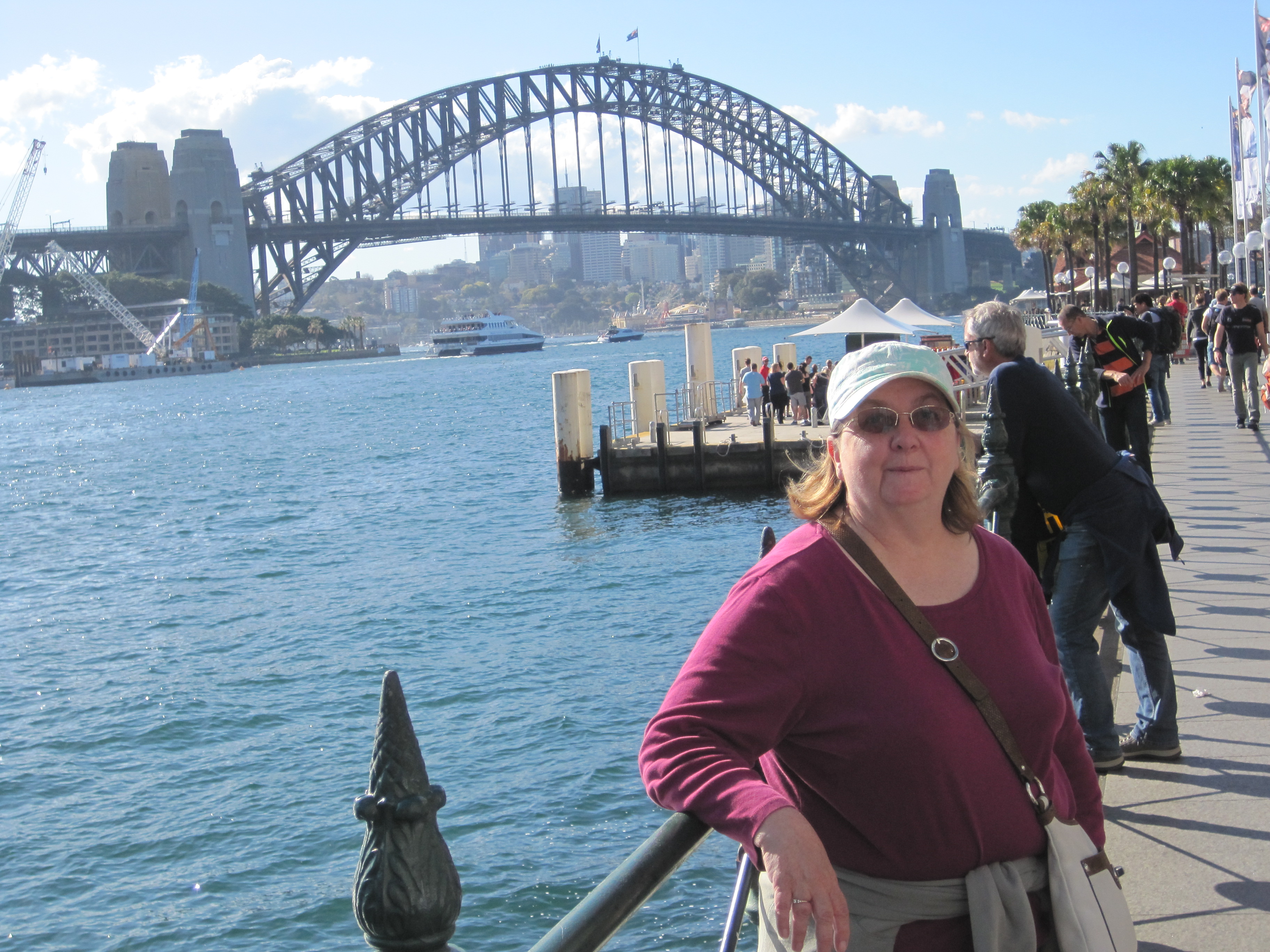
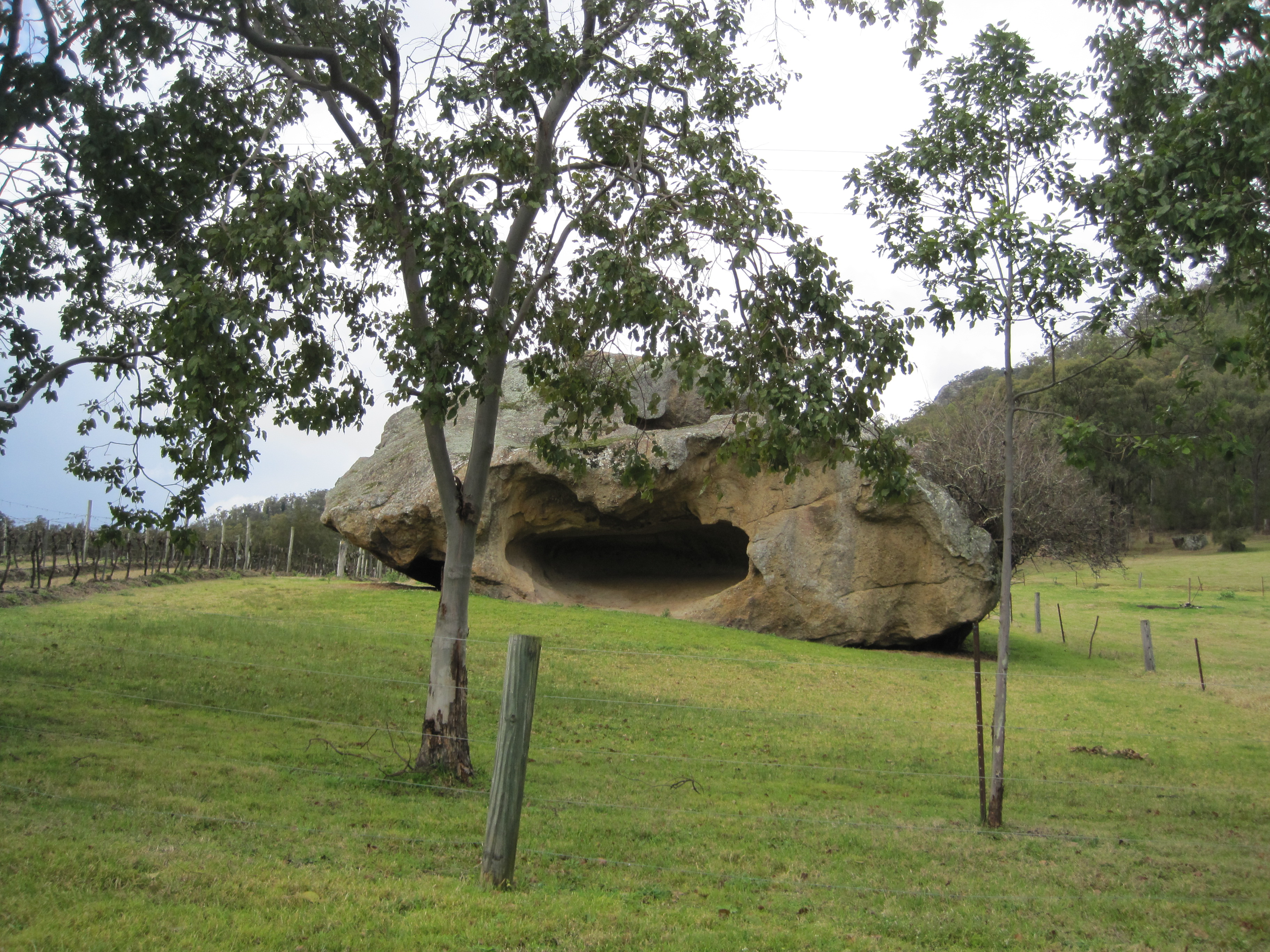
Ron and I just returned from another visit to Australia.  This time around we stayed in the Sydney area to accommodate some business meetings that Ron had to attend to.  We spent two days in Sydney proper and the rest of the time we based ourselves in Maitland in the Hunter Valley and branched out with day trips from there.  The Hunter Valley is about two hour out of Sydney and bursts with vineyards, great wine and gourmet foods.  Having crossed both the International Date Line and the Equator, we found ourselves moving from the height of summer in Vancouver, to the early spring weather of New South Wales, where the blossoms are just blooming.  We chased some rainbows, visited both beaches and wineries, and ate wonderful meals as we meandered through the area of small towns and villages with distinctive Australian flair.

IMG_2605  IMG_2621  IMG_2648  IMG_2693

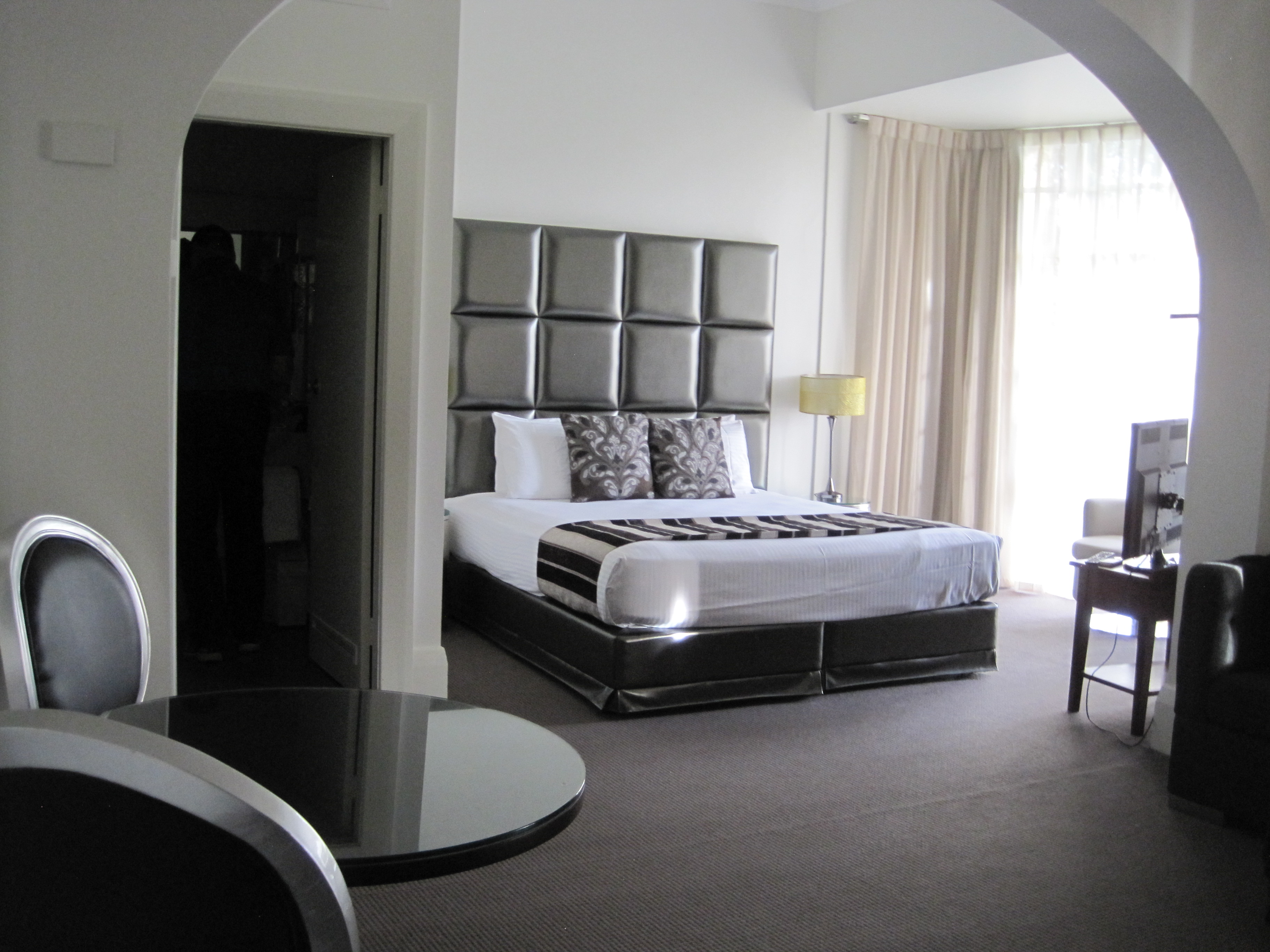
Our hotel, the Monte Pio, a converted convent with attached Abby, was both comfortable and welcoming at a reasonable cost. Check it out if you happen to be in the area.

IMG_2612

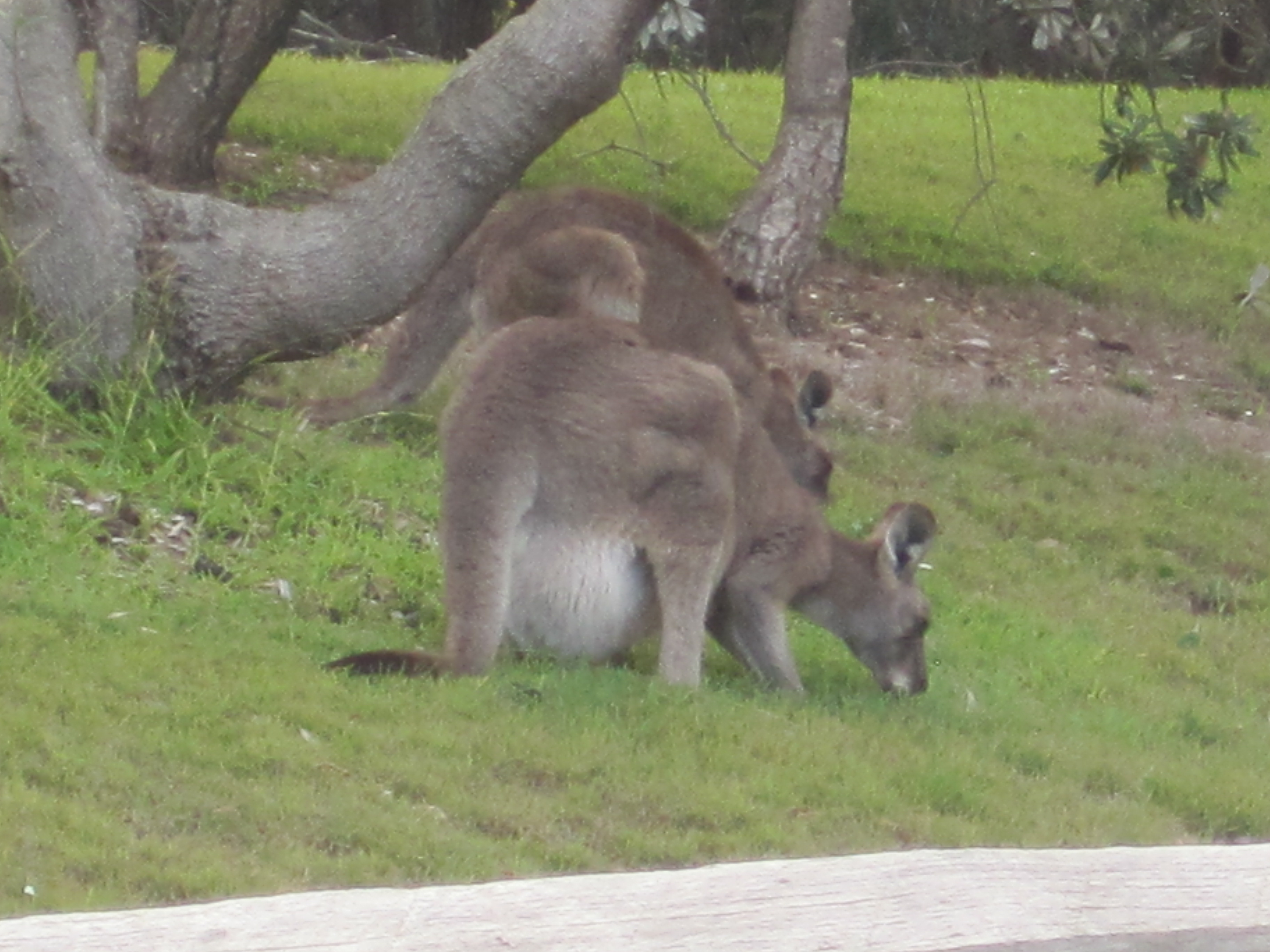
I didn’t find any fibre related events to attend this trip, but saw lots of animals, including kangaroos, wallabies, cows, horses, sheep, rabbits, alpaca, and even camels!

IMG_2700

Just to keep me amused on the long 13.5 hour flight and early mornings at the hotel, I took along some handspun I am using to crochet a blanket.  A sneak peak here and more on this later.

IMG_2722

Now, on my first day back home, I am already starting with the busy and enjoyable round of spinning, weaving, guild meetings, and workshops.


Posted in Uncategorized | Tagged , , , , , | Leave a comment

My Summer Project – a Double Double Weave

This summer was glorious, hot and sunny for the most part.  In between enjoying the sunshine, travel, spending time with family and friends and guild activities, I spent my spare time playing with my summer project.  This was inspired by a piece Jane Stafford showed us at her workshop – a delicate cotton 4-layer shawl she purchased on her trip to India.  So, while nothing is really new in weaving, this was new to me and I enjoyed finding pockets of time to work on this.

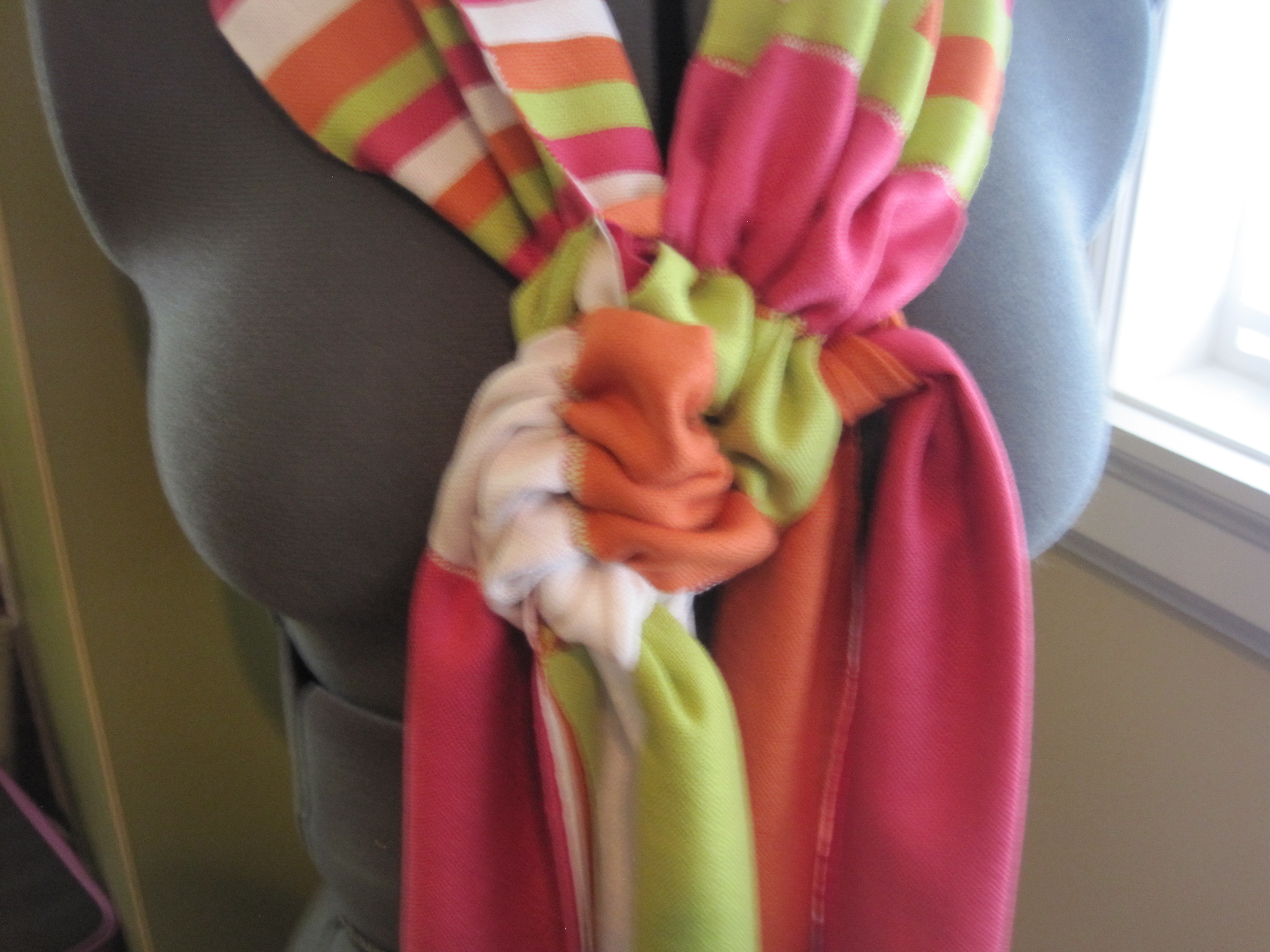
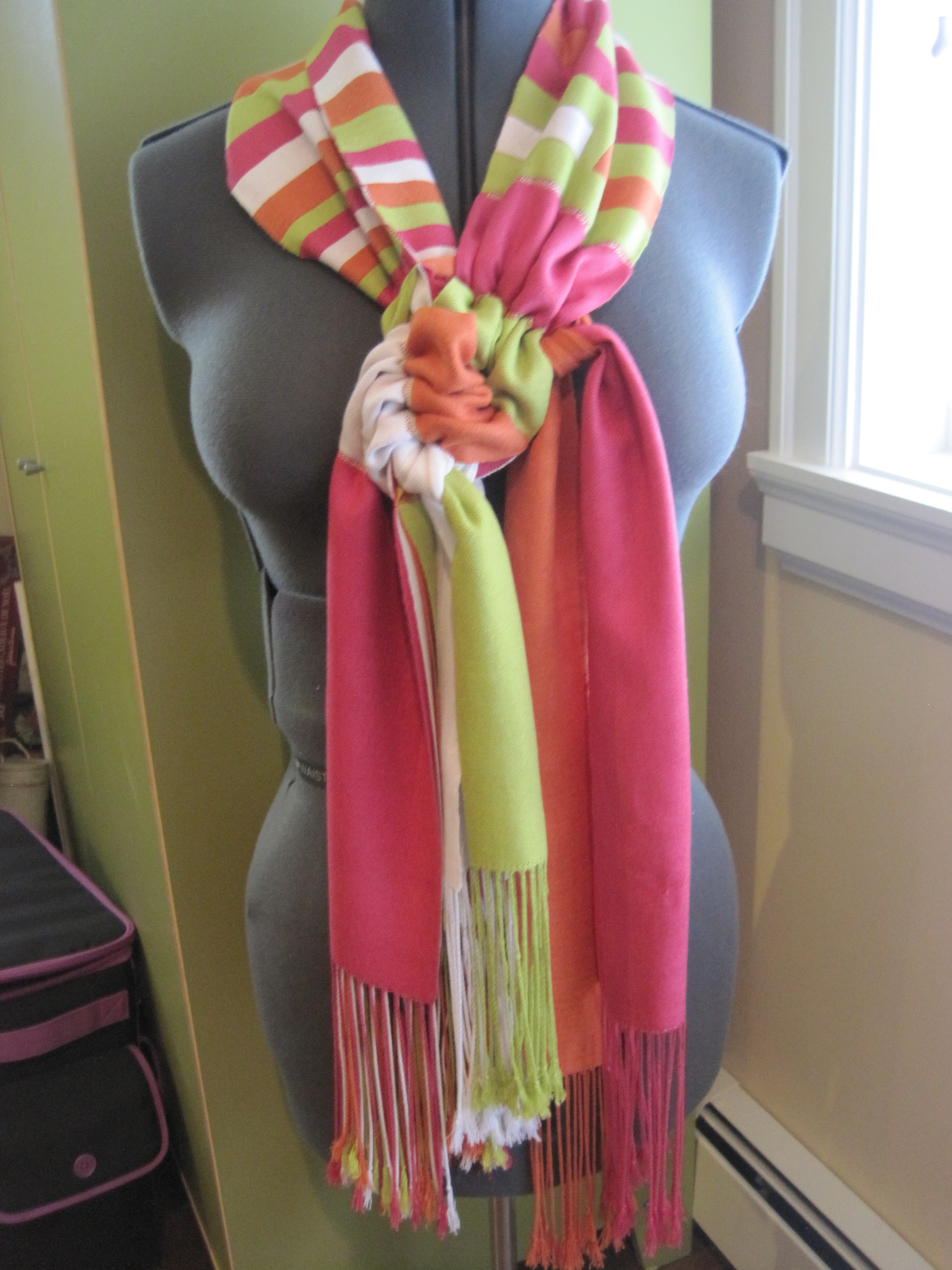
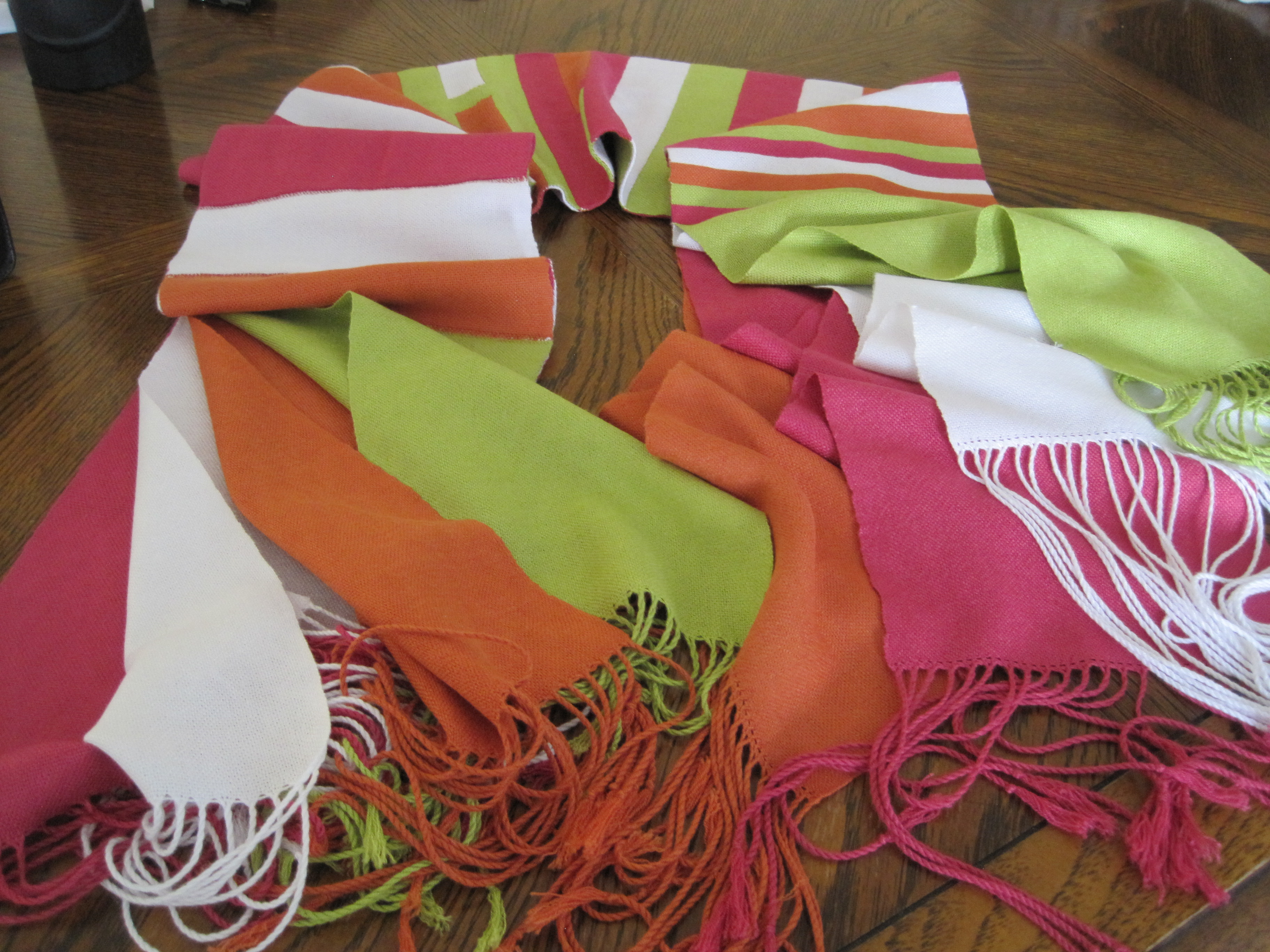
As we move into the last few weeks of summer, and the days begin to get shorter again, I would like to share with you my now completed intense summer project.  A four layer scarf!  A real Tim Horton’s “double-double”!

IMG_2559 IMG_2589

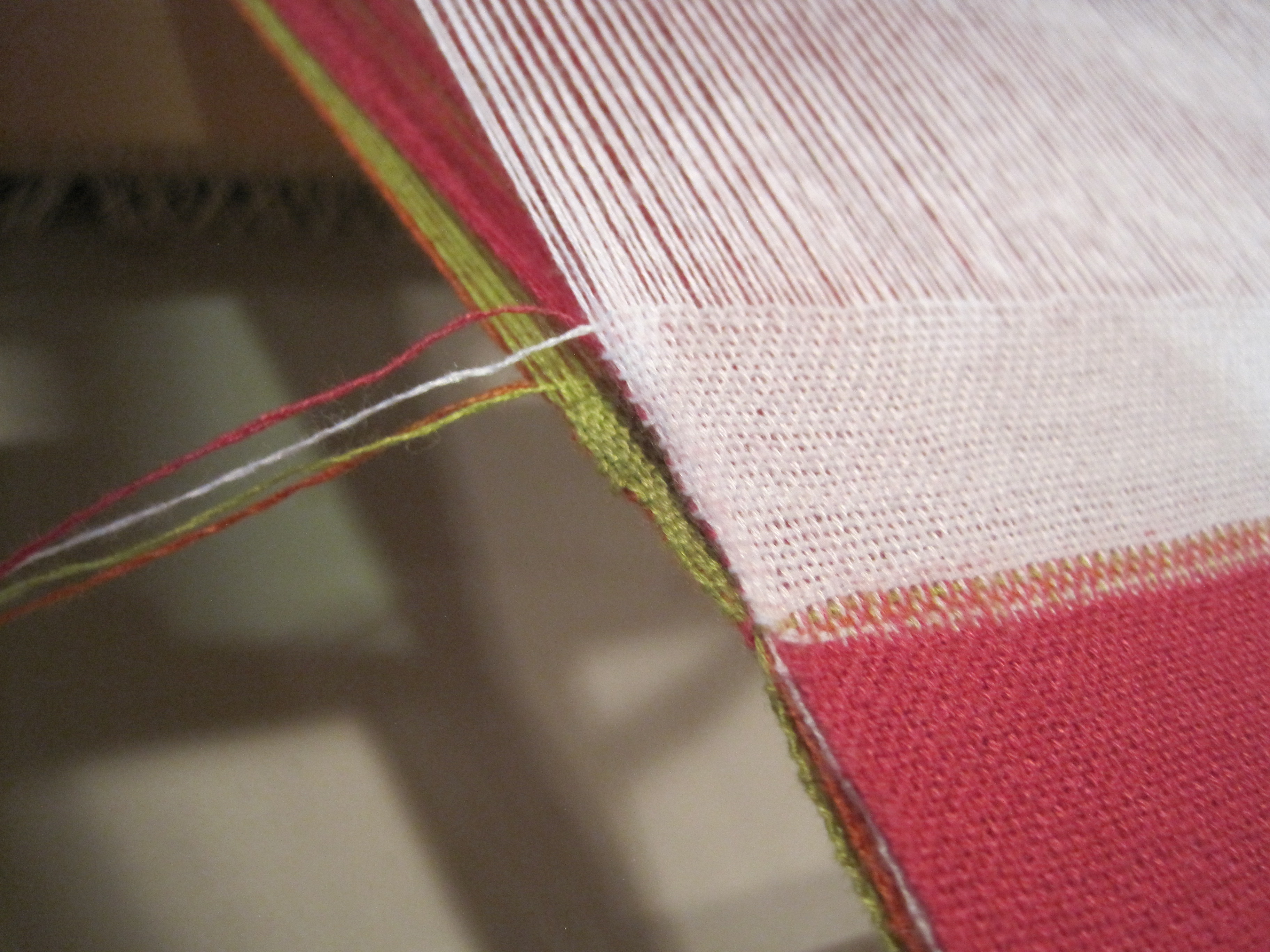
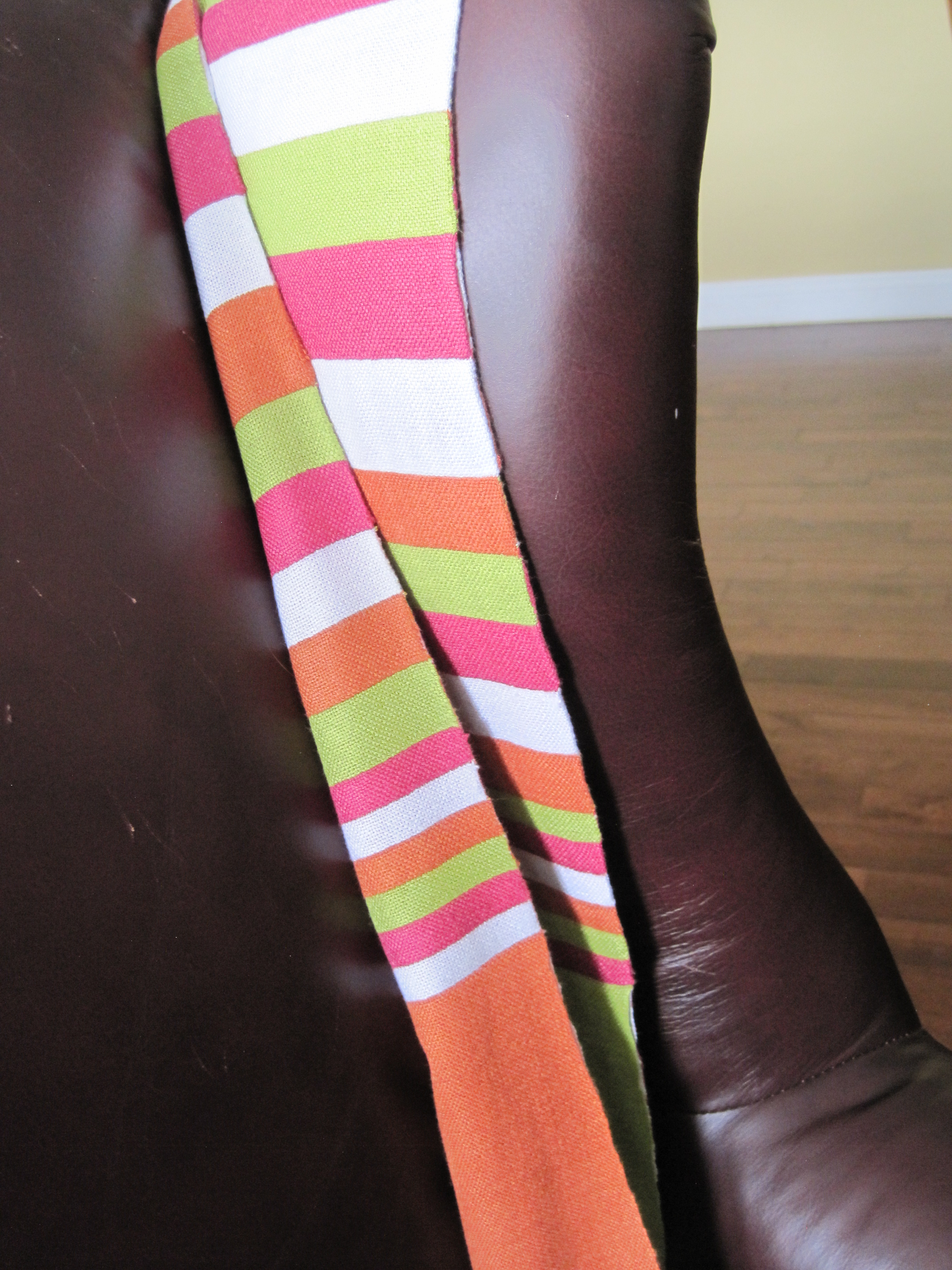
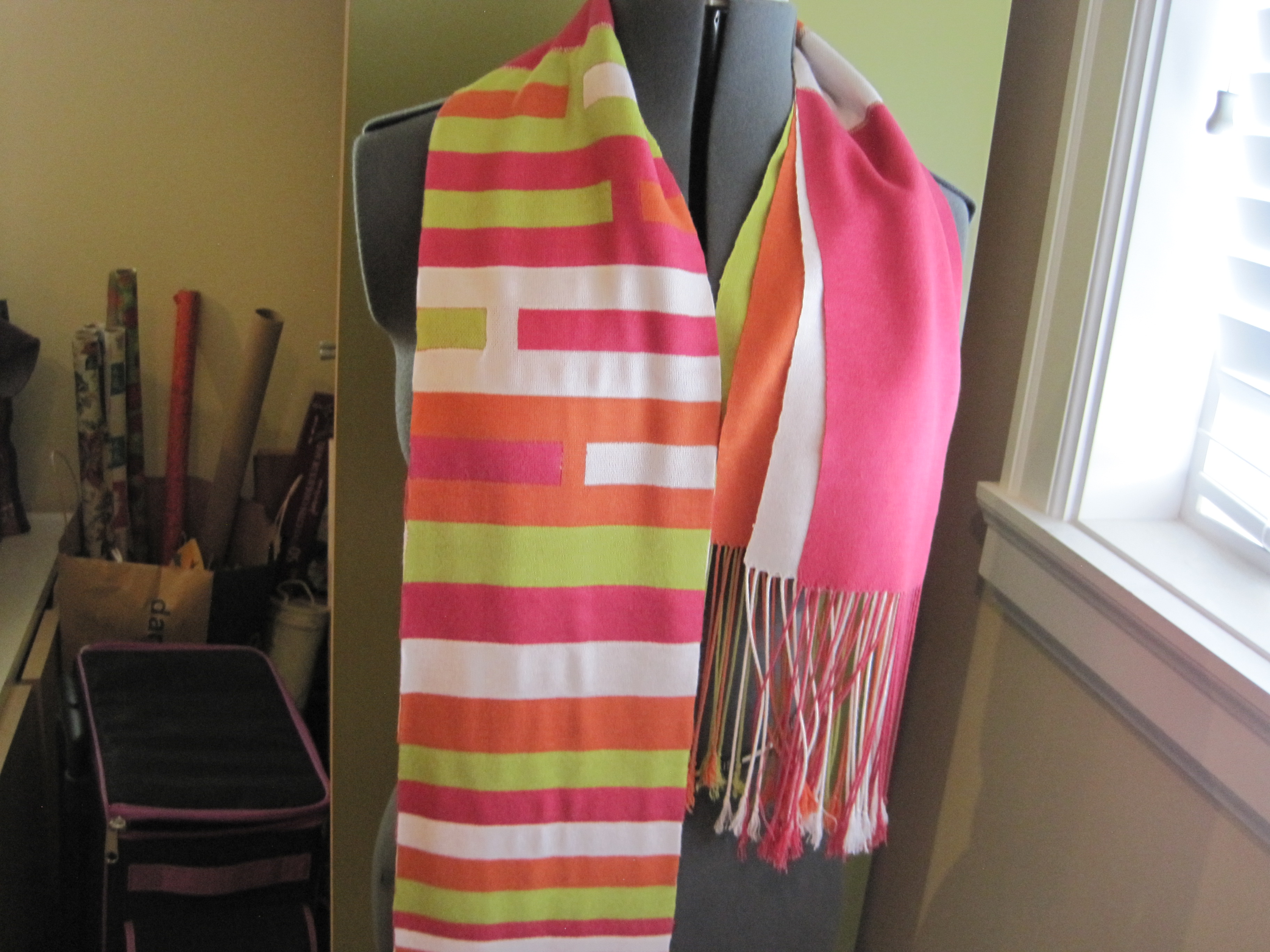
This scarf has four layers of super soft drape in Bambu 12 – green, orange, white and pink, woven on my eight shaft “Jane” table loom.  Each colour was threaded on two shafts, allowing plain weave layers in pure colours.  The draft is simple, the warping up and weaving was slow, slow, slow.

I measured, sleyed and threaded each layer separately.  Each colour was 24 ends per inch, 8 inches wide, and three yards long, for a total of 96 ends per inch.  Layer 1 (green) on shafts 1 and 5; Layer 2 (orange) is on shafts 2 and 6; Layer 3 (white) is on shafts 3 and 7; and Layer 4 (pink) is on shafts 4 and 8.  I tried to upload a copy of the draft, but this didn’t work. If you are interested in a copy of the draft, let me know by e-mail, and  I can send you the pdf.

IMG_2553


Weaving was also slow, 96 picks per inch.  So, it really did take me all summer to finish this!

First I wove four separate layers for the end, open at the sides so they could float freely.

Next I wove tunnels – one colour on top, second colour in the centre, these two colours attached at the sides, second half of the tunnel – third colour in the centre, fourth colour on the bottom with these two colours attached at the sides.  I wove four tunnels in all, changing the colour order, so different colours appeared on top, top-middle, bottom middle, and bottom for each tunnel.  The separate scarf ends can be stuffed through the tunnels for a fun way to wear the scarf.

IMG_2586

The centre section is closed on the sides, and I experimented with striped layers of different widths, and also played with pick-up (extremely slow, because each colour had to be on top, and top-middle, and bottom middle, and bottom, for each pass of the weft).  Such a leap of faith to weave without being able to see the  middle or the bottom side, and hoping that the colours are falling where I want.

IMG_2591  IMG_2602  IMG_2590

Then, the final end, four separate layers again.  I made each layer a different length, just for fun.  Finally, I twisted 8 threads per twisted fringe for a total of 96 twisted fringe ends.

I am so happy with the finished scarf and learned a few things along the way.  I love the way the colours stayed brilliant and clear.

IMG_2599 IMG_2584


That’s what I did with my summer.  What did you do with yours?


Posted in Weaving | Tagged , , , , , , , , , , , , , | 3 Comments

Summer and Winter Weave, Crackle and Spring Colour Explosion

I’m doing a little of this, a little of that, while enjoying the wonderful colour explosion of the late Spring flowers.

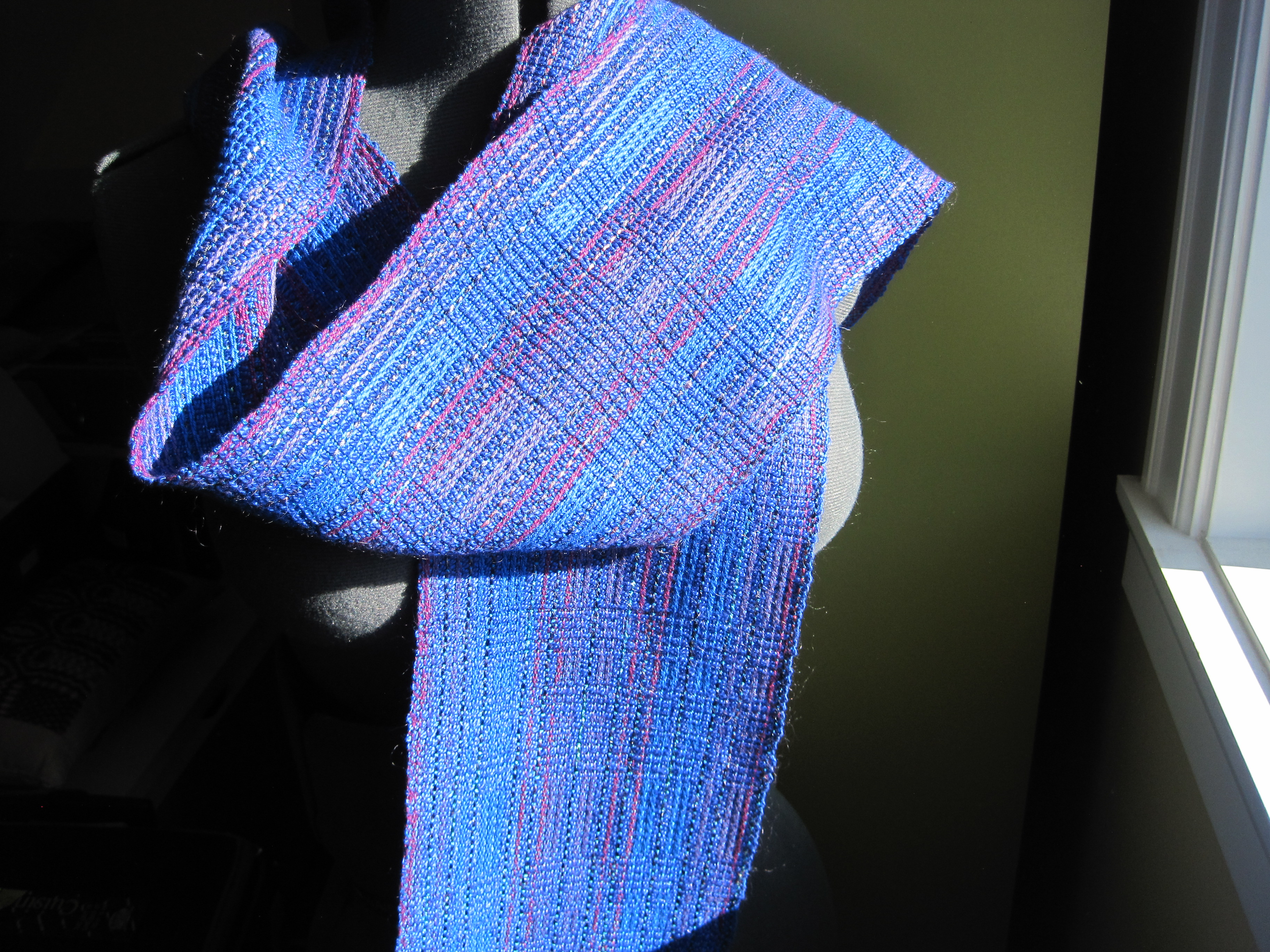
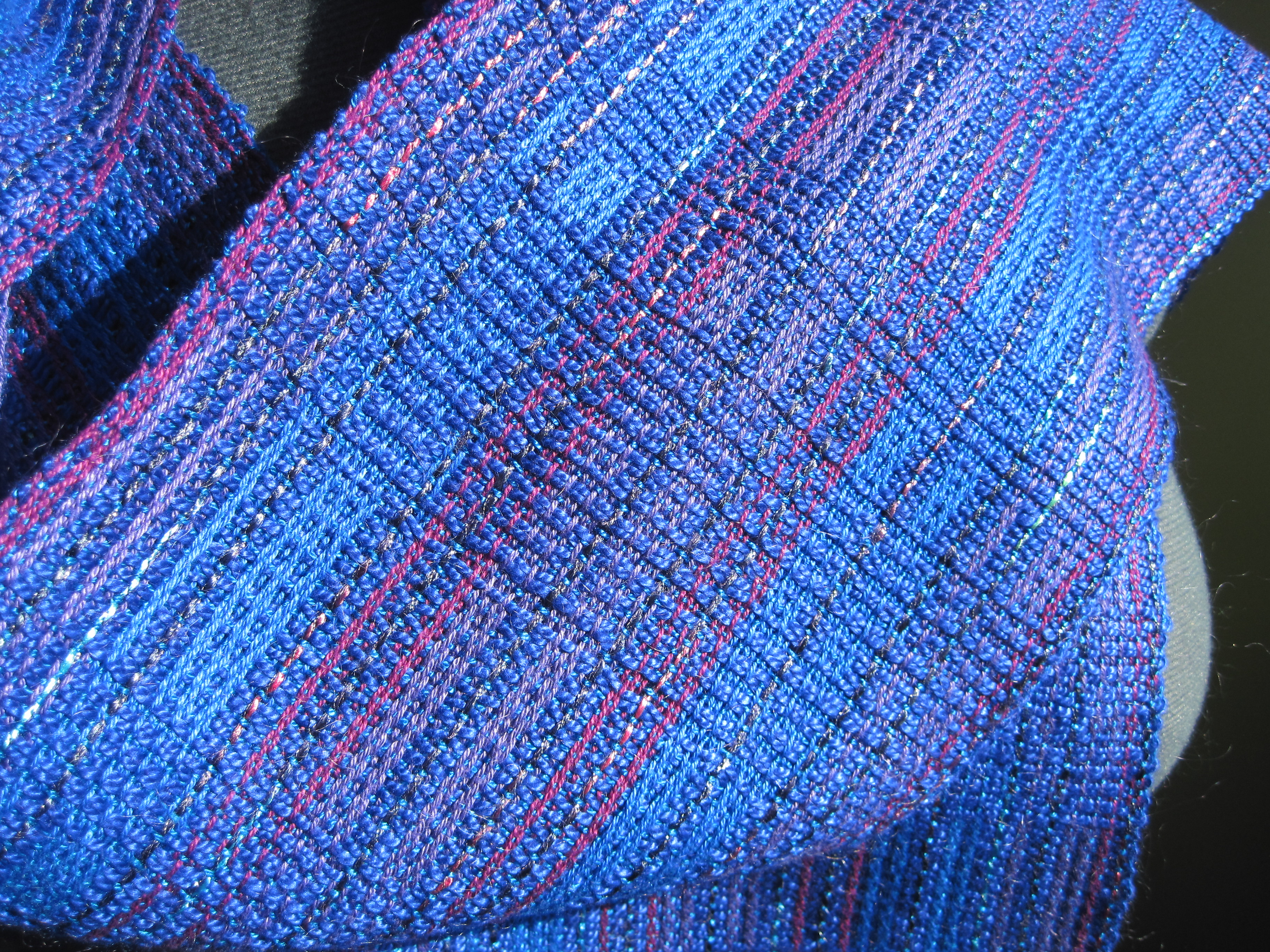
Here is the third effort in my continuing study of Summer and Winter Weave.  This is 4 shaft Summer and Winter on a multi-coloured warp.  I wove a scarf with a 2/8 cotton warp, and added a little bling to the tie-down warp in every Block A.  The tabby weft is 2/8 tencel to encourage drape, and the Pattern weft is 5/2 UKI mercerized cotton.  Because all the colours are close in value, the result is a scarf that appears to have more texture than pattern.

IMG_2519  IMG_2520

To finish off the Crackle Weave projects, I wove two baby blankets on the same white warp of 2/8 cotton.  The first has a pattern weft of “Baby Bamboo” knitting yarn and tabby weft same as the warp, woven in traditional crackle with colour changing with the blocks.  It has a wonderful weight and feel.

IMG_2509

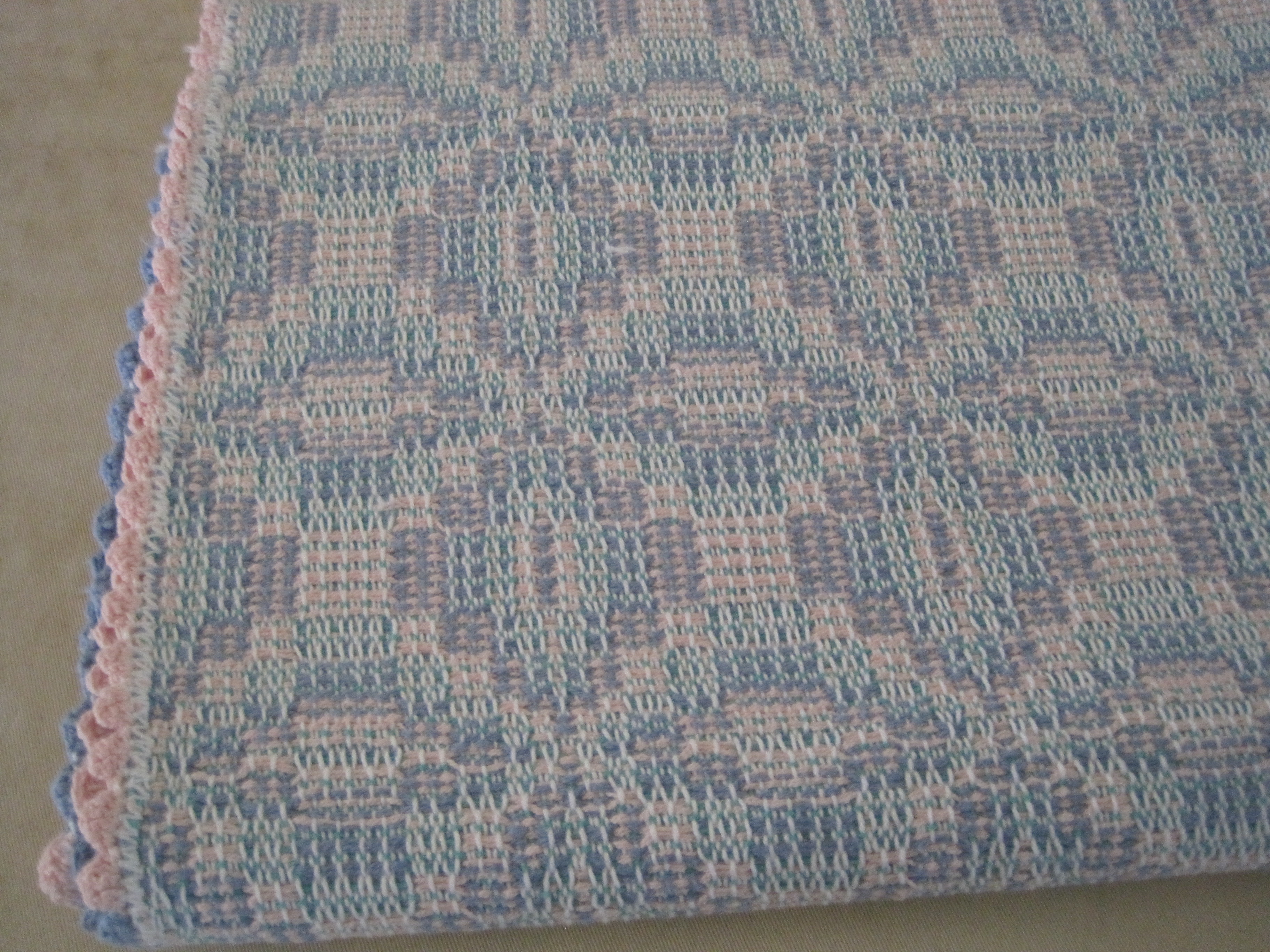
The second blanket is woven in polychrome crackle in pink and blue 2/8 cotton, which highlights the pattern.  Both blankets are finished with a crocheted edging.  Amazing what can be done on a four shaft loom.

IMG_2513

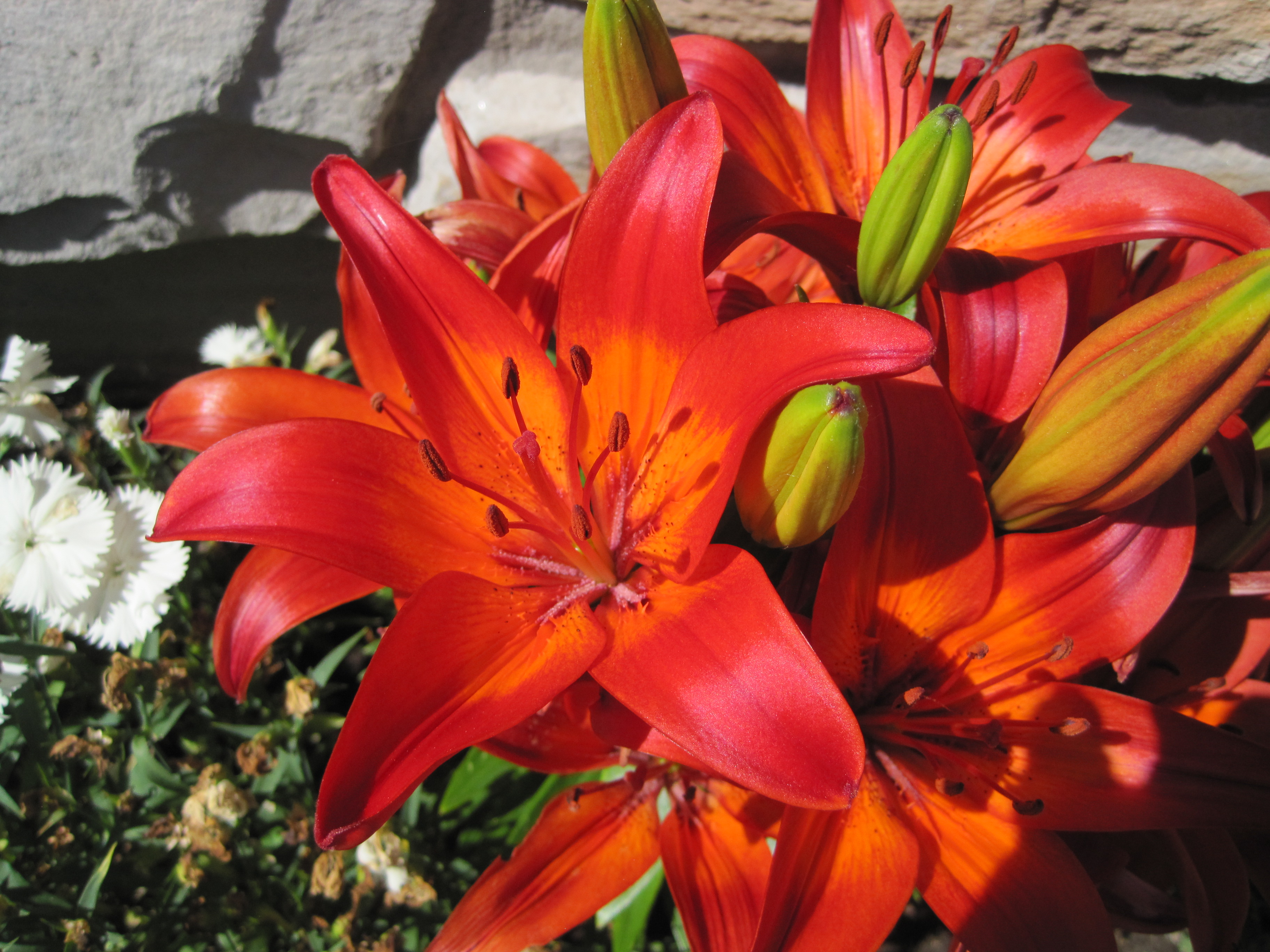
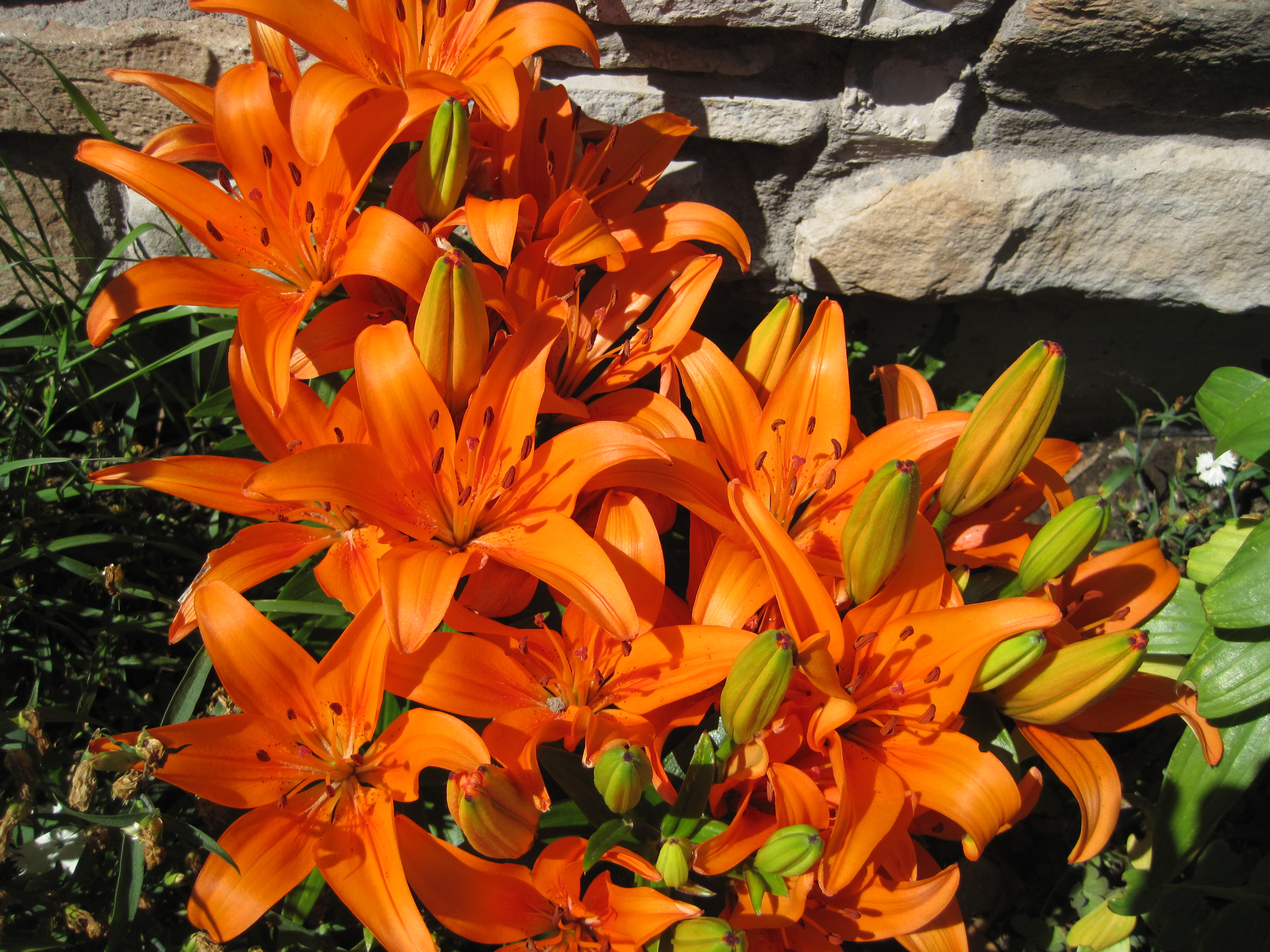
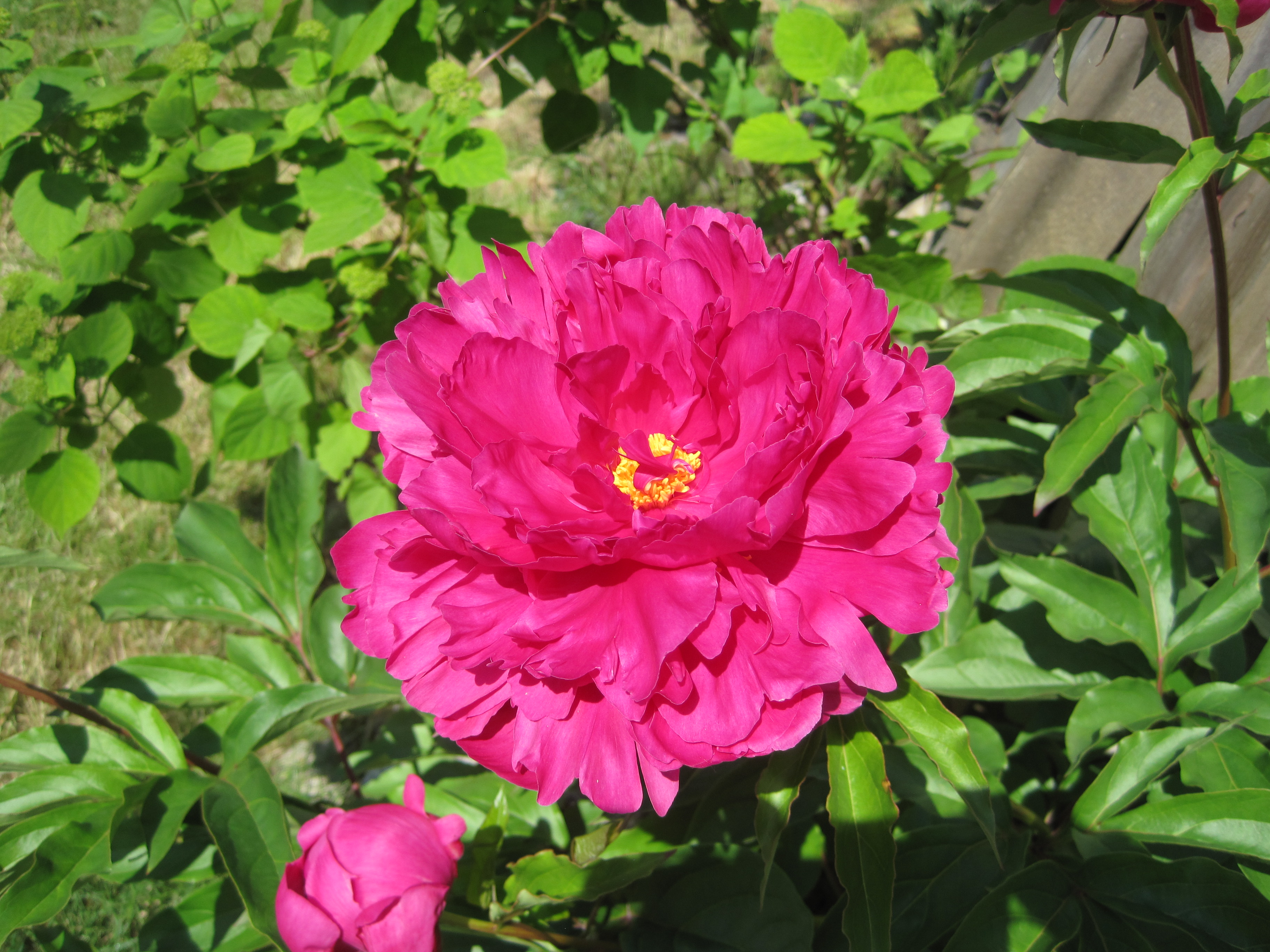
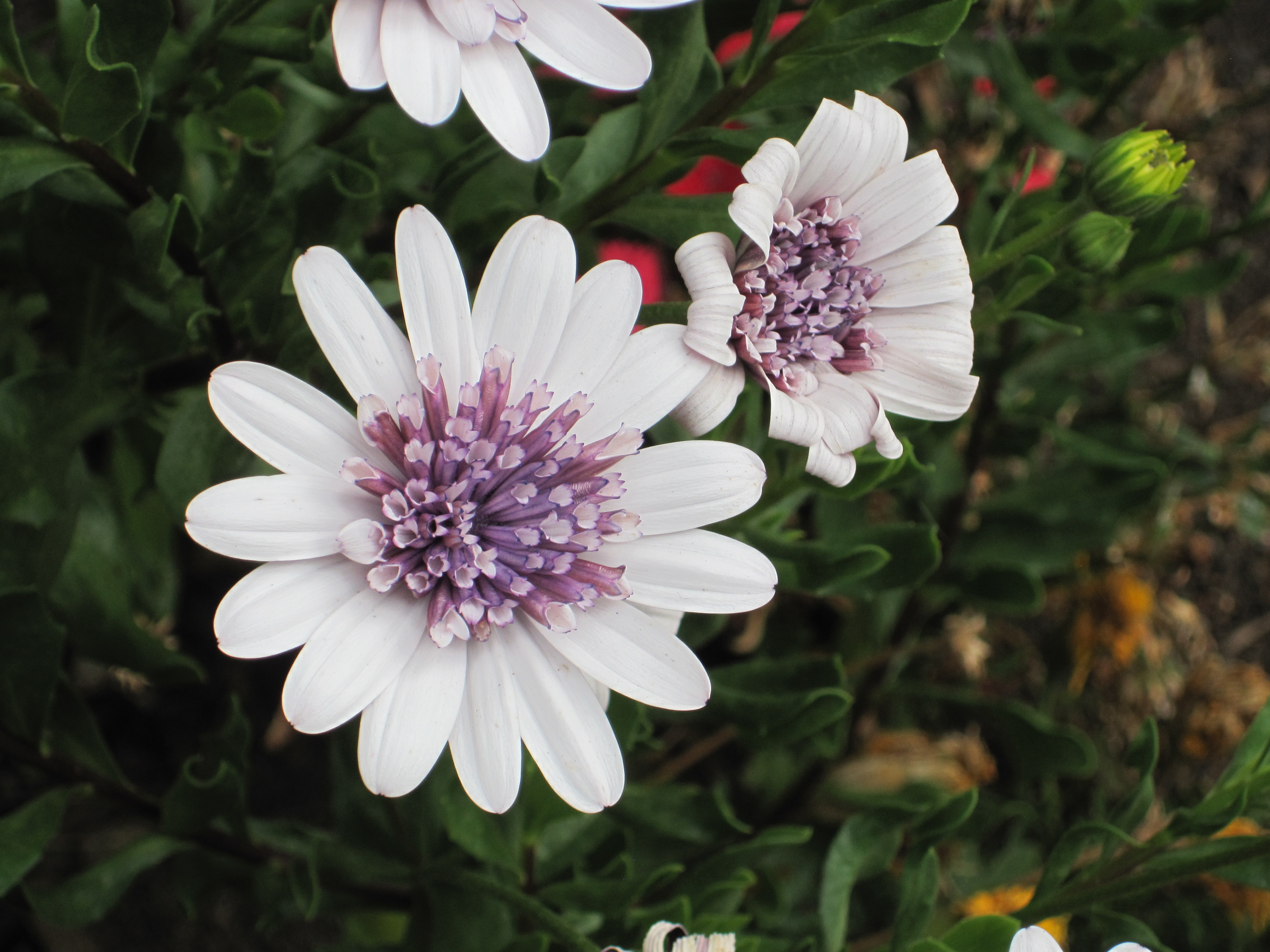
But I haven’t just been staying indoors weaving.  We are enjoying beautiful sunny days and the flowers in my yard are glorious.  The tiger lilies have come in in vibrant orange and red this year, the peonies are brilliant fuchsia, and the white flowers bring balance.  I will enjoy them all before the rains and cloudy days come back.

IMG_2507  IMG_2506

IMG_2501  IMG_0912

Posted in Weaving | Tagged , , , , , , , , , , | 3 Comments

It’s All in the Cards

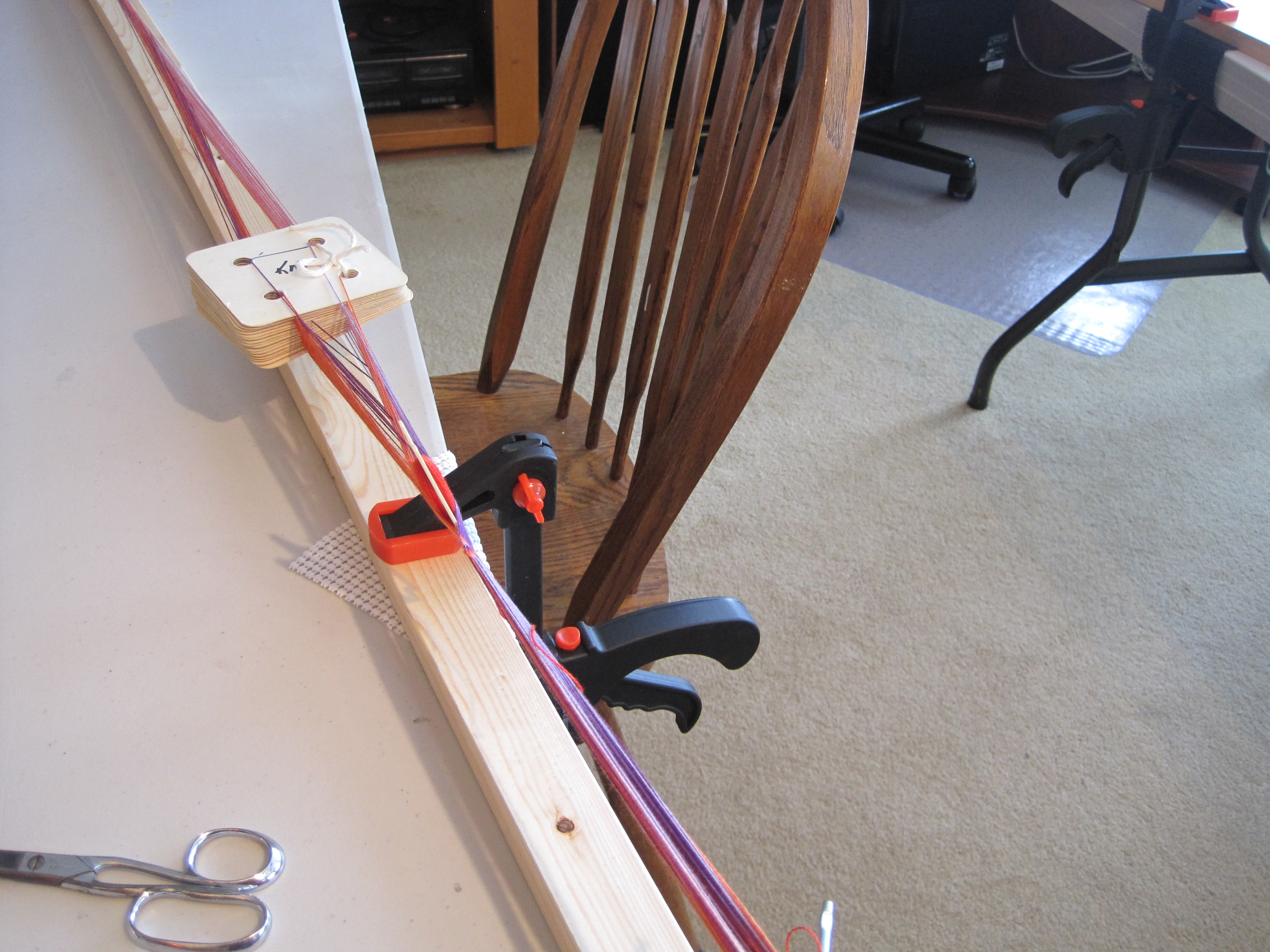
Yesterday was a fun day, spent at Brenda’s (Penelope Fibre Arts) where Kim McKenna (Claddagh Fibre Arts) taught an introductory workshop on Card Weaving.  Card weaving uses a set of cards, with holes punched in the four corners.  A huge variety of patterns can be achieves, simply by how you thread, twist and turn the cards.  Card weaving, also known as tablet weaving, has a very long and rich history, and is worth spending more time in research and study.

Kim had the looms set up for us to start,

IMG_2487

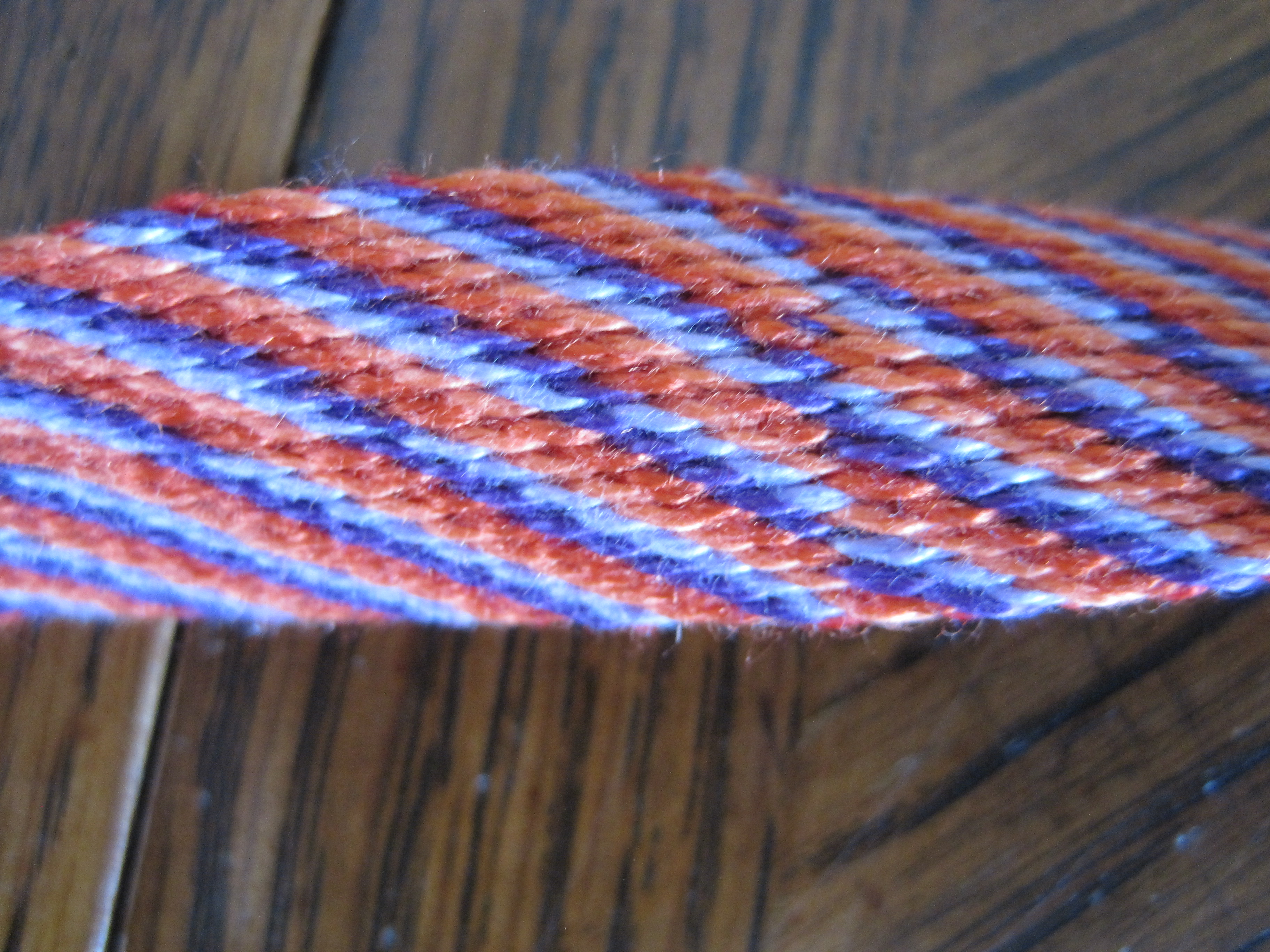
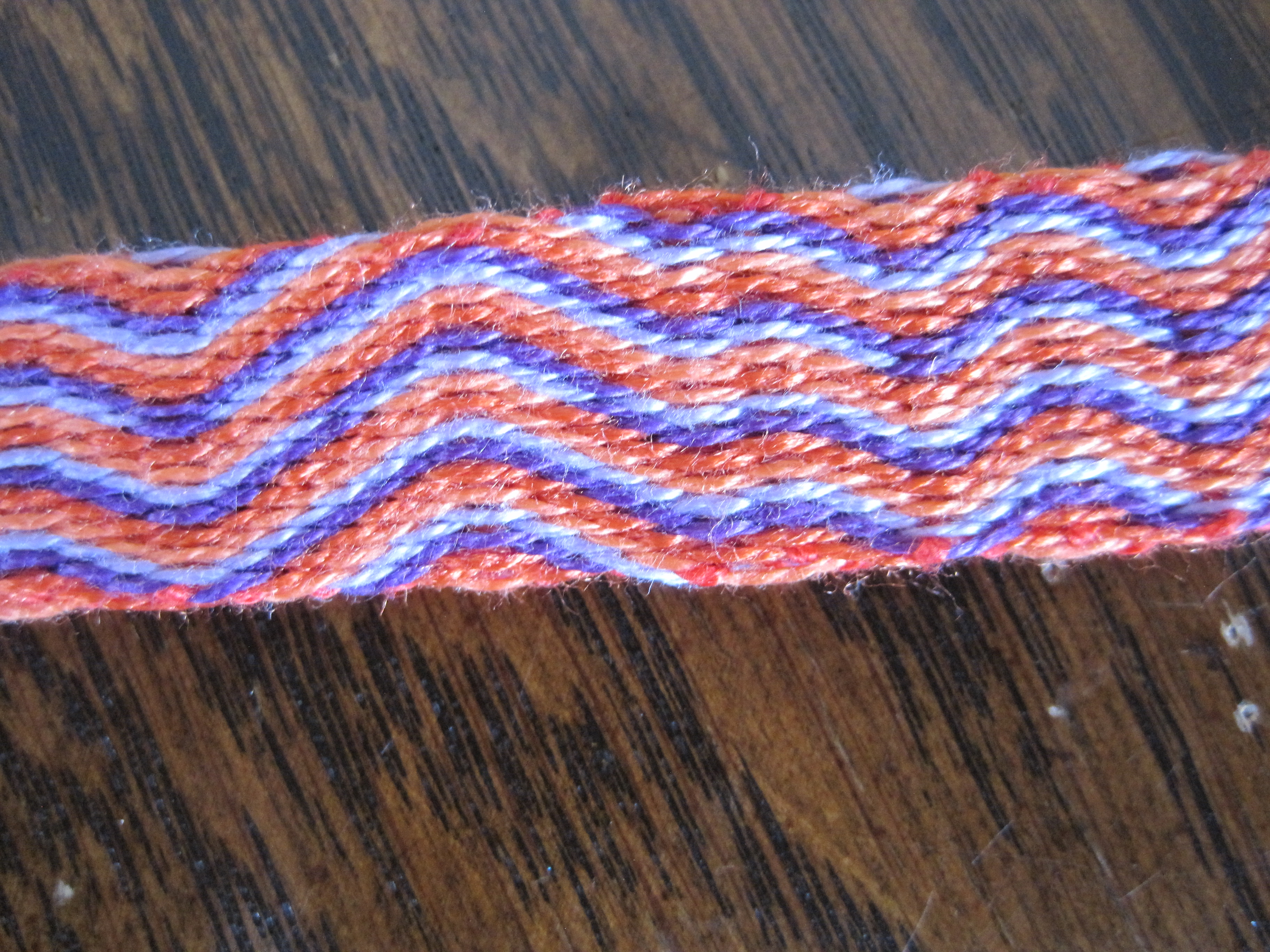
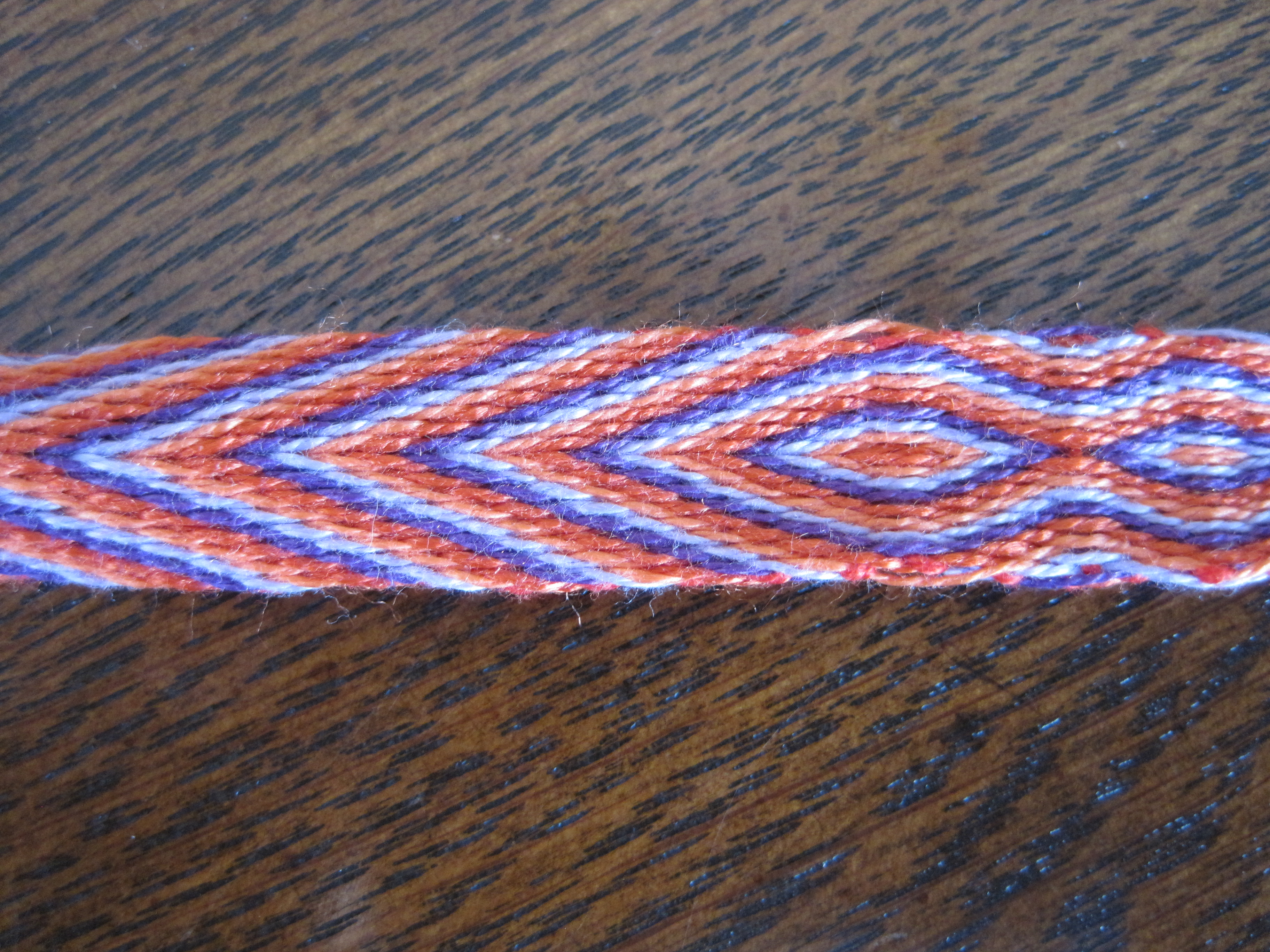
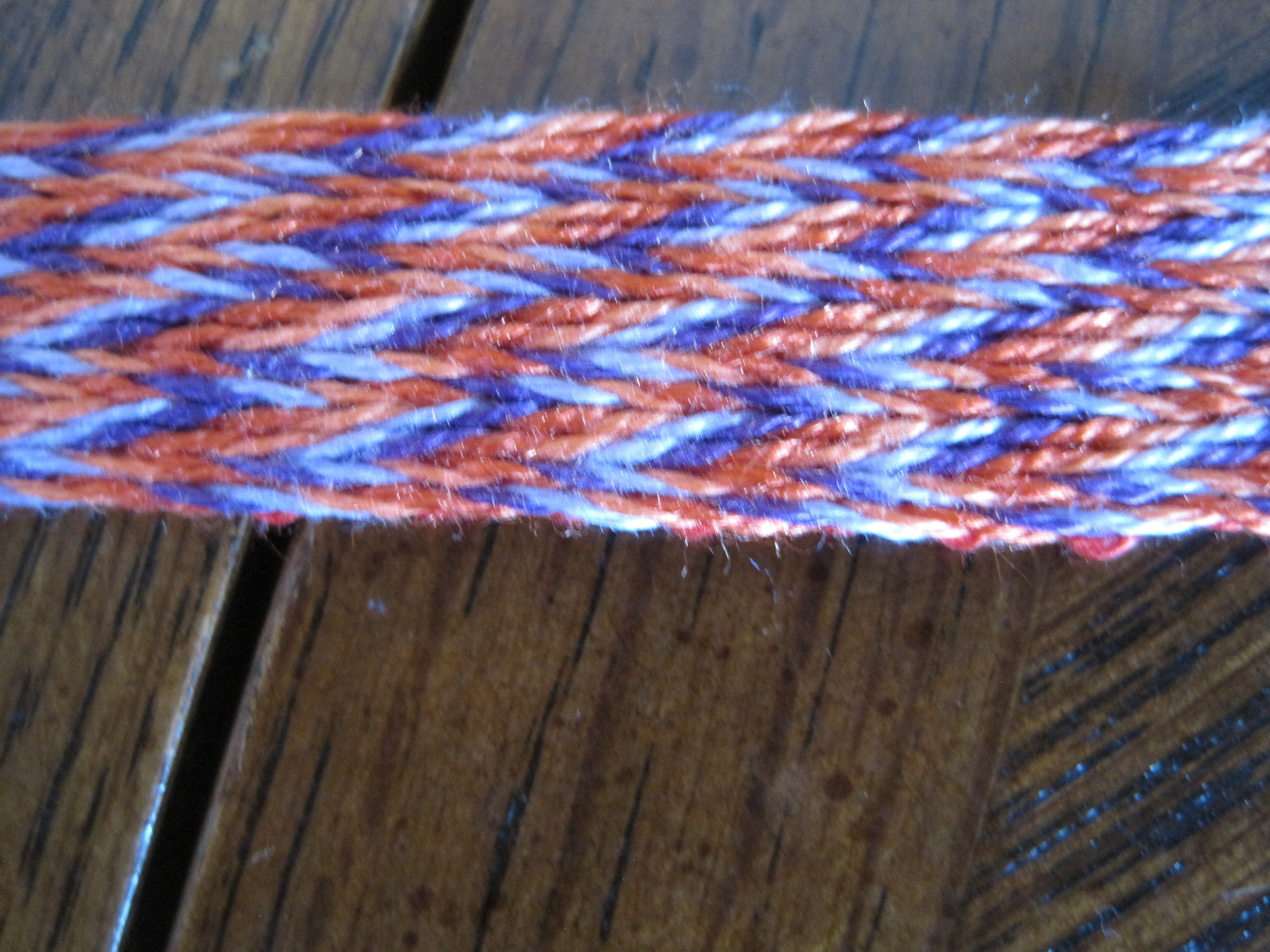
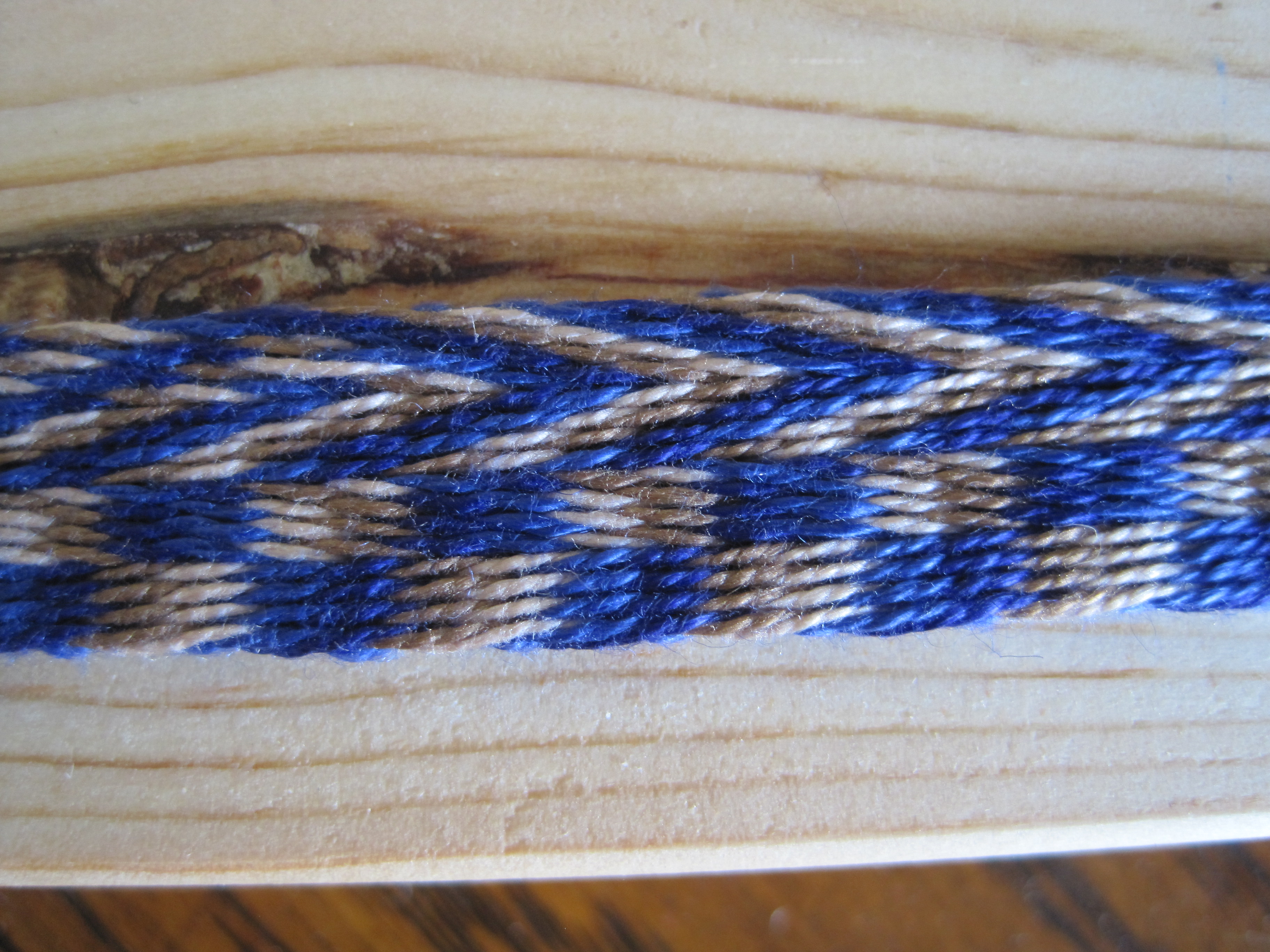
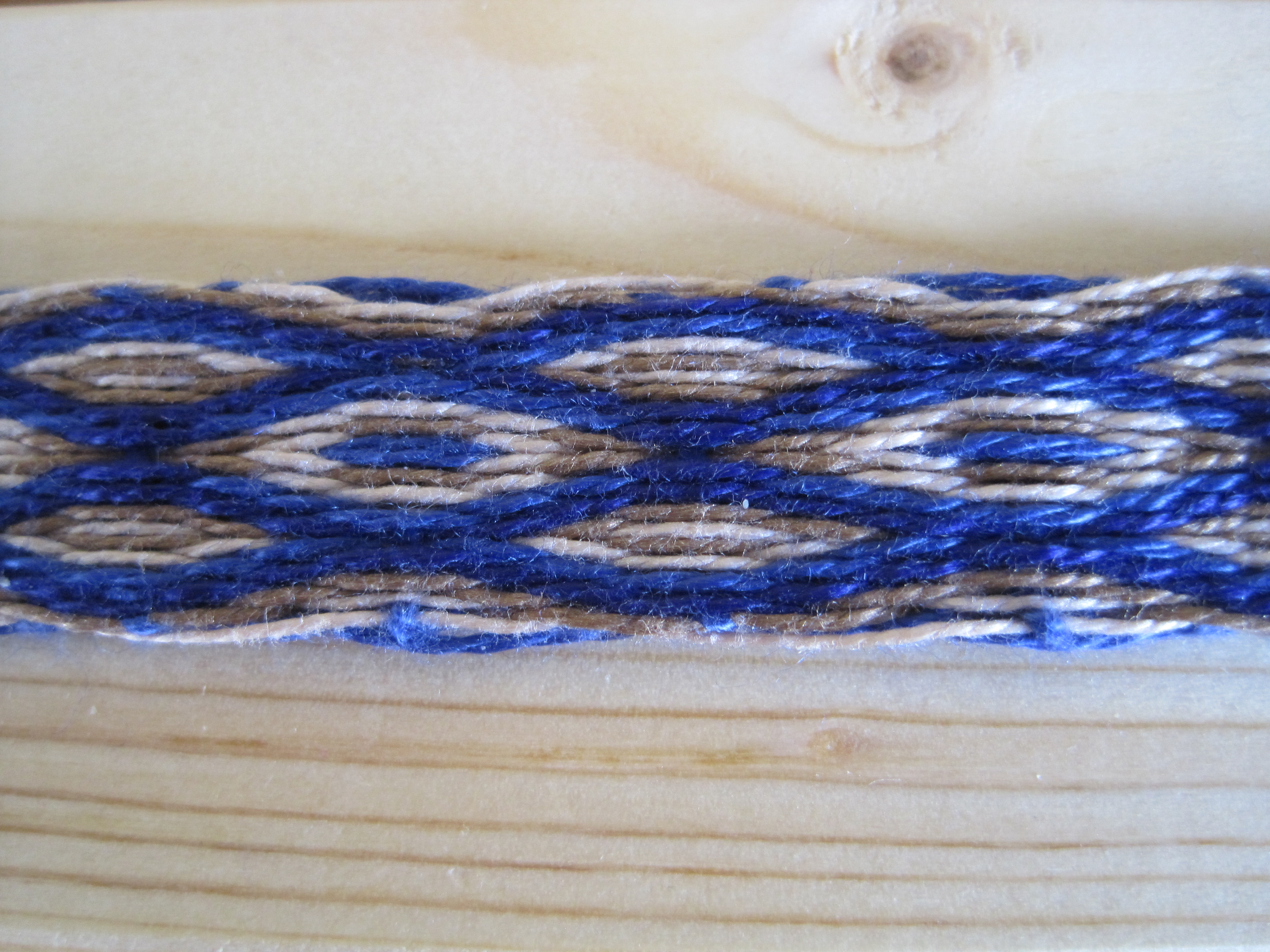
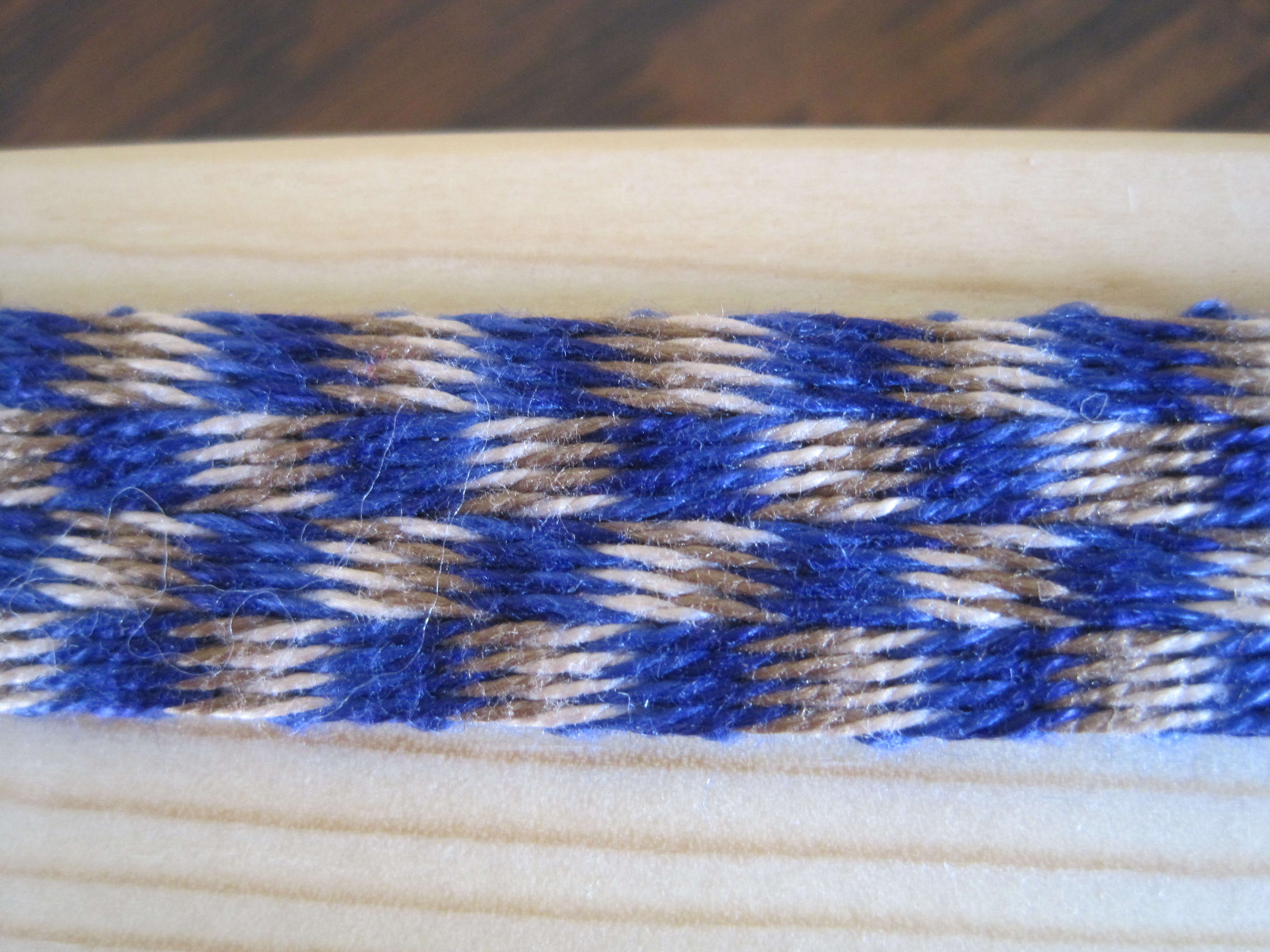
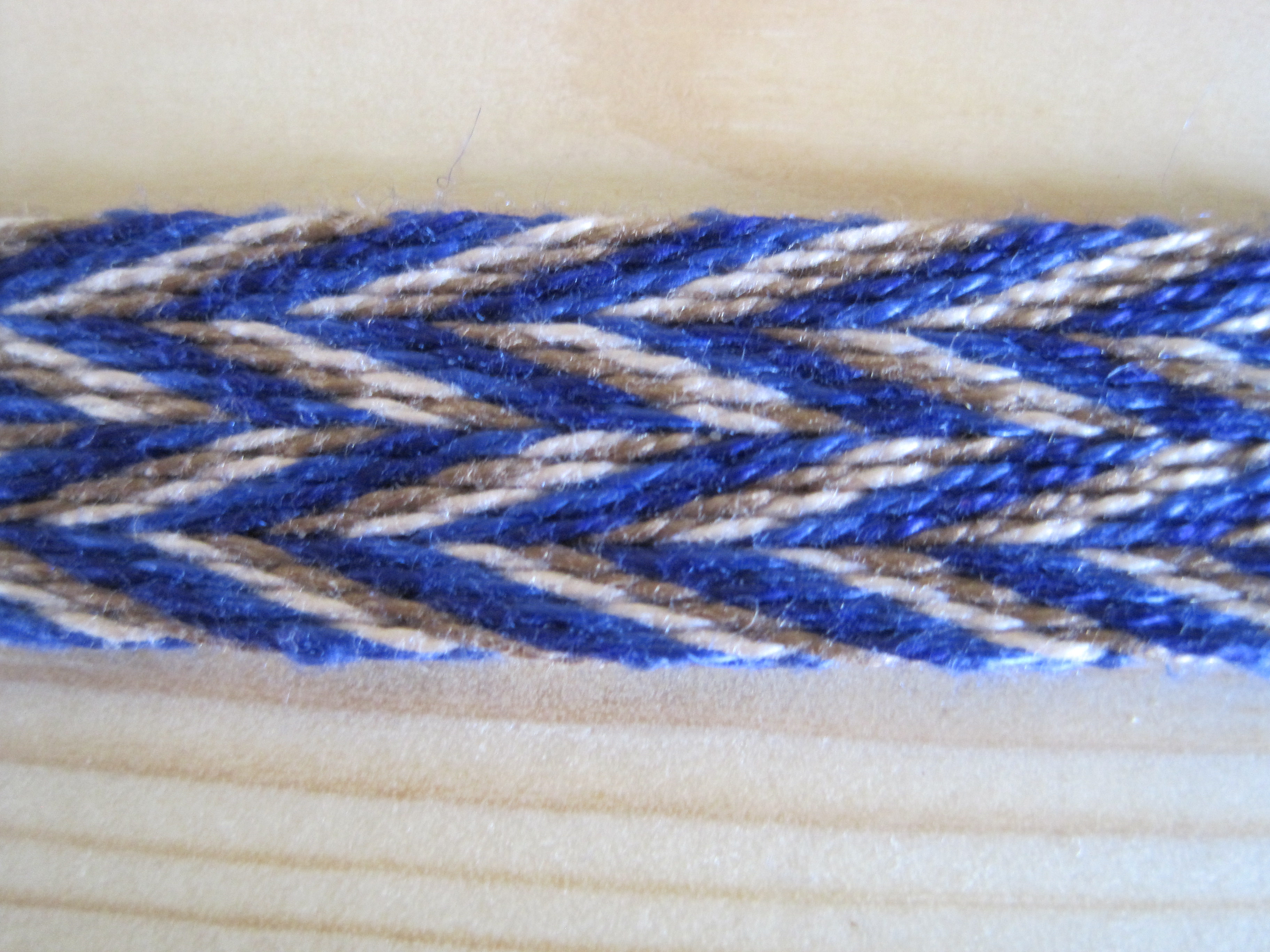
and we learned basic stitch designs including checker, diagonal, wavy, horizontal, 2/2 and 4/4 offset chevrons, larger chevron, and diamonds, on sixteen cards.

IMG_2500 IMG_2497  IMG_2496  IMG_2498

Kim then showed us how to set up the looms on our own, and let us borrow them to take home to play with.  This morning I wove off four small bookmarks, each with a different pattern.

IMG_2492 IMG_2493 IMG_2495 IMG_2494

The warp is two shades of brown and two shades of blue.  This is a lovely way to create bands and tapes, and I look forward to trying lots of different things with this way of weaving.   Thanks, Kim, for the great day!

Now I am off to Dye pot club, a group of local spinners, knitters and dyers who meet every last Friday of the month, for conversations and fun show and tell, as well as sitting and spinning, and even occasionally, dyeing.


Posted in Spinning, Weaving | Tagged , , , , , , , , | Leave a comment

Crackle Weave Class Samples

I just finished teaching two Saturday classes on Crackle Weave.  I had a great time, and had seven participants, who told me that they had a great time also.  I worked really hard to prepare for the class and had twelve samples for the group to work through.  I am so totally amazed at the diversity of this weave, and to think that we were able to achieve twelve completely different looks, and just on four shafts.  Each participants warped their loom with a one colour warp in 2/8 cotton, and each person wove on their own loom.  We worked the wefts in 2/8 cotton, used double for pattern weft and single for tabby weft.  Using these constants we changed treadling combinations and colours to achieve the different looks.  In Crackle Weave, there are four blocks on 4 shafts.

The profile draft for the symmetrical samples:

6A  5B  4C  3D  2A  3D  4C  5B  6A
And for the asymmetrical samples:

2D  2C  2B  3A  13D  8C  5B  3A

Sample 1:  Traditional Crackle Weave treadling, one Pattern Weft and one tabby weft

IMG_2467

Sample 2: Classic Crackle treadling, Pattern Weft, ground weft x and ground weft y.  There is no tabby in this version.

IMG_2469

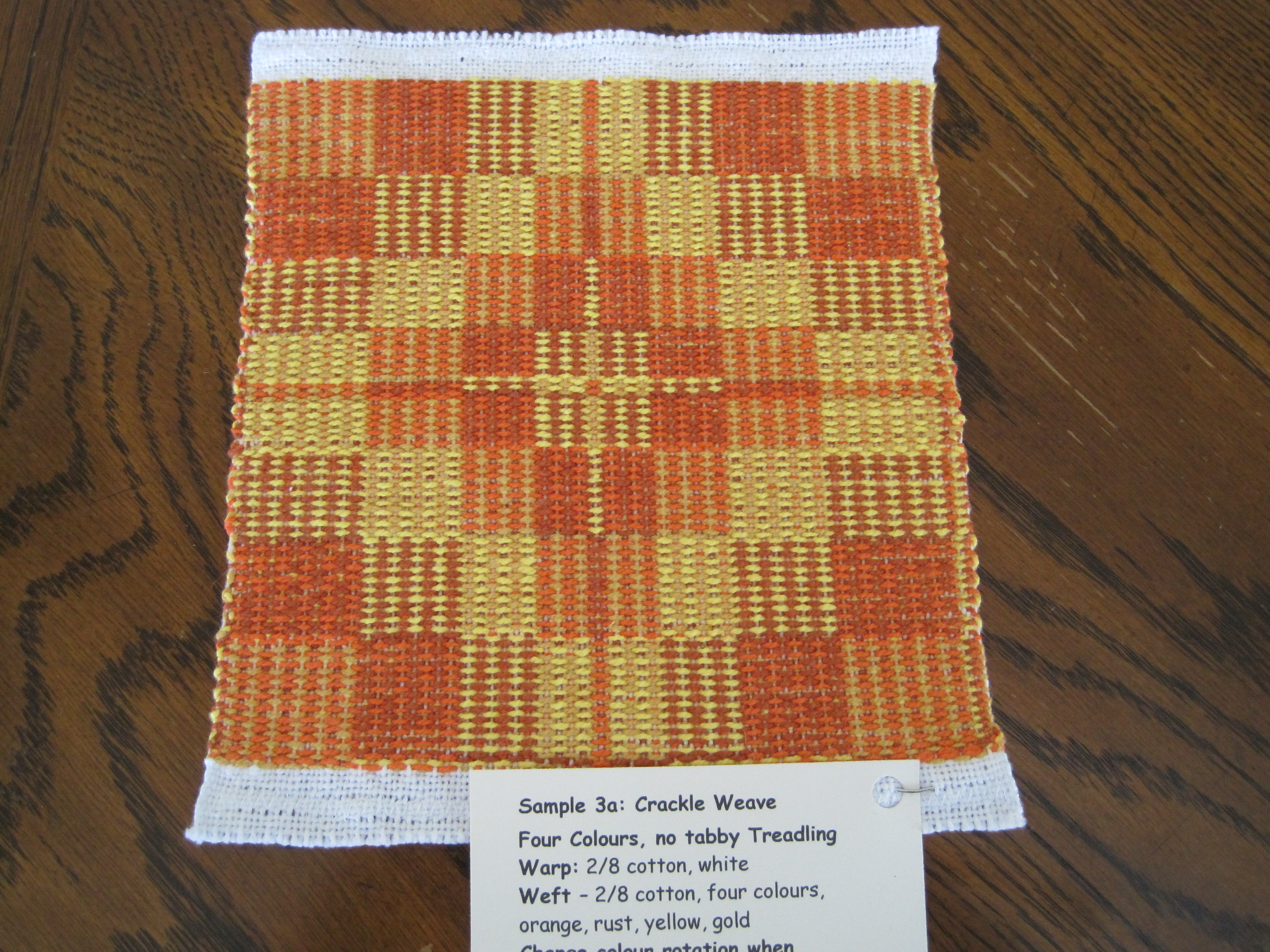
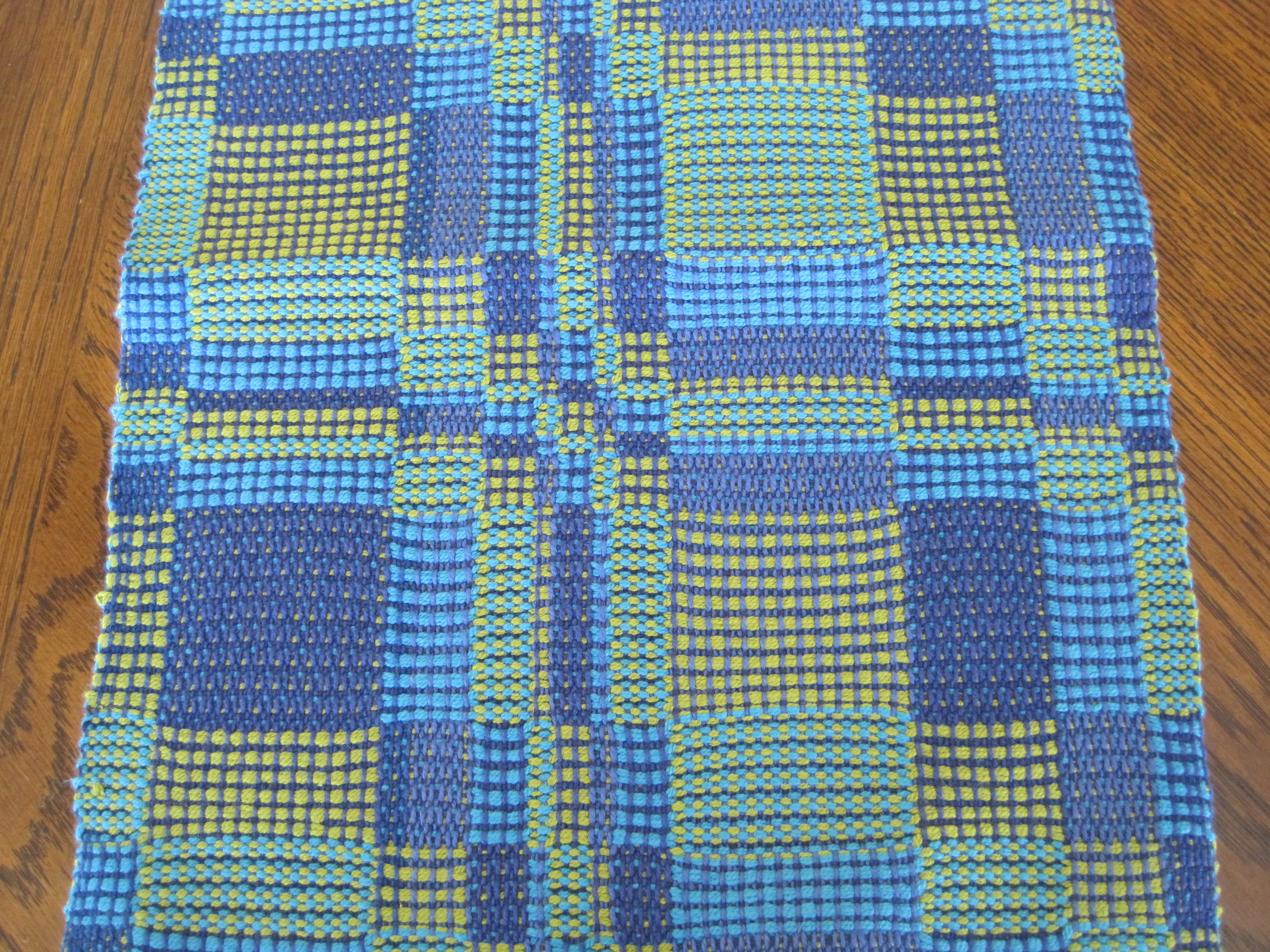
Sample 3: Four Colours, no tabby, all colours are the same weight, and the colours are rotated as you change from one block to the next.

IMG_2470

Sample 4:  Woven as Twill – one shuttle only, woven with a straight draw twill treadling.  You can also try this as a reversing point twill, or an advancing twill.

IMG_2472

Sample 5: Woven on Opposites – two pattern shuttles, no tabby

IMG_2473

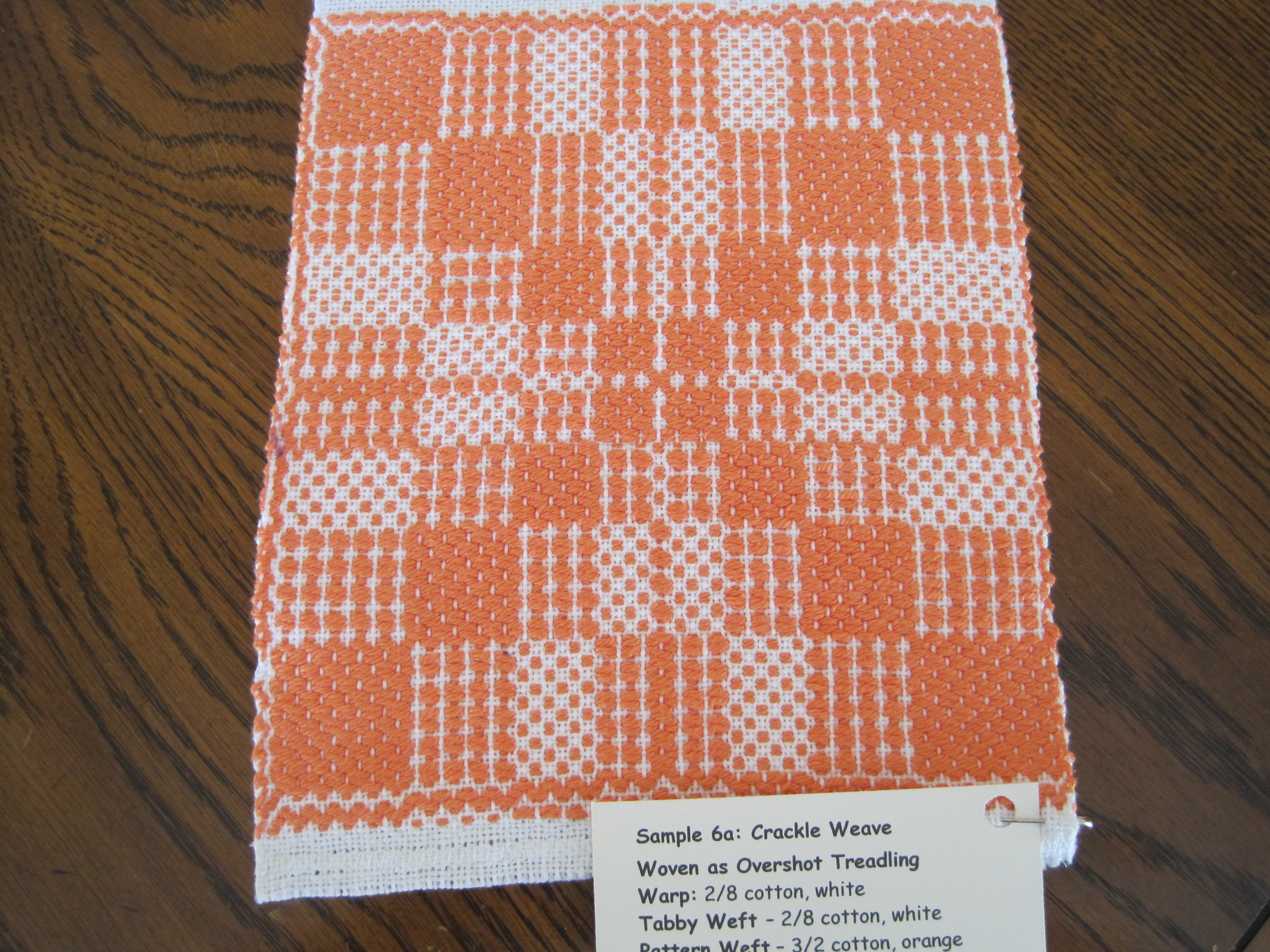
Sample 6: Woven as Overshot – one pattern weft, one tabby weft

IMG_2474

Sample 7: Woven with tabby as shadow – in this case, you have one pattern weft shot, followed by two tabby weft shots, the first tabby is the same colour as the warp and the second tabby is a contrasting colour.  You can see the pops of both the navy and the green tabby wefts peaking through.

IMG_2478


Samples 8 and 9: Traditional Polychrome Crackle(8), and Traditional Polychrome Crackle with Colours Reversed(9) – two pattern wefts and one tabby weft – throw pattern weft one, then pattern weft two, and then tabby.  The second version has the pattern wefts reversed, so throw pattern weft two 2, then pattern weft one, and then tabby.

IMG_2479  IMG_2480


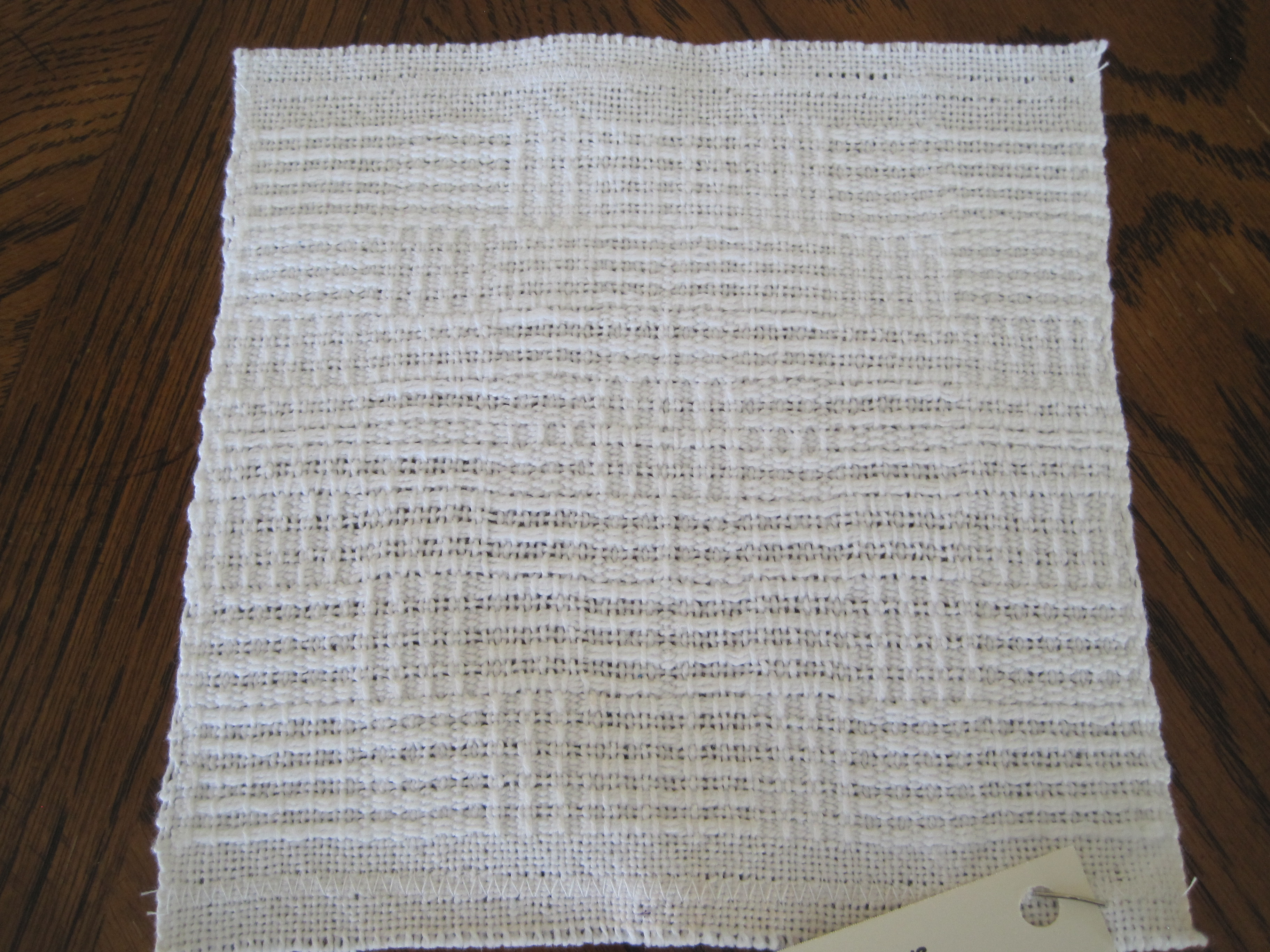
Sample 10 – Treadles as lace – woven with one shuttle only, same thread and same colour as warp.

IMG_2481

Sample 11: Woven as Summer and Winter Pairs – Pattern Weft (may be more than one colour) and tabby weft.

IMG_2484

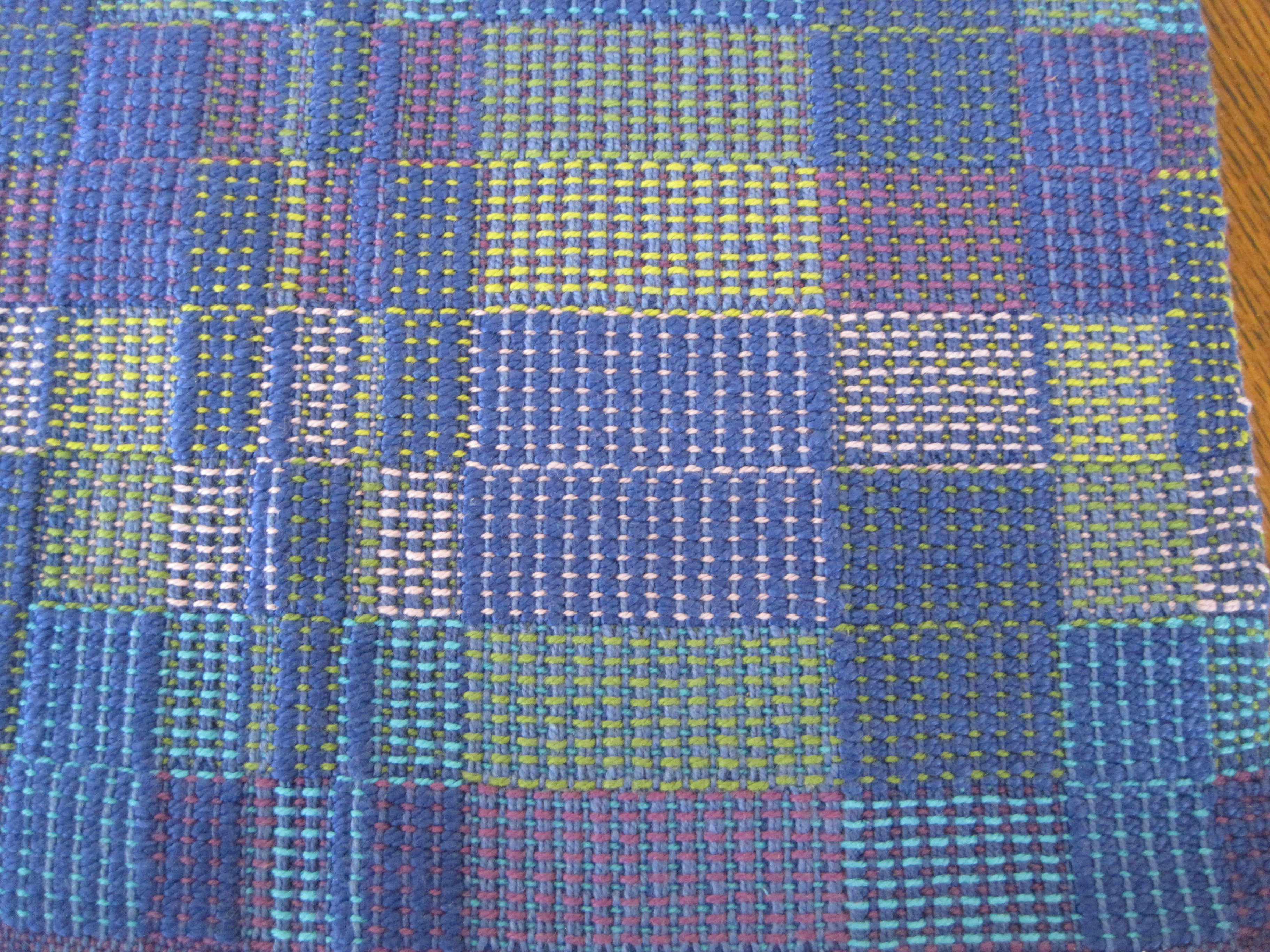
Sample 12: Classic Crackle Treadling – fun with rotating colours – follows the same classic crackle treadling as seen in Sample 2, with Pattern weft, ground weft x, and ground weft y, no tabby.  In this case, the pattern weft stays the same, but the colours for ground weft x and ground weft y, rotate among five different colours, dropping one and adding another each time you change blocks.  An amazing variety appears as the weave does its magic, with twenty different colour effects from five colours.

IMG_2485


Posted in Uncategorized, Weaving | Tagged , , , , , , , , | 2 Comments